Your med spa competes with every dermatology office, plastic surgery practice, and franchise chain within a ten-mile radius, plus the flood of national telehealth weight-loss brands now targeting your same zip code. Patients searching for Botox, laser hair removal, or medical weight loss rarely call the first name they see. They scan, compare, and choose the practice that feels safest and most credible, usually in under ninety seconds on a mobile screen. That decision is almost entirely driven by branding and website design before a single consultation happens.
Most med spa owners think of branding as a logo and a color palette. In reality, brand position is the single clearest marketing advantage you have. It answers the question every potential patient asks silently: "Why this practice and not the one down the street?" The website then has to translate that answer into trust signals, treatment information, and a frictionless path to booking. Get both right and your cost-per-consult drops. Get either one wrong and even a generous paid-ads budget will underperform.
What Does Med Spa Branding Actually Mean for Your Practice?
Med spa branding is the combination of your positioning statement, visual identity, tone of voice, and the consistent promise you make to prospective patients. It tells the market exactly who you help, what results you deliver, and why your clinical approach is different, before anyone walks through your door.
Positioning is the strategic core. A med spa that tries to be everything to everyone ends up being memorable to no one. Consider the difference between "full-service medical spa" (generic) and "body contouring and medical weight loss center for women over 40 in [City]" (specific). The second version immediately resonates with a defined patient and filters out poor-fit inquiries, which actually lowers your staff's time cost per booked consult.
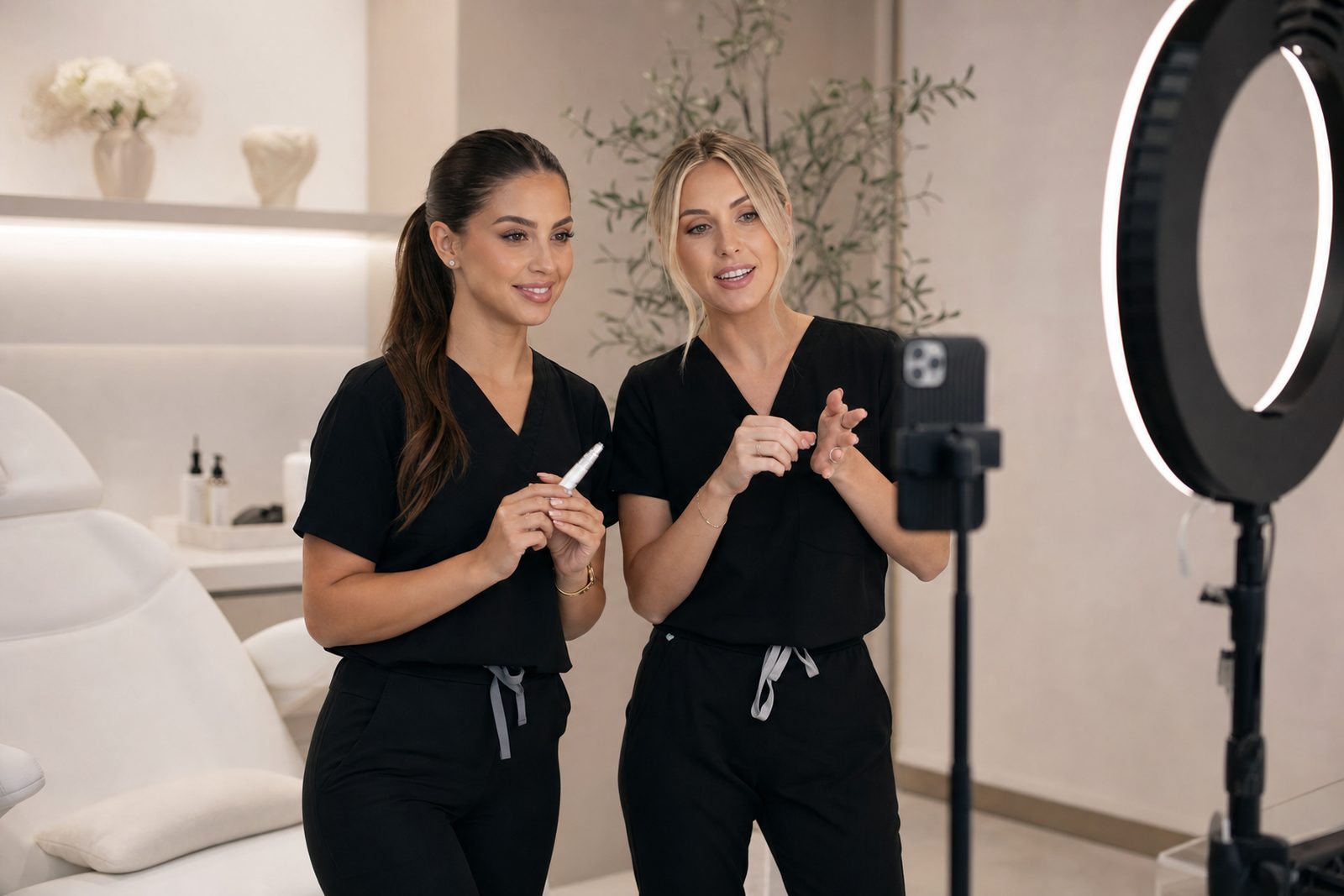
Visual identity follows positioning. Your typography, photography style, and color palette should visually confirm your positioning promise. A luxury anti-aging practice and a results-focused body contouring clinic should look and feel completely different, even if both offer similar treatment menus. Patients make subconscious credibility judgments in milliseconds based on imagery alone. Stock photography of generic spa rooms signals a commodity. Real photos of your actual treatment suite, your injectors, and your devices signal authenticity and build the kind of trust that supports premium pricing on services like RF microneedling or a CoolSculpting series.
Tone of voice matters too. The language on your website, in your emails, and across your social profiles should sound like a knowledgeable, warm clinical professional, not a discount coupon service. If you accept membership patients for recurring services like Botox maintenance, neurotoxin touch-ups, or monthly facials, your brand tone signals whether those patients feel like valued members of a clinical community or like coupon clippers. That perception affects retention rates and the lifetime value of each patient on your books. The American Med Spa Association (AmSpa) consistently points out that patient trust is the foundation of sustainable med spa growth, and that trust starts with how your brand presents itself before the first appointment.
Which Website Pages Convert Med Spa Visitors into Booked Consults?
The highest-converting med spa websites share a predictable structure: a clear homepage that confirms brand position, individual treatment pages with clinical detail and realistic outcome language, a visible provider credentials section, a transparent approach to pricing, and a frictionless booking path available on every page.
Your homepage has one job: confirm that the visitor is in the right place and give them a clear next step. Above the fold, display your positioning statement, a high-quality image of your actual space or team, and a single primary call-to-action ("Book a Free Consult" or "Schedule Your Assessment"). Clutter kills conversions. If your homepage opens with a rotating banner of seven different promotions, visitors cannot process which action to take and they leave.
Treatment pages are where most med spa websites lose potential patients. A single page titled "Injectables" that lists Botox, Dysport, Juvéderm, and Sculptra in four bullet points is not enough. Each major service, at minimum each service category, deserves its own page with a description of how the treatment works, what results look like and on what timeline, who is a good candidate, how many sessions are typically needed, and what the recovery looks like. This level of detail does two things: it pre-qualifies patients before they consult, saving your injector or coordinator time, and it satisfies the search intent of patients doing pre-purchase research, which is most of them.
Pricing transparency is a nuanced but important trust signal. You do not need to list exact per-unit pricing for every neurotoxin or filler. But showing a starting price range ("Botox treatments starting at $X per area") or a membership tier overview removes the anxiety patients feel about asking "but how much will this actually cost?" Practices that hide pricing entirely tend to attract a higher volume of low-intent inquiries, which raises cost-per-consult. A well-structured med spa web design balances transparency with flexibility so patients feel informed rather than ambushed at the consult.
Provider credential pages are often an afterthought and should not be. Your medical director's name, state license, and supervising credentials are legal requirements in most states and powerful trust signals online. Patients choosing between an injector with a one-line bio and one with a full profile including training, certifications, and before-and-after philosophy almost always choose the latter, especially for high-ticket treatments like filler, thread lifts, or laser resurfacing.
6 Trust Elements Every High-Converting Med Spa Website Needs
Beyond page structure, specific on-page elements move visitors from curious browsers to booked patients. Each element below addresses a specific trust barrier your prospective patients bring to the visit.
- Verified patient reviews displayed on-site: Embed Google or RealSelf reviews directly on treatment pages and the homepage. Third-party verification signals authenticity. A collection of 50-plus reviews with an average above 4.7 stars meaningfully reduces booking hesitation for first-time patients considering high-cost treatments.
- Before-and-after photo galleries with clinical context: Label results with treatment type, number of sessions, and approximate timeframe. Unlabeled photos look like stock imagery. Specific context builds credibility and sets realistic expectations, which also improves post-treatment satisfaction and review quality.
- Medical director disclosure and licensing information: State regulations for med spas vary widely, but displaying your medical director's name and credentials is both a compliance best practice and a patient trust signal. Patients increasingly search for this information before booking aesthetic procedures.
- Mobile page speed under three seconds: More than 70 percent of local service searches happen on mobile devices. Following Google's mobile-friendly guidance and compressing images, minimizing redirects, and using a fast hosting platform directly affects how many visitors reach your booking form before bouncing.
- Persistent online booking access on every page: A booking button or embedded scheduler visible in the header and at the bottom of every treatment page removes the friction of hunting for a phone number. Practices that add persistent booking see measurable lift in after-hours consult requests, which can represent 30 to 50 percent of total bookings depending on market demographics.
- Membership or loyalty program visibility: If you offer a monthly membership for recurring Botox, skincare, or body treatments, feature it prominently. Membership programs increase patient lifetime value and predictable monthly revenue. Patients who see a membership option early in their research are more likely to enter with that intent, which changes their value to your practice significantly.
How Does Brand Differentiation Function as a Marketing Strategy?
When your brand position is specific and clear, every marketing channel becomes more efficient. Paid ads convert at a higher rate because the message matches what the right patient is searching for. SEO builds faster because your content speaks to a defined audience. Word-of-mouth referrals arrive pre-qualified. Differentiation is not just identity, it is a conversion mechanism.
Think about the economics. If your cost-per-click on Google Ads for "lip filler [city]" runs between $4 and $12, and your landing page converts at 3 percent, you are spending roughly $133 to $400 to generate one consult inquiry, before staff time to confirm and book. A stronger brand position and a more targeted landing page that speaks directly to your defined patient avatar, matching their specific concern and desired outcome, can realistically push conversion rates to 6 to 10 percent, which cuts your cost-per-consult in half without changing your ad spend. That is the economic argument for investing in brand strategy before scaling paid advertising.
Differentiation also affects organic search. A med spa positioned as a "medical weight loss and GLP-1 management clinic for busy professionals in [City]" can own a niche content cluster around medical weight loss topics, semaglutide treatment information, and body composition metrics that a generalist med spa cannot compete with effectively. Niche authority builds faster and holds longer in local search results.
Brand differentiation extends to your treatment menu decisions. Choosing which devices to invest in, which services to feature prominently, and which to offer quietly as secondary services is itself a branding decision. A practice centered on skin health and rejuvenation might lead with medical-grade facials, laser resurfacing, and microneedling with PRP, and position Botox as a maintenance add-on rather than a hero service. That framing attracts a different patient type and supports different average transaction values than a practice that leads with volume neurotoxin pricing. Exploring med spa marketing ideas that align with your defined position always outperforms generic promotional tactics that could apply to any practice.
How SCALZ.AI Approaches Med Spa Branding and Website Projects
Our team starts with positioning before touching design. We document what makes a practice's clinical approach distinct, define the patient profile most likely to generate recurring revenue, and build the website architecture and visual identity around that foundation, rather than retrofitting a brand story onto a template.
In practice, this means our discovery process with a new med spa client involves reviewing their current treatment mix, average transaction value, membership penetration if any, and the competitive landscape within their primary radius. We look at what the top three to five local competitors say about themselves and identify the white space in positioning that our client can own credibly. We have worked with practices where the obvious differentiator turned out to be the depth of their provider bios and the quality of their patient photography rather than any specific treatment offering. Sometimes the gap is simpler than owners expect.
On the website side, our team builds treatment pages designed to answer the specific questions a patient at each stage of the decision process is asking. Early-stage visitors need education and trust. Mid-stage visitors need social proof and outcome specificity. Late-stage visitors need a frictionless path to book. A well-architected med spa site serves all three stages without requiring visitors to hunt for information. We also integrate the technical elements that affect organic search visibility and work with our med spa marketing agency team to ensure the site structure supports the broader SEO and paid strategy from day one.
One honest caveat: branding and website work takes time to show booking impact through organic channels. Practices expecting a new site to generate a surge of organic consult requests within thirty days are likely to be disappointed. Organic growth from a well-branded, well-optimized site typically becomes measurable over three to six months. If you need immediate volume, paid ads running in parallel are the more appropriate lever. We also apply med spa conversion rate optimization principles to both paid landing pages and organic pages, because the fastest way to improve your return on any traffic investment is to convert a higher percentage of the visitors you already have, rather than simply buying more of them.
Your brand position and your website are the first clinical impression you make on every prospective patient, and that impression compounds over time into your practice's reputation, your organic ranking strength, and your cost to acquire a new booking. Treating them as one-time setup tasks rather than ongoing strategic assets is the most common and most costly branding mistake med spa owners make. A clear position, a fast and credible website, and consistent trust signals do not just look good, they measurably change how many visitors turn into patients who stay.