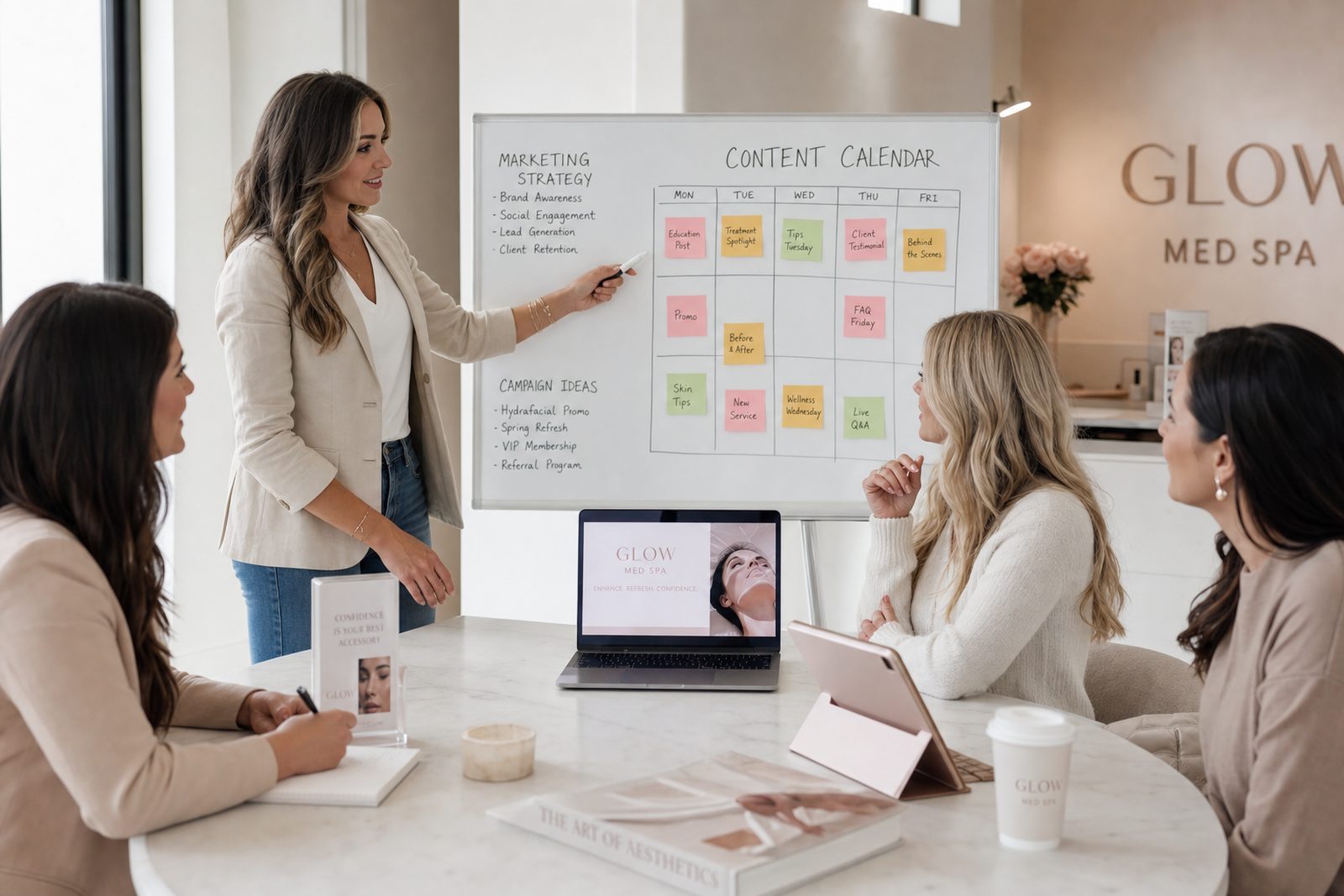
Most med spa owners do not have a marketing problem. They have a prioritization problem. Someone sells them on TikTok influencer posts while their Google Business Profile sits unclaimed, their review count stalls at 47, and past patients never receive a rebooking reminder. The result: money spent in the wrong places, empty treatment rooms on Tuesdays, and a cost-per-consult that quietly climbs above what Botox margins can absorb.
This post is a ranked playbook, not a random list of 50 tactics. It tells you what to do first when your budget is limited, which frameworks (the 3-3-3 rule, the 4 P's, the 5 C's) actually translate to aesthetics, and which channels drive predictable bookings versus which ones just generate likes. Whether you offer a full menu of injectables, laser hair removal, body contouring, and medical weight loss, or you are still writing a how to write a med spa business plan draft, the sequence below applies.
What Should a Med Spa Do First With a Limited Marketing Budget?
Before buying ads, fix the things that are free or nearly free: your Google Business Profile, your review volume, and your offer clarity. These three moves generate bookings for months without ongoing spend and raise the return on every paid dollar you add later.
Most aesthetics practices have a Google Business Profile (GBP) that is 60 percent complete. A missing service menu, no before-and-after photos, and an outdated hours listing cost you clicks you already earned through word of mouth. Completing your GBP, posting weekly treatment updates, and turning on Q&A responses can move a practice from the local map pack's fourth or fifth position to the top three, which is where the majority of "med spa near me" clicks land. According to Google Business Profile guidelines, accurate and complete listings are a core ranking signal.
Second, build a review engine before you need one. Ask every satisfied patient for a Google review at checkout, not in a follow-up email three days later. Train your front desk to say something specific: "If you loved your experience with [provider name] today, a quick Google review helps other patients find us." Aim for a volume of reviews in the 80-to-200 range if you are in a mid-size market, 200-plus in major metros. Practices with fewer than 50 reviews lose comparison clicks to competitors daily, regardless of clinical quality.
Third, clarify your signature offer before running ads. If your homepage says "full-service med spa" and lists 22 treatments, you are not helping a new patient decide. Pick one anchor service per season (for example, "$299 lip filler consult and treatment, this month only") and make it the center of your homepage hero and your paid ads. A specific offer converts at a meaningfully higher rate than a general branding message, and it gives your ad campaigns a measurable cost-per-booking to track.
How Do the 3-3-3 Rule, 4 P's, and 5 C's Apply to Med Spa Marketing?
These frameworks are not academic exercises. Applied to a med spa, they give you a repeatable structure for planning campaigns, pricing services, and understanding why patients choose you or your competitor down the street.
The 4 P's (Product, Price, Place, Promotion) work like this in aesthetics. Product is your treatment menu and provider credentials, including your medical director's oversight model and any device differentiators (for instance, owning a Morpheus8 or CoolSculpting Elite in a market where competitors only offer RF microneedling). Price is not just your menu price but your perceived value, which is where membership tiers and package pricing give you flexibility without cutting per-unit rates. Place means where patients find and book you, including your website, GBP, and any booking integrations with platforms like Vagaro or Jane. Promotion is paid ads, email, SMS, organic social, and referral programs working in a coordinated sequence.
The 5 C's (Company, Customers, Competitors, Collaborators, Climate) help you audit your position once or twice a year. Under Competitors, mystery-shop the top three med spas in your zip code. Note their membership price, their most-promoted service, and their review count. Under Collaborators, think about which local businesses, such as OB-GYN practices, fitness studios, or plastic surgeons, could generate referral traffic to your injectors. Under Climate, track regulatory changes from organizations like the American Med Spa Association (AmSpa), because state-level scope-of-practice rules directly affect which services you can promote and how you must describe your supervision model in ad copy.
The 3-3-3 rule, as applied to med spas, means targeting three patient segments (new patients, lapsed patients at 90-plus days without a visit, and existing patients ready for an add-on service), across three channels (email, SMS, and paid social), with three touchpoints before expecting a booking. This prevents the common mistake of blasting one email and concluding that "email doesn't work for our practice."
6 Med Spa Marketing Channels Ranked by ROI and Effort
The channels below are ordered from highest sustained ROI to lower. Effort ratings are relative to a two-to-four person admin team. Use this list to sequence your marketing build-out over six to twelve months.
- Google Business Profile and local SEO optimization Completing your GBP, earning consistent reviews, and building local citations (NAP consistency across directories) produces compounding organic visibility. A well-optimized profile can drive 30 to 60 inbound calls per month in competitive markets with zero ad spend once established.
- Email and SMS rebooking automation Patients who have already purchased from you convert at a dramatically lower cost than cold traffic. A simple automated sequence (post-treatment follow-up at day 3, rebooking prompt at day 60, and a lapsed-patient win-back at day 90) keeps your chair full without creative production costs.
- Membership and package offers A tiered membership (for example, $149 per month for one neurotoxin zone, $249 per month for injectables plus one laser session) converts single-visit patients into recurring revenue. Practices with active memberships report more predictable monthly revenue and higher lifetime patient value than those relying on one-time bookings.
- Targeted paid social advertising Meta (Facebook and Instagram) ads targeting women aged 28 to 55 within a 10-to-15 mile radius of your practice remain one of the fastest ways to generate new-patient leads for specific treatments. Budget ranges of $1,500 to $4,000 per month are workable for single-location practices, but the offer and landing page matter more than the budget level.
- Med spa SEO through content and technical optimization Working with a med spa marketing agency that understands aesthetic search intent, or investing in med spa SEO in-house, builds traffic that compounds over 12 to 24 months. High-intent keywords like "laser hair removal [city]" or "Botox near [neighborhood]" have strong commercial intent and lower competition than national terms.
- Organic social media and educational content Consistent posting of real provider content, treatment walkthroughs, and patient education (with appropriate HIPAA-compliant consent protocols) builds brand trust and supports ad retargeting audiences. Med spa social media marketing works best as a trust layer on top of paid and organic search, not as a standalone acquisition channel.
How Do You Turn Paid Ads Into a Predictable Booking Machine?
Paid social ads work for med spas when three things align: a specific offer, a fast-loading landing page with a single call to action, and a follow-up sequence that converts the lead within 24 hours. Without all three, you are paying for leads your front desk cannot close.
On Meta, your audience targeting should start narrow. Women aged 30 to 55, within 10 miles of your practice, with interests in skincare or wellness, is a workable starting point for a Botox or filler campaign. Broad audiences waste budget on people unlikely to travel to your location. Once your pixel has enough conversion data (typically 50-plus bookings attributed), you can expand to lookalike audiences built from your existing patient email list.
Your ad creative does not need a large production budget. A clean 15-to-30 second video of a provider explaining the treatment, filmed in the treatment room, consistently outperforms polished stock-footage ads because it signals authenticity and shows the actual clinical environment. Pair this with a headline that names the treatment and the offer: "$350 syringe of Juvederm, April only, 3 spots left this week." Scarcity and specificity work in aesthetics because patients delay booking without a reason to act now.
Your landing page should have one job: collect a name, phone number, and preferred appointment time. Remove navigation menus, secondary links, and anything that competes with the form. Connect the form to your practice management system or a CRM so your front desk is notified within minutes, not hours. Industry benchmarks suggest that contact-to-consult conversion rates drop significantly after a 30-minute response delay, so same-day follow-up is not optional if you want your ad spend to pay off.
Track cost-per-lead and cost-per-booked-consult separately. A campaign generating leads at $18 each sounds efficient until you learn that your team converts only one in eight leads, putting your true cost-per-consult near $144. Knowing this number tells you whether the problem is the ad (fix targeting and creative) or the front desk (fix the follow-up script and speed).
What We've Seen Work Across Aesthetic Practices at Different Growth Stages
Our team works with med spas ranging from single-provider startups to multi-location regional groups. The patterns that separate growing practices from stagnant ones are less about budget and more about sequencing, consistency, and measurement discipline.
The most reliable early-stage move we see is the combination of GBP optimization with a review ask process built into the checkout workflow. Practices that implement a systematic review request (verbal ask plus an automated text with a direct Google review link sent within two hours of the appointment) can grow from 40 reviews to 120-plus within 90 days without paid media. That review momentum then improves their local pack ranking, which reduces the cost-per-click on any paid campaigns they add next.
One specific operational detail our team looks for when auditing a new client: whether the practice's GBP service list matches the treatments on the website and the booking system. Mismatches (for example, "CoolSculpting" listed on GBP but rebranded to "body contouring" on the site) create trust gaps that suppress both organic ranking and conversion rate. Fixing this alignment takes less than a day and has measurable impact.
The honest caveat: SEO and GBP optimization take time. If a practice needs bookings within the next four weeks because a new device payment is due or a new provider needs a full schedule, organic search is not the right first answer. In that scenario, a small, tightly targeted paid social campaign with a specific offer is the faster path to revenue, with SEO running in parallel as a longer-term investment. We do not recommend clients abandon organic strategy for short-term pressure, but we also do not pretend that content built today ranks next week.
Membership programs, which we increasingly help practices design and promote, require a minimum of three to four months of consistent promotion before the recurring revenue feels material. Practices that launch a membership and expect transformational results in 30 days typically abandon the program before it gains traction. The economics work, but patience is part of the model.
Building a marketing system that fills your med spa's schedule consistently takes more than picking the right channels. It takes running those channels in the right sequence, measuring what matters (cost-per-consult, cost-per-booking, patient retention rate, and membership conversion rate), and adjusting monthly. Start with your Google presence and your review process, add a clear recurring offer, then layer in paid ads once your conversion infrastructure is ready. That sequence, applied consistently over six to twelve months, produces results that random bursts of ad spend never will.