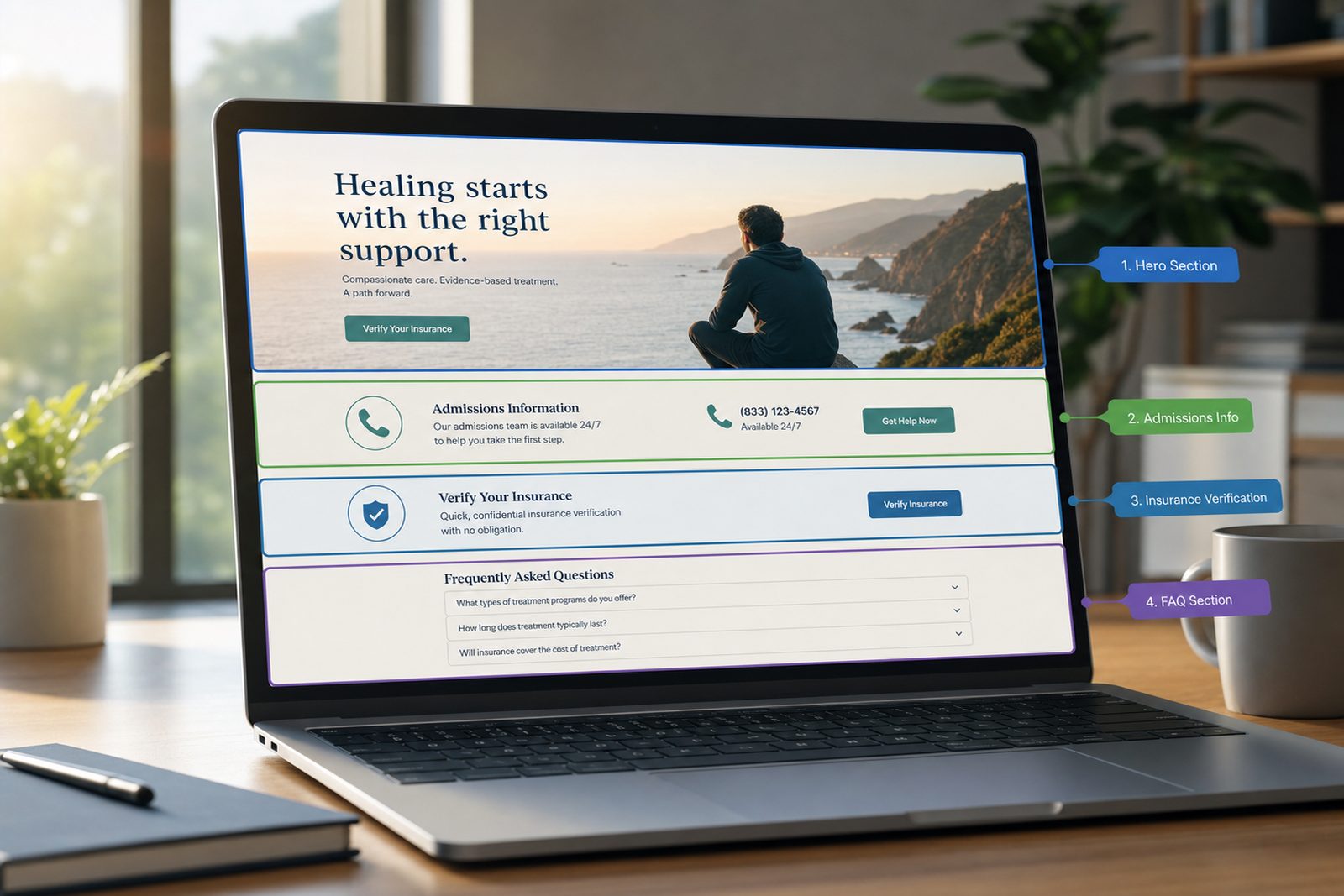
Treatment center marketers are watching a quiet shift play out in real time. Prospective patients and their families increasingly turn to AI-powered answer engines before they ever click a search result. ChatGPT, Perplexity, Google AI Overviews, and Gemini pull structured answers from pages that are written and marked up to be extracted, not just crawled. If your aeo landing pages are built the old way, with keyword-stuffed hero sections and buried admissions copy, you are invisible in those answers. The opportunity cost is real, and it compounds every week your competitors gain citation momentum.
This is a page-by-page on-page playbook. It covers four page templates that carry the most admissions weight in behavioral health: your admissions page, your insurance verification page, your levels-of-care pages, and your location pages. For each template, you will find guidance on the first 60 words, the schema stack, the entities you must name, and the internal-link pattern that builds citation velocity. Think of it as the tactical companion to the AEO playbook for treatment centers, with a tighter focus on what actually lives on the page.
Why Do Rehab Landing Pages Fail in AI Answer Surfaces?
Most rehab landing pages fail in AI answer surfaces because they open with brand storytelling, not answerable statements. Answer engines extract the first coherent, factual sentence they can find. If your page opens with a tagline or a stock-photo caption, the model skips it entirely.
Answer engines are extraction machines. They scan a page looking for a short passage that directly answers a user query, then they pull that passage, attribute it, and surface it. The page that wins is not always the one with the strongest domain authority. It is the one with the clearest, most citable first paragraph.
In behavioral health, this matters more than in almost any other vertical. Families searching for addiction treatment at midnight are not browsing. They are asking urgent, specific questions: "Does this facility take my insurance?" "What is the difference between PHP and IOP?" "Is there a detox center near me that accepts Medicaid?" These are answerable questions. If your page answers them in the first sentence, you have a real chance of being cited. If your page opens with "Our compassionate team is here for you," the model moves on.
The underlying issue is a mismatch between how pages were built and how AI models consume them. Most treatment center pages were designed for human persuasion. The AEO rewrite is about restructuring for machine extraction first, human conversion second. The good news is that the two goals are compatible. A clear, direct opening that gets cited by AI also converts human visitors better, because it answers the question they came with.
For a broader grounding in the strategy layer before you touch the page, see our AEO strategy framework for rehab marketers.
What Should the First 60 Words of a Rehab Admissions Page Say?
The first 60 words of a rehab admissions page should state what the facility offers, who it serves, where it is located, and what the next step is. Lead with a declarative sentence that includes your facility name, the condition treated, and the geographic area. That structure is what AI models extract.
Here is a working template. "[Facility Name] offers medically supervised detox and residential addiction treatment in [City, State]. Admissions are open 24 hours a day, seven days a week. Most major insurance plans are accepted. To start the intake process, call [number] or complete the form below." That is 38 words. It names the entity, the service, the location, the access point, and the action. Every element is extractable.
Why does the geographic reference matter in the opening? Because AI Overviews and Perplexity increasingly filter answers by location when the query includes one. If your facility name and city do not appear together in the first paragraph, the model cannot confidently assign your page to a geographic query. You lose local citation eligibility entirely.
The admissions page also needs to address the most common question that triggers the page visit: "How do I get someone into rehab?" or "What is the admissions process?" Add a second short paragraph, no more than 40 words, that describes your intake sequence in plain steps. "Step one: call our admissions line. Step two: complete a brief clinical screening. Step three: we confirm your insurance and arrange transport." Numbered steps are highly extractable structures.
One structural note: do not bury this answerable content below a hero image with a three-word tagline. The first rendered text on the page is what most crawlers see first. Put the answerable paragraph above the fold in the HTML, even if your design team wants the brand image first. Work with your developer to ensure the text node appears early in the DOM.
Which Schema Types Belong on Each Rehab Page Template?
Each rehab page template needs a tailored schema stack, not a single sitewide type. The admissions page needs MedicalWebPage and FAQPage. Insurance pages need MedicalWebPage and HowTo. Levels-of-care pages need MedicalWebPage plus a Service type. Location pages need LocalBusiness with MedicalClinic subtype plus BreadcrumbList.
Start with MedicalWebPage schema on every clinical or informational page. This type includes a medicalAudience property that signals the page is written for patients or caregivers, and an about property where you can reference the specific condition or treatment. These signals matter for medical E-E-A-T because they help search systems understand the page's intended context.
On your admissions page, add FAQPage schema using the actual questions your admissions team answers every day: "Do you accept Medicaid?" "Is detox medically supervised?" "What should I bring to treatment?" Each FAQ answer in the schema should be 40 to 80 words, plain prose, and a real answer. Do not use marketing copy inside FAQ schema. The model is reading it verbatim.
On your insurance verification page, HowTo schema is underused and high-value. Mark up the insurance verification steps as a HowTo, with each step named and described. When a user asks "How do I verify insurance for rehab?" your page becomes the structured answer source. The HowTo type includes step objects, each with a name and text property. Keep each step's text under 60 words.
On location pages, the LocalBusiness type with a MedicalClinic subtype is the foundation. Include address, telephone, openingHours, geo, and hasMap properties. Add the medicalSpecialty property with values like "Psychiatry" or "Addiction Medicine" where accurate. This is also where you implement Google Article schema for any editorial content nested within the location page, such as a local-treatment overview section.
How Does Entity Clarity Affect AI Citation on Service Pages?
AI models cite pages that clearly name the entities involved: the facility, the treatment modality, the condition, and the geographic area. Service pages that use vague pronouns and brand-speak instead of named entities are structurally invisible to AI extraction, even if they rank on page one of Google.
Entity clarity means using the full proper name of each thing, every time it matters. Your PHP page should say "partial hospitalization program" in full on first use, then define it: "A partial hospitalization program (PHP) provides structured clinical treatment for five to seven hours per day, five days per week, without overnight stays." That definition is a citable fact. The abbreviation alone is not.
Each level-of-care page should also name the conditions that program treats. "Our IOP is designed for adults managing alcohol use disorder, opioid use disorder, or co-occurring mental health conditions including depression and anxiety." That sentence names six entities: IOP, adults, alcohol use disorder, opioid use disorder, depression, anxiety. A model looking for "IOP for alcohol use disorder" can now find and cite this page with high confidence.
The internal-link pattern matters here too. When your PHP page links to your detox page and your IOP page, and those pages link back to the PHP page using the full phrase "partial hospitalization program," you are building a co-citation web that reinforces entity relationships across the site. This is what we mean by citation velocity: the rate at which your entity cluster grows coherent enough for AI models to trust it as a source.
For the local SEO layer that complements entity clarity on location pages, see our guide to local SEO for treatment centers.
7 On-Page Elements That Strengthen AEO for Rehab Pages
Every page in your AEO stack needs these structural elements in place before schema and content optimization can fully take hold. Here is the page-level checklist our team applies to rehab websites.
- Direct-answer opening paragraph, under 60 words. Write the first paragraph as a self-contained answer to the page's primary question. Name the facility, service, location, and action. This is the passage AI models are most likely to extract and cite verbatim.
- Named entities in body text, not just headers. Use the full proper name of every treatment modality, condition, and location in the body paragraphs, not just in headings. AI extraction reads body text, and heading text alone does not give models enough context to cite confidently.
- FAQPage schema with real clinical questions. Add at least four FAQ pairs to admissions, insurance, and service pages. Use the exact questions your admissions coordinators hear on the phone. Mark them up with FAQPage schema and write answers in plain, extractable prose.
- MedicalWebPage schema on every clinical page. Apply this type sitewide to all pages that discuss treatment, conditions, or clinical services. Include the
aboutandmedicalAudienceproperties with specific values, not generic placeholders. - Internal links using full entity phrases as anchors. Link between related pages using the full name of the destination's topic as anchor text. "Partial hospitalization program" beats "learn more" for both AI entity graphs and classical SEO link equity.
- Structured step content on process pages. Insurance verification, admissions, and intake pages should describe their process as numbered steps, both in visible text and in HowTo schema. Numbered steps are among the most reliably extracted structures in AI answer generation.
- Location and contact information in the HTML body, not just the footer. For location pages especially, the address, phone number, and hours should appear as readable text near the top of the page body, not only in structured data or a footer widget.
What Makes Insurance Verification Pages High-Value AEO Real Estate?
Insurance verification pages answer one of the highest-intent questions in behavioral health search: "Does this rehab take my insurance?" That question is asked millions of times a year. A well-built insurance verification page, with citation architecture in place, can earn AI Overview placement for insurance-plus-rehab queries at scale.
The insurance verification page is often treated as a utility page, something quick and transactional. That framing misses its AEO potential entirely. Families and individuals searching for treatment frequently make their first real decision based on insurance coverage. The page that clearly answers "Yes, we accept [Payer Name]" is the page that earns the call.
Start with a coverage list structured as an HTML table or a definition list. List each payer by full name, not abbreviation. "Blue Cross Blue Shield of Florida" is more citable than "BCBS." Include the plan types you accept for each carrier where you can. "We accept Blue Cross Blue Shield of Florida PPO and HMO plans for residential and outpatient treatment." That sentence is specific, entity-rich, and answerable.
Add a HowTo schema block that walks through the verification process. Step one: gather your insurance card. Step two: call our admissions line or submit the online form. Step three: our team contacts your insurer within one business day. Step four: we share your coverage details before intake. Each step should be 30 to 50 words. The HowTo markup makes this content directly eligible for structured results in Google and for extraction by AI models processing process-oriented queries.
Finally, add a FAQ section that addresses the questions people actually ask about using insurance for rehab: "Will my insurance cover detox?" "What is a deductible in addiction treatment?" "Does my plan cover out-of-state treatment?" These are real questions with real answers. Writing clear, honest answers to them is both good AEO practice and good patient service.
What Our Team Has Observed About AEO Rollouts in Behavioral Health
Across our behavioral health work, including the work documented in our behavioral health SEO case study, we have seen that AEO gains in the rehab vertical are not instant. The pages that earn AI citations earliest are the ones with the clearest entity structure and the most citable opening paragraphs, not necessarily the ones with the most schema markup.
Our team's standard rollout sequence starts with content before schema. We rewrite the first 60 words of every core page template first, because that is the passage extraction engines hit first. Once the opening paragraphs are clear, direct, and entity-rich, we layer in the schema stack. Doing it in reverse, adding schema to pages with vague hero copy, produces far weaker results. The schema points the model to the content, but if the content is not extractable, the schema cannot compensate.
We also run a weekly citation audit during the first 90 days of any AEO engagement. We query AI Overviews, Perplexity, and ChatGPT with the exact questions our client pages are designed to answer, then track whether our pages are being cited, partially cited, or ignored. This cadence gives us real feedback on which page templates are working and which need another round of revision. It is a slower feedback loop than rank tracking, but it is the right one for this kind of work.
One honest caveat: if a treatment center's site has thin content, inconsistent NAP data across directories, or significant technical issues like slow load times and broken structured data, the AEO work takes longer to show results. We are not able to shortcut the foundational layer. For centers in that situation, we recommend working through the complete rehab SEO guide to address the baseline before prioritizing AEO on-page optimization. AEO amplifies what is already coherent. It does not replace coherence.
Our MVBH behavioral health work showed us that the combination of entity clarity, schema stacking, and internal-link architecture built across multiple page templates produces compounding citation gains. No single page wins in isolation. The citation network across the site is what creates durable visibility. You can read the full account at our behavioral health SEO case study.
Treatment center marketers who are newer to this work often ask how long the on-page AEO process takes. For a site with 20 to 40 core pages, a full on-page AEO audit, rewrite pass, and schema implementation typically spans four to eight weeks, depending on how much existing content is salvageable and how quickly approvals move through clinical and compliance review. Behavioral health sites rightly involve clinical staff in content sign-off. That process adds time, and it should. The content has to be accurate before it earns the right to be cited.
The most important mindset shift for marketing teams is to stop thinking about landing pages as conversion devices alone and start thinking about them as knowledge resources that happen to convert. The pages that get cited by AI are the ones that teach clearly. Teaching clearly converts human visitors too. The goals are not in conflict.
Treatment centers that commit to building pages with genuine informational depth, clear entity structure, and honest clinical context will earn citation velocity in AI answer surfaces over time. That is not a shortcut. It is the actual path.