


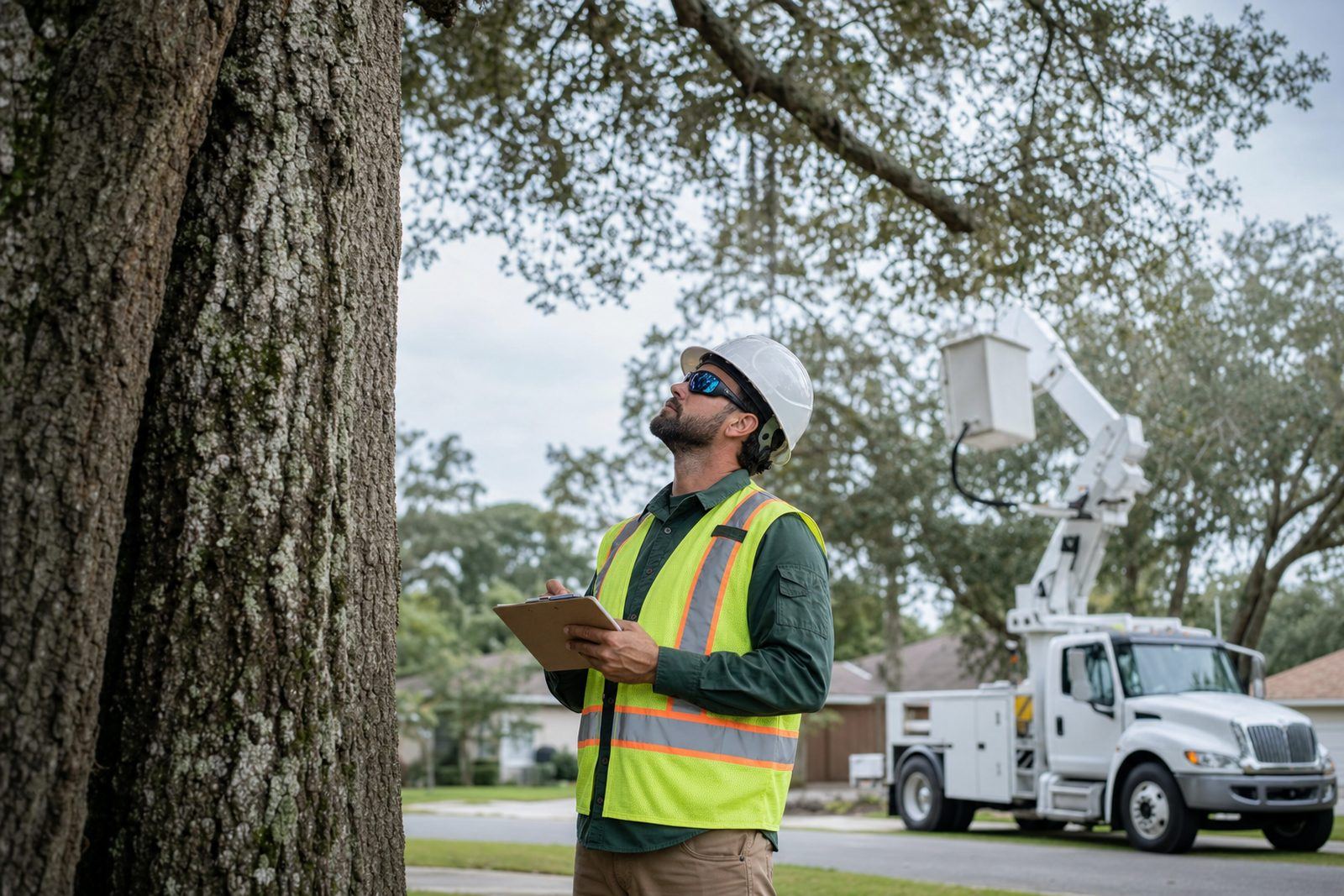
Most SEO agencies will show you a chart with a steep green line and a client name you can't verify. This post takes a different approach. The numbers here are pulled from a real Google Search Console and rank-tracking snapshot from July 2026, and the business is publicly listed: Florida Foliage Tree Service in Daytona Beach, Florida. If you want to understand what a tree service SEO case study actually looks like at ground level, including what worked, what was modest, and what surprised us, keep reading.
The results are meaningful but deliberately unexaggerated. Florida Foliage tracks 80 keywords and holds 13 positions in the top 10 and 31 in the top 20. That's not a headline number compared to an e-commerce brand or a national law firm, and we'll say so plainly. But for a single-location tree service in a mid-size Florida market, it represents consistent, qualified organic traffic and something increasingly rare: a citation from ChatGPT with live web search enabled. The full story is in our Florida Foliage tree service SEO case study documentation, but this post walks through the reasoning behind each decision.
What Were the Baseline Conditions Before Work Began?
Florida Foliage had a functional website and a claimed Google Business Profile, but almost no on-page content tied to specific services, credentials, or service areas. The site ranked for branded terms only. That thin content baseline is common for owner-operated tree services and is exactly where targeted work pays off fastest.
The competitive landscape in Daytona Beach for tree services is crowded at the top by national directories. Angi, Yelp, HomeAdvisor, and Thumbtack consistently take several first-page positions. That's the reality for most home service categories. The practical goal isn't to displace those directories. It's to rank in the remaining organic slots and dominate the Google Business Profile map pack for high-intent queries like "tree removal Daytona Beach FL" and "emergency tree service near me."
The site had no structured data, no FAQ content, and no pages for specific service types beyond a single generic "services" page. The GBP listing had the primary category set to "Tree Service" but no secondary categories, no service descriptions, and fewer than ten photos. Posts hadn't been updated in over a year. This isn't a criticism; it reflects where most small operators are when they start thinking seriously about tree service SEO.
One genuine asset existed: the owner holds ISA (International Society of Arboriculture) arborist credentials. That single fact became the strategic foundation. Credentials are hard for competitors to replicate quickly. They satisfy Google's E-E-A-T standards for expertise and authority, and they give AI engines a specific, citable claim about the business. Starting from a credential rather than a service type is a different kind of brief, and it changed almost every content decision that followed.
Why Did the Arborist Angle Outperform Generic Tree Service Pages?
Generic "tree removal" pages compete against dozens of nearly identical local competitors. Arborist-credential content targets a smaller, higher-trust segment of searchers who want a certified expert, not just a crew with a chainsaw. That narrower intent produced faster ranking movement and stronger AI citation signals.
Search intent for "arborist Daytona Beach" differs from intent for "tree cutting near me." The person searching for a certified arborist has usually already decided they need professional expertise. Maybe it's a large oak near a foundation, a diseased tree they can't diagnose, or a pre-sale tree inspection for a real estate transaction. That intent is specific, commercial, and high-value per job. Florida Foliage now holds position 6 for "arborist Daytona Beach" and position 4 for "arborist inspection." Those rankings reflect real content investment, not keyword stuffing.
The pages built around arborist credentials included: a detailed bio page explaining the ISA certification process and what it means for the homeowner; a tree health assessment service page describing the inspection process step by step; and a plant health care page that separated diagnostic work from removal work. Each page linked internally to related services and back to the main arborist profile. That internal linking structure helped Google understand the site's topical depth rather than treating it as a one-page business card.
The credential angle also created useful differentiation for Google's AI Overviews. When a user asks "should I hire a certified arborist or a tree service company," a page that explains ISA certification in plain language is exactly what an AI summary can extract from and cite. Generic pages that list services and prices give AI nothing to work with. That distinction matters more as AI Overviews appear for informational and near-informational queries in home services.
5 Specific Tactics That Drove the July 2026 Ranking Snapshot
Every ranking improvement traces back to a specific decision. Here are the five moves that mattered most for Florida Foliage, with enough detail to apply them directly.
- Emergency service pages built for intent, not just keywords. A dedicated "emergency tree removal Daytona Beach" page was created with content that addressed real user concerns: response time ranges, what to do right after a tree falls, how insurance claims typically work, and what information to have ready when calling. The page answered questions competitor pages ignored. It now contributes to map pack visibility for emergency queries.
- FAQ schema on every service page. Structured FAQ markup was added to the arborist inspection page, the tree removal page, and the stump grinding page. The questions were written to match natural language queries, not keyword phrases. This is directly connected to AI citation behavior. You can read more about the method in our post on FAQ schema for AI citations. ChatGPT with live web search pulled content from floridafoliage.com in response to Daytona Beach tree service queries, and the structured FAQ content was a likely contributing factor.
- GBP service categories and service descriptions updated. The Google Business Profile was updated to include secondary categories ("Arborist," "Tree Trimming Service," "Stump Removal Service") and each service was described in 100 to 150 words using language that matched common search queries. According to Google Business Profile ranking factors, relevance is one of the three core signals for local ranking, and service descriptions contribute to relevance scoring.
- Location-specific content added without creating doorway pages. A Volusia County service area section was added to the homepage with neighborhood-level context rather than a list of city names. Pages for nearby communities like Port Orange and Ormond Beach were created only where there was genuine service delivery and enough distinct content to justify a separate page. Thin location pages built purely for keyword targeting are a liability in the current algorithm environment.
- Consistent monthly GBP posting with seasonal relevance. Posts were scheduled monthly to align with Florida's hurricane season (June through November), peak storm damage periods, and seasonal tree care needs like post-freeze assessment. Each post linked to the relevant service page. This cadence isn't glamorous, but GBP freshness is a real signal for local pack rankings, and most competitors simply stop posting after the first few months.
What We Have Seen Working (and Where We Are Honest About Limits)
Our team uses a content-first sequencing model: credential pages and service-specific pages before any link building, structured data before any AI surface optimization. That sequence produced movement within the first three to four months for Florida Foliage. The honest caveat is that this market is mid-size. The same approach in a high-competition market like Miami or Tampa would take longer and cost more to see comparable results.
The operational detail worth sharing: we build service pages in a specific order based on a query gap analysis against the top three to five local competitors. For Florida Foliage, that meant prioritizing arborist and inspection content first because those gaps were wide and competitors had nothing relevant. Generic tree removal and trimming content came second. This sequencing avoids the common mistake of writing ten thin service pages at once and getting nowhere with any of them.
We also run a monthly structured data audit using schema validation tools to catch markup errors before they persist. FAQ schema errors are more common than most practitioners acknowledge, and a malformed FAQ block won't surface in AI answers the way a clean one does. This audit cadence is part of our standard local SEO services workflow.
The honest limitation: 80 tracked keywords is a modest footprint. For a Daytona Beach tree service, it represents meaningful coverage of the relevant local intent landscape. But if you're expecting the same work to produce 500 ranked keywords for a single-location business in this vertical, that expectation isn't realistic. Tree service is a geographically bounded category. The query universe is smaller than, say, HVAC or dental. That's not a failure of strategy; it's just the math of a local service market. The goal is to own the queries that produce phone calls. Position 5 for "tree removal Daytona Beach FL" and a ChatGPT citation are worth far more than 400 rankings for terms nobody searches.
We're also measured about AI citations. ChatGPT placing Florida Foliage in its top five for Daytona Beach tree services is a real data point from July 2026. It reflects that the site has citable, credible content. But AI search behavior is still shifting. What surfaces today may be weighted differently in six months. We treat AI citation optimization as a complement to classic SEO, not a replacement for it.
How Do You Apply These Lessons to Your Own Tree Service or Home Service Business?
Start with any credential or verifiable expertise your business holds. That's harder to replicate and more useful to AI engines than generic service pages. Then build emergency and inspection-specific content around real user questions, add FAQ schema to every service page, and keep your GBP accurate and active. Do that consistently over six to nine months before evaluating results.
The sequence matters as much as the tactics. Many business owners try to do everything at once and end up doing none of it well. A single arborist credential page with real depth, proper schema, and strong internal links will outperform five thin service pages in almost every scenario we've observed. Depth beats breadth in a geographically constrained market.
Review your GBP quarterly at minimum. Service categories, photos, and descriptions all affect local pack ranking, and most competitors let them stagnate after the initial setup. If your business serves multiple neighborhoods or counties, add location context to your homepage. Consider dedicated pages only where you have genuine, differentiated content to publish. Copied-and-modified city pages are a short-term tactic that frequently backfires with manual reviews and ranking drops.
Finally, think about the questions your customers actually ask on the phone and in estimate consultations. Those are your FAQ schema opportunities. "How much does tree removal cost in Florida?" and "Do I need a permit to remove a tree in Daytona Beach?" are real questions with real search volume. Answering them thoroughly on your site, with proper markup, is the most direct path to both Google rankings and AI surface visibility in 2026.
The Florida Foliage results are not exceptional by the standards of high-volume verticals, and that honesty is the point. They are real, verified, and reproducible with the right content strategy and enough patience to let the work compound. A local tree service that owns its credential angle, serves its local queries well, and maintains a clean GBP will consistently outperform competitors who spend the same budget on generic content and paid directory placements. The arborist differentiator was available to this client from day one; it just needed to be built into the site in a way that search engines and AI surfaces could read, evaluate, and cite.