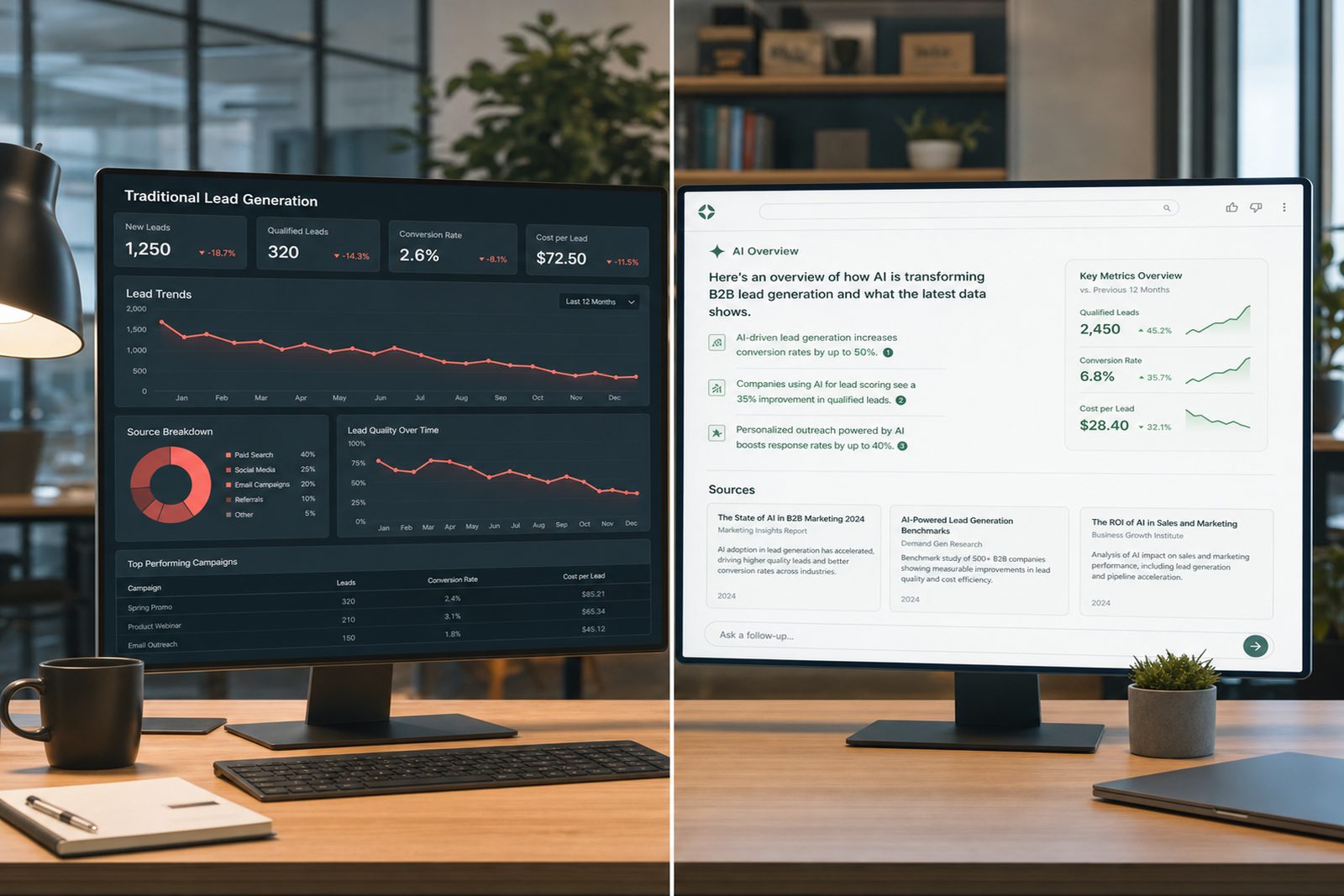
Rehab lead generation has always been expensive and competitive. Treatment centers have paid directory vendors hundreds of dollars per call, stuffed landing pages with keywords, and watched cost-per-lead climb year after year with no ceiling in sight. That playbook made sense when Google returned ten blue links and the top three slots captured most of the clicks. It no longer makes that much sense in 2026.
Google's AI Overviews now answer a significant share of high-intent behavioral health queries before a user ever sees a paid listing or an organic result. Phrases like "alcohol rehab near me," "how long does detox take," and "what does residential treatment cost" now trigger AI-generated summaries that cite two or three sources and satisfy enough intent that a portion of searchers never scroll further. The centers that appear inside those citations are building a brand impression and a conversion pathway that no pay-per-lead vendor can replicate. Those that are absent are losing top-of-funnel volume they may not even be measuring yet.
Why Is the Old Rehab Lead Generation Playbook Breaking Down?
Classic rehab lead generation relied on paid directories, PPC, and SEO for generic keywords. AI Overviews now intercept those queries upstream, reducing click-through rates to paid and organic listings and shrinking the pool of users that directory vendors and ad platforms ever reach.
The pay-per-lead model for addiction treatment grew quickly in the early 2010s because Google's results page rewarded aggregators. A directory site could rank for hundreds of treatment-related terms, collect calls, and resell them to facilities. For a period, this worked for both sides. Facilities got volume. Directories got margin.
Cost-per-lead at the directory and PPC level has climbed steadily across the industry. Observed ranges from publicly discussed industry forums and agency reporting put average blended CPLs for inpatient addiction treatment somewhere between $150 and $600 per qualified inquiry, with some competitive metro markets pushing well above that. The important word is "qualified." Raw call volume from shared leads often carries a high disqualification rate, so the true cost per admitted patient is much higher than the headline CPL figure suggests.
Now overlay a second pressure: AI Overviews. When Google's AI answers a query like "what to expect in detox" with a three-paragraph summary citing a treatment center's educational article, that center has captured attention and built trust before the user has clicked anything. The user who then searches the center's name and calls directly is not counted in any directory's lead report. That conversion is invisible to the old measurement model, which is part of why so many admissions teams are confused by declining paid lead quality even as total inquiry volume holds steady.
To understand what rehab marketing costs across channels, it helps to look at a full picture of spend rather than just the CPL from a single vendor. See our breakdown of what rehab marketing costs across both paid and organic strategies for treatment centers. The gap between channel costs has widened considerably as AI surfaces mature.
How Do AI Overviews Actually Work for Behavioral Health Queries?
AI Overviews pull from pages Google's systems judge as authoritative, specific, and trustworthy for a given query. For behavioral health, that means clinically accurate, well-structured content with clear author credentials and strong E-E-A-T signals tends to get cited more often than thin landing pages optimized purely for a keyword.
Google has not published a definitive list of signals that determine which sources get cited inside AI Overviews. Based on observable patterns across behavioral health and other YMYL (Your Money or Your Life) verticals, a few factors appear consistently in cited content. The page answers a specific question directly and early. The site has demonstrated topical authority across a cluster of related content. The author or organization has verifiable credentials or a real-world track record. The content does not contradict guidance from recognized health authorities like SAMHSA.
For a treatment center, this means a page titled "What Happens During Medical Detox" that opens with a clear clinical explanation, cites the medical literature, and is attributed to a credentialed clinical staff member has a meaningfully better chance of AIO citation than a page titled "Medical Detox Program" that leads with a facility tour description and a call to action.
The implication for lead generation is significant. A center cited in an AI Overview for a high-volume query does not just get a click. It gets name recognition. Users who see a facility name in an AI answer and then close the browser often return later with a branded search. Branded searches convert at a far higher rate than non-branded paid clicks because the user has already formed a mental shortlist. That first touchpoint inside the AI answer is doing conversion work even when it does not produce an immediate click.
This is why our team treats AIO citation not as a vanity metric but as a top-of-funnel lead generation event. Understanding how to earn those citations consistently is covered in detail in our guide on how to rank in AI Overviews as a treatment center.
What CPL Patterns Have We Actually Observed From 2024 to 2026?
From 2024 into 2026, observed cost-per-lead data from treatment center campaigns shows paid directory and PPC channels holding or increasing in CPL while organic and AIO-influenced branded search channels are producing lower-cost, higher-intent inquiries. The gap between these channels has widened as AI answer surfaces have matured.
We want to be precise about what we are and are not claiming here. We are not publishing a controlled study. We are sharing patterns we have observed while working on behavioral health marketing, confirmed by what practitioners discuss openly in industry forums and what agency reporting has shown in aggregate.
From roughly mid-2024 onward, several patterns became consistent. First, paid search CPL in addiction treatment held between $180 and $550 for campaigns targeting competitive terms in high-density markets. Second, lead quality from shared pay-per-lead vendors declined in several cases, with disqualification rates reported anecdotally in the 40 to 60 percent range for non-exclusive leads. Third, centers that had invested in structured content clusters began reporting an increasing share of "how did you hear about us" responses that referenced online research without a specific ad click, which aligns with AIO-influenced discovery pathways.
The third pattern is the hardest to measure and the most important. Standard attribution tools, including Google Ads conversion tracking and most CRM call-tracking setups, are not built to capture the AIO-influenced brand search. A user sees the center's name in an AI Overview, closes the browser, comes back two days later, types the center's name, and calls. That call is attributed to direct or branded organic. The AI Overview gets no credit in the attribution model even though it was the first touchpoint.
This attribution gap is one of the reasons many admissions directors are underinvesting in content and AIO strategy relative to paid. The paid channel shows up clearly in the dashboard. The AIO influence is nearly invisible unless you are looking at branded search volume trends inside Google Search Console and cross-referencing with intake source data.
6 Shifts That Define the AIO-First Rehab Lead Generation Architecture
The centers gaining ground in 2026 are not abandoning paid channels entirely. They are restructuring how paid, organic, and content work together so that AI Overview citations feed the whole funnel rather than sitting in a separate "content marketing" silo. These six operational shifts define what that looks like in practice.
- Clinical question clusters replace keyword pages. Instead of building one page for "drug rehab in [city]," AIO-first centers build a cluster of ten to fifteen pages answering specific clinical and logistical questions: what detox involves, how to verify insurance for treatment, what family involvement looks like in residential care. Each page targets an AIO-triggering question, and collectively they build topical authority that lifts the whole domain.
- Author credentials are visible and verifiable. Google's systems reward content where a real person with relevant credentials is attached to the page. Bylines from licensed counselors, clinical directors, or physicians with a linked bio page that includes licensure information are a meaningful signal for YMYL health content. Generic "staff writer" attributions are a missed opportunity.
- AIO citation monitoring becomes a weekly task. Teams set up regular searches for their top thirty queries and note when and how the AI Overview changes, which sources it cites, and whether the center appears. This is not automated yet for most teams, but it is a deliberate operational cadence rather than an occasional check.
- Branded search volume is tracked as a lead gen KPI. When AIO citations drive brand awareness, branded search volume rises before inquiry volume rises. Tracking this in Google Search Console and flagging week-over-week changes gives an early signal that content is doing top-of-funnel work even when direct attribution is not captured.
- Paid budgets shift toward remarketing rather than cold acquisition. Because AIO and organic content handle first-touch awareness more efficiently, paid spend is increasingly justified as a remarketing tool, targeting users who have already visited the site. CPLs for remarketing audiences are typically a fraction of cold acquisition CPLs and conversion rates are higher.
- Content is structured for extraction, not just reading. AIO systems pull short, direct answers from pages. Content teams train writers to open each section with a two-to-three sentence direct answer before expanding. This format serves both the AI extraction and the human reader who scans before committing to a full read.
Why Do AIO Citations Drive Higher-Converting Branded Searches?
When a treatment center is cited inside an AI Overview, the user forms a positive first impression before ever visiting the site. That prior exposure shortens the trust-building process. Branded searches that follow AIO exposure convert at higher rates because the user is no longer evaluating from scratch.
Trust is the central variable in behavioral health inquiries. A person looking for addiction treatment for themselves or a family member is making a high-stakes, emotionally loaded decision. They are not converting on the first ad they see. Research from behavioral health consumer studies consistently shows that families contact multiple facilities, conduct significant online research, and make decisions over days or weeks rather than minutes.
In that journey, an AI Overview citation does something a paid ad cannot. When Google's AI system presents a treatment center's information as a credible answer to a clinical question, it is implicitly endorsing that source. The user receives it as a recommendation from a trusted information system rather than as advertising. That is a fundamentally different kind of brand impression.
This is why admissions teams that track call source carefully often find that branded organic callers are easier to admit than paid directory leads. They have done more research. They have already formed a preference. They are calling to confirm and to ask practical questions, not to gather basic information they have not found yet. The center that earned that brand preference through AIO citation did not pay a per-lead fee for it.
The full strategic framework for building this kind of answer-engine presence is detailed in the AEO playbook for treatment centers, which covers both the technical and content requirements for consistent citation across AI answer surfaces.
What Our Team Has Observed Working in Behavioral Health SEO
Our team has worked directly in behavioral health SEO, including the MVBH case study, and we have observed consistent patterns: content structured around clinical questions outperforms generic location pages for both AIO citation and organic ranking, but the results require foundational trust signals to be in place first.
In our MVBH behavioral health work, we applied a content architecture that prioritized clinical question clusters over location-keyword pages. The approach followed the same logic described earlier in this post: build topical authority by answering the specific questions that treatment seekers and family members actually ask, structure each page for AIO extraction, and attach real clinical credentials to the content. You can read more about the approach in our behavioral health SEO case study.
One specific operational detail: we run a content audit on a quarterly basis specifically for behavioral health clients that maps existing pages against the AIO trigger queries we have identified for that service area. Pages that are not structured for extraction get flagged for a rewrite. Pages that are missing from the cluster entirely get added to the production queue. This is not a one-time project. It is a standing cadence because the queries that trigger AI Overviews shift as Google's systems update.
We also want to be honest about the limitation here. If a treatment center's site has significant trust problems, such as no staff bios, no physical address, no licensure information, thin content across the board, and a history of thin affiliate-style pages, the content strategy alone will not produce fast results. The foundational E-E-A-T signals have to be in place before the content work pays off at the AIO level. For centers in that situation, the right first step is a trust-signal audit, not a content sprint. Rushing content production onto a low-trust domain typically does not accelerate AIO citation.
We have also seen that smaller, single-location centers can compete effectively in this model if they focus on hyper-specific local clinical questions rather than trying to rank nationally. A center in Asheville, North Carolina that becomes the most authoritative source for questions about "detox in western North Carolina" or "trauma-informed IOP near Asheville" can earn AIO citations in a geographic context even without the domain authority of a national brand.
How Should a Treatment Center Budget for This Shift?
Budgeting for an AIO-first rehab lead generation strategy means rebalancing spending from pure paid acquisition toward content production, clinical author programs, and technical SEO. Most centers should not eliminate paid channels entirely, but the allocation that made sense in 2022 rarely makes sense in 2026.
A useful framework is to think in thirds. One third of the digital marketing budget toward paid (weighted toward remarketing rather than cold acquisition). One third toward content production and clinical SEO. One third toward local presence, reputation, and referral network development. These proportions will vary by center size, market competitiveness, and how much foundational SEO work has already been done. They are a starting point for a conversation, not a formula.
The content and SEO third is the piece that most treatment centers have historically underfunded. A single experienced behavioral health SEO content writer costs somewhere between $3,000 and $6,000 per month for meaningful output. Clinical review adds time and cost. Technical SEO infrastructure, especially for centers that have inherited poorly structured WordPress sites, can require a significant upfront investment. These numbers are real, and centers that are used to thinking in terms of per-lead costs sometimes struggle to connect the content investment to an inquiry outcome. The attribution problem described earlier is part of why that connection is hard to see.
For a more granular look at what to expect to pay across channels and service providers, see our post on what to pay for rehab lead generation. The numbers in that post reflect honest ranges based on actual market conditions rather than a sales pitch for any particular channel.
The centers that are ahead of this shift in 2026 started investing in clinical content and AIO strategy in 2023 and 2024. The compound effect of topical authority and citation frequency is not something that can be bought in a quarter. It is built over six to eighteen months of consistent, structured effort. That timeline is a real constraint, and any agency or vendor that promises faster results through shortcuts is probably selling something that will not survive a Google quality update.
Building a citation-worthy, trustworthy content presence is the only rehab lead generation strategy that improves over time rather than degrading as ad costs rise and AI surfaces capture more of the query page. Centers that commit to that foundation now will have a structural advantage that their competitors will find very difficult to close.