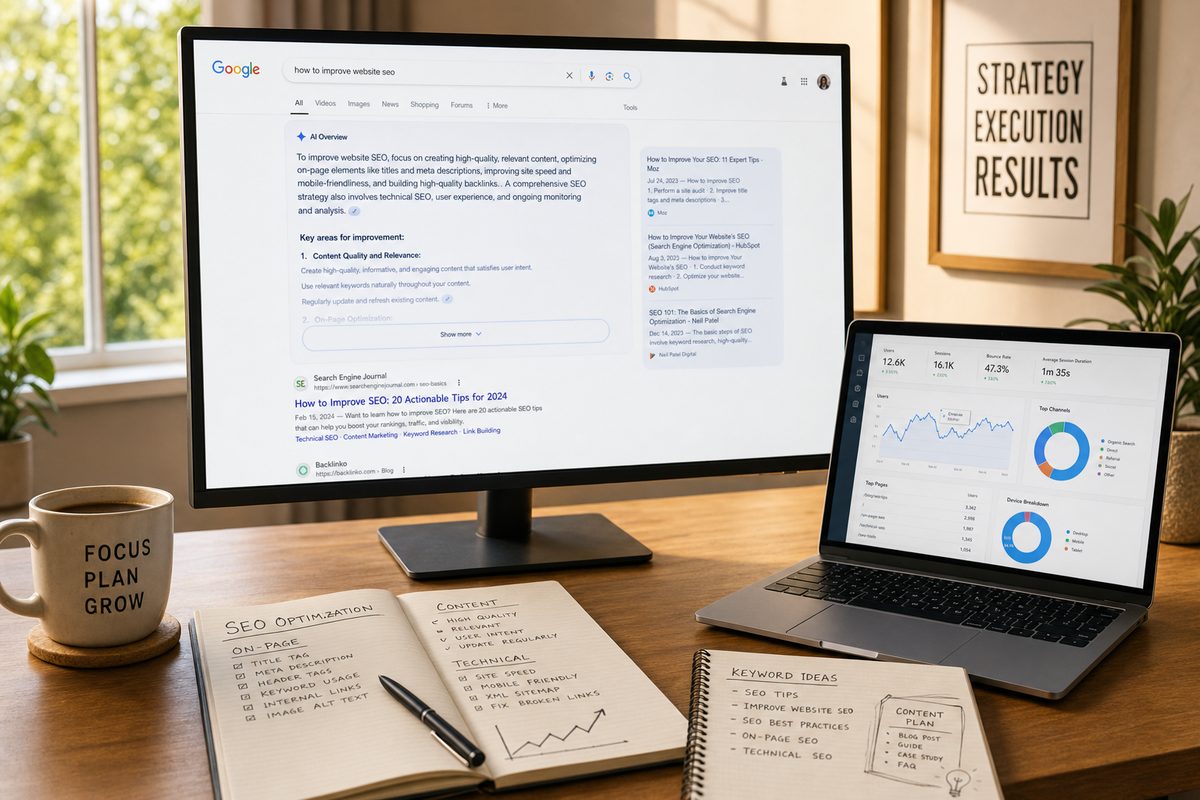



Every week, a potential customer opens ChatGPT or Perplexity, types something like "best luxury mental health treatment in Massachusetts" or "top HVAC company in Tampa," and acts on whatever name appears in that answer. If your brand isn't in that answer, you're invisible to that person. It doesn't matter how well you rank on page one of Google. The race to get mentioned in AI search isn't hypothetical anymore. It's happening right now, and the businesses appearing in those citations are capturing high-intent traffic before a searcher ever visits a results page.
The challenge is that no one can simply buy their way into an AI citation. ChatGPT, Perplexity, and Gemini don't sell placement the way Google sells ads. They retrieve, synthesize, and surface information from sources they've indexed or are permitted to call. That means the path to a mention is earned, not purchased. It runs through content architecture, entity consistency, and source authority. This post breaks down the actual levers that move the needle, what realistic timelines look like, and where most businesses are leaving citations on the table. If you want a deeper foundation before reading on, our answer engine optimization services page covers the strategic framework we build from.
Why Do AI Engines Cite Some Brands and Not Others?
AI engines cite brands whose information appears in sources they trust, is structured for easy extraction, and consistently matches across multiple locations on the web. Brands that are hard to verify, inconsistently described, or buried inside unstructured prose are rarely surfaced, even if the underlying business is excellent.
ChatGPT's browsing model, Perplexity's live-index retrieval, and Gemini's grounding layer all share a common behavior: they look for a confident, extractable answer to the query at hand. When a model finds a page that leads with a clean declarative sentence, backs it with supporting facts, and echoes the same entity attributes across multiple corroborating sources, that page becomes a reliable candidate for citation. When a page buries its key claim in paragraph seven, uses inconsistent business names, and has no external corroboration, the model skips it.
Entity consistency is the part most businesses underestimate. An AI model building an answer about your business will check your Google Business Profile, your website, your Wikipedia or Wikidata entry if one exists, your major directory listings, and any editorial coverage it can reach. If your name, location, specialty, and descriptive framing differ across those sources, the model treats your information as low confidence. If they all agree, you read as a verified, trustworthy entity. The difference in citation likelihood between those two states is significant, even if it's invisible to a human skimming your website.
It also helps to know that these engines don't read every page on your site. They sample. Perplexity, for example, draws heavily from sources it's pre-indexed as authoritative: major publications, established directories, Reddit threads with strong engagement, YouTube transcripts, and well-structured business websites. Getting your facts into those upstream sources is often faster than optimizing your own site in isolation.
6 Levers That Improve Your Chances of an AI Citation
No single tactic guarantees a mention. But consistently applying the right combination of signals over three to six months materially improves how often AI engines find your brand retrievable and worth citing. Here are the six levers that matter most in practice.
- Lead every key page with a quotable answer sentence. Write a clean, 30-to-50-word opening sentence that directly states what your business does, for whom, and where. AI engines extract these sentences as snippets. If your page opens with a vague tagline or a brand story, the model has nothing clean to lift.
- Deploy FAQ and HowTo schema on relevant pages. Schema.org structured data for AI parsing and Google Search Central guidance on AI Overviews gives models a machine-readable layer on top of your prose. FAQ schema on a service page lets a model read your questions and answers as discrete, citable units rather than scanning unstructured paragraphs. HowTo schema works the same way for process-based content.
- Standardize your entity data across every major source. Audit your Google Business Profile, Yelp, Healthgrades, Avvo, Houzz, or whichever directories fit your vertical. Every listing should use the exact same legal business name, address format, phone number, and one-line description. Discrepancies erode model confidence in your entity.
- Earn placement on sources AI engines already sample. Reddit threads with substantive engagement, YouTube videos with accurate auto-captions, local business journals, industry-specific publications, and high-authority directory profiles (Zocdoc for healthcare, FindLaw for legal, Angi for home services) all feed into the retrieval layer. Getting mentioned in those places isn't old-school PR. It's direct pipeline work for AI citation.
- Build a Wikidata or Wikipedia entry if you qualify. Wikidata is a structured knowledge graph that Google, Bing, and several AI engines query directly. If your business or its principals meet notability thresholds, a verified Wikidata entry creates a canonical entity anchor that models use when resolving ambiguous queries about your brand.
- Re-test your citation status on a regular cadence. Run target queries in ChatGPT, Perplexity, and Gemini monthly. Screenshot and log the results. Look for which sources they cite when they mention a competitor. Then close the gap by getting your content or entity data into those same upstream sources. This re-test loop turns AI search from a mystery into a measurable workstream.
Does Structured Schema Actually Change What AI Engines Cite?
Structured schema doesn't guarantee a citation, but it meaningfully improves extractability, which is one of the factors these engines weigh. Pages with well-formed FAQ, HowTo, and LocalBusiness schema give models cleaner, more parseable data than unstructured prose, which reduces friction in the retrieval step.
In practical terms, implementing LocalBusiness schema with your accurate name, address, hours, service area, and a precise description of your specialty can help a model correctly associate your page with a query, even when the query uses different phrasing. A med spa that marks up its services with MedicalBusiness and HealthAndBeautyBusiness schema is more likely to surface on a query like "non-surgical body contouring near me" than a competitor whose service descriptions exist only as unstructured page copy.
FAQ schema deserves particular attention. Each question-and-answer pair you mark up becomes a discrete, retrievable unit. Write a question like "Is your facility covered by insurance?" and a clean 50-word answer, and that pair can be extracted by Perplexity or Gemini directly. The model can quote it in an AI answer without parsing surrounding context. The more precise and factual your answers, the more usable they are. Avoid vague answers like "It depends" inside schema. Give the model something concrete to cite.
For businesses in regulated verticals like healthcare, legal, or financial services, schema also helps with accuracy. A personal injury law firm that uses Attorney and LegalService schema with specific practice areas is less likely to be misrepresented in an AI answer than one whose site only mentions "we handle all types of cases" in a paragraph buried under a slider image. Clarity at the machine-readable level translates to accuracy at the answer-surface level. That matters for citations and for avoiding hallucinated descriptions that can damage a brand. You can go deeper on this topic in our post on entity SEO for AI search.
A Real-World Example: MV Behavioral Health
MV Behavioral Health, a luxury mental health treatment provider in Massachusetts, appears in both ChatGPT and Perplexity citation results for queries about high-end mental health care in the state, verified in July 2026. Their site combines answer-first content, structured entity data, and placement in health-specific directories that these engines already draw from.
This isn't an anomaly. Looking at why a site like MV Behavioral Health gets cited for a competitive, high-value query like "luxury mental health treatment Massachusetts" reveals a consistent pattern. The site's key pages open with clear, factual statements about the level of care, the setting, and the population served. There's no ambiguity about what the facility offers or where it operates. That clarity is extractable in a way that a page leading with a mission statement or a photo gallery simply isn't.
Beyond the site itself, the brand has a consistent presence in directories that Perplexity specifically samples for healthcare queries, including Psychology Today, Healthgrades, and SAMHSA's treatment locator. Each listing uses the same name and the same description of the specialty. When a model queries multiple sources and gets the same answer about the same entity, confidence in that entity rises. Citation follows.
The lesson isn't to copy MV Behavioral Health's exact playbook. It's to audit your own brand the way a model would. Start from a query your ideal customer would type, look at the sources the model returns, and identify the gap between where you appear and where those cited sources live. Then close that gap systematically. This is also closely related to how to optimize for AI Overviews, which we cover in detail in our post on how to rank in Google AI Overviews.
What Have We Seen in Our Own AEO Work?
Across client engagements, our team has found that the fastest path to AI citation is usually not more content. It's cleaner, more extractable versions of content that already exists, combined with entity data cleanup across directories and a deliberate push to earn mentions in the upstream sources these engines already trust.
Our process typically starts with a citation audit. We run 20 to 40 target queries across ChatGPT, Perplexity, and Gemini, document which sources they cite, and map the gap between those sources and where the client currently has presence. From there, we prioritize entity cleanup, fixing name, address, and description inconsistencies, along with schema implementation on the highest-traffic service pages and a short list of specific publications or directories where we want the client mentioned.
One operational detail worth sharing: we use a structured "answer block" template for rewriting service page intros. Each intro follows a pattern of claim, qualifier, and specificity. For example: "[Business Name] provides [specific service] to [specific audience] in [specific geography], with [one concrete differentiator]." That sentence is designed to be extracted verbatim. When we audit pages six to eight weeks after implementation, we consistently see improved citation rates in Perplexity's live-index results, which updates faster than ChatGPT's training data.
The honest caveat is that this process is slower for businesses in highly saturated markets or those with very limited existing coverage on third-party sources. A new HVAC company in a large metro with no directory presence, no press mentions, and a brand-new domain will see citation results in a timeline of six to twelve months rather than two to three. In those cases, we're candid with clients that foundational credibility work has to come before AI citation optimization. There's no shortcut around being a verifiable, well-documented entity. Our AI Overviews optimization post covers the overlap between Google's AI surfaces and third-party AI engines for clients navigating both at once.
Getting your brand cited across AI answer engines is a compounding investment. Each schema improvement, directory cleanup, and editorial mention adds one more signal to a web of information that models use to verify and surface your business. There is no single action that flips a switch. But businesses that treat AI citation as a structured, testable workstream rather than a mystery are already separating from competitors who are waiting for certainty before they act. Start with what is retrievable, clean up what is inconsistent, and build presence where these engines already look.