

Refresh Or Add Pages In AI SEO For Addiction Treatment
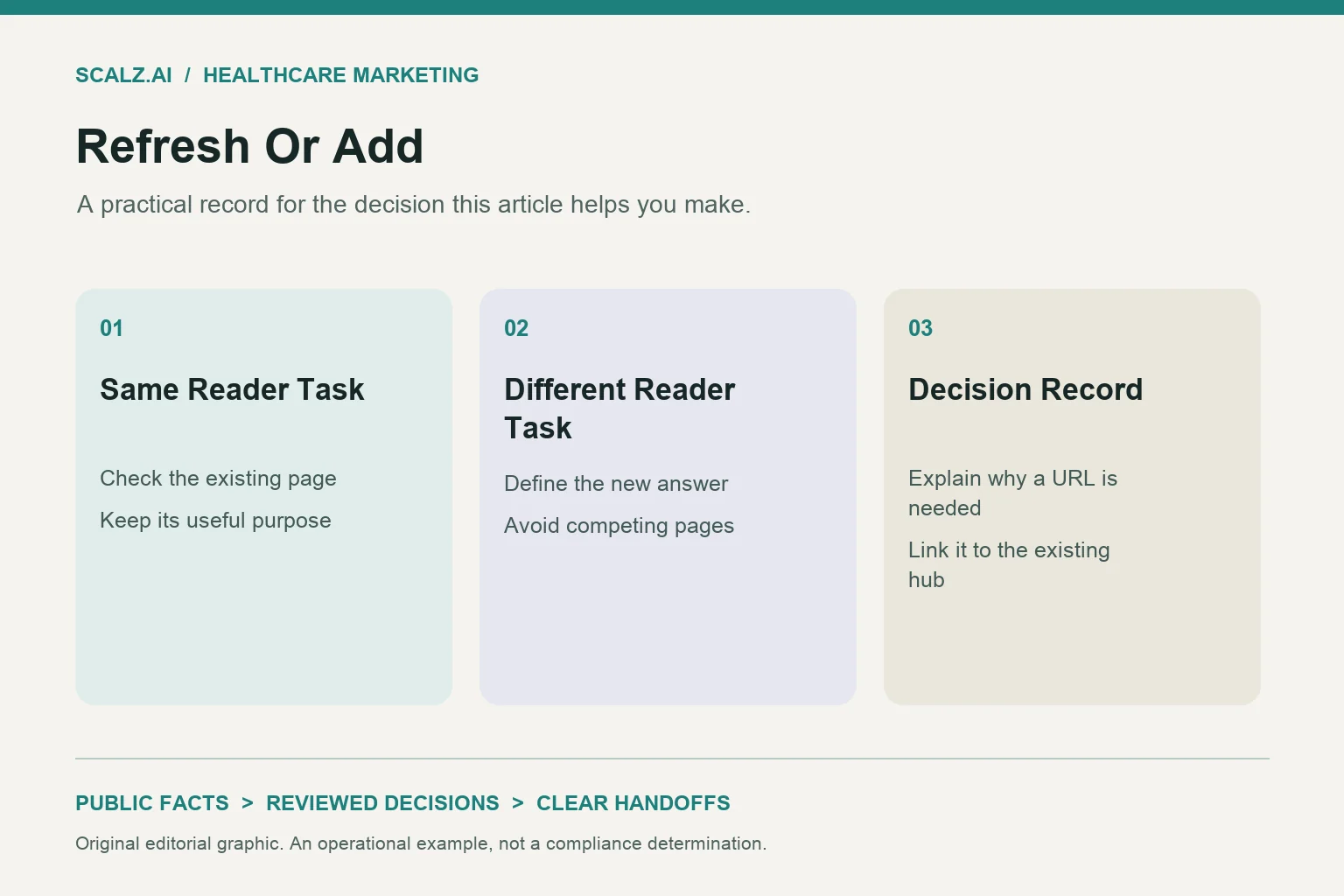
For AI SEO for addiction treatment, update an existing page when a newly found question serves the same reader task, supports the same next action, and fits that page’s scope. Add a support URL when the question needs a distinct, useful answer that the existing page cannot carry without changing its purpose. Hold either assignment when essential facility facts remain unverified.
Make this choice before assigning a writer. The practical output is a recorded route: update an identified page, commission a distinct support page, or pause for a named missing fact.
AI SEO for addiction treatment: Use four routing gates
Within an addiction treatment SEO plan, page placement should follow the reader’s task. The same principle applies to AI SEO services: a new keyword variation alone does not justify another URL.
Run each proposed question through four gates in order. Compare its audience, next action, answer scope, and required facts with the closest existing page. Record an explanation at each gate rather than adding up a score that could hide an important difference.
- Audience gate: Continue toward an update when the proposed answer serves the existing reader’s task and decision stage.
- Action gate: Continue toward an update when the reader finishes with the same practical next step for the same reason.
- Scope gate: Choose an update when the answer fits naturally beneath the existing page’s promise without turning a supporting point into a second main topic.
- Evidence gate: Release the assignment only when the facts needed for that route are available and approved for public use.
A difference at either of the first two gates makes a separate page a candidate, not an automatic decision. It still needs enough distinct substance to stand alone. If neither route offers a complete, useful answer, retain the question in the backlog with its unresolved dependency.
Normal SEO foundations apply to Google’s AI features; no special AI markup is required. Use the routing decision to improve the answer’s home, rather than commissioning a page merely to label it AI-ready.
Match the reader’s task before comparing keywords
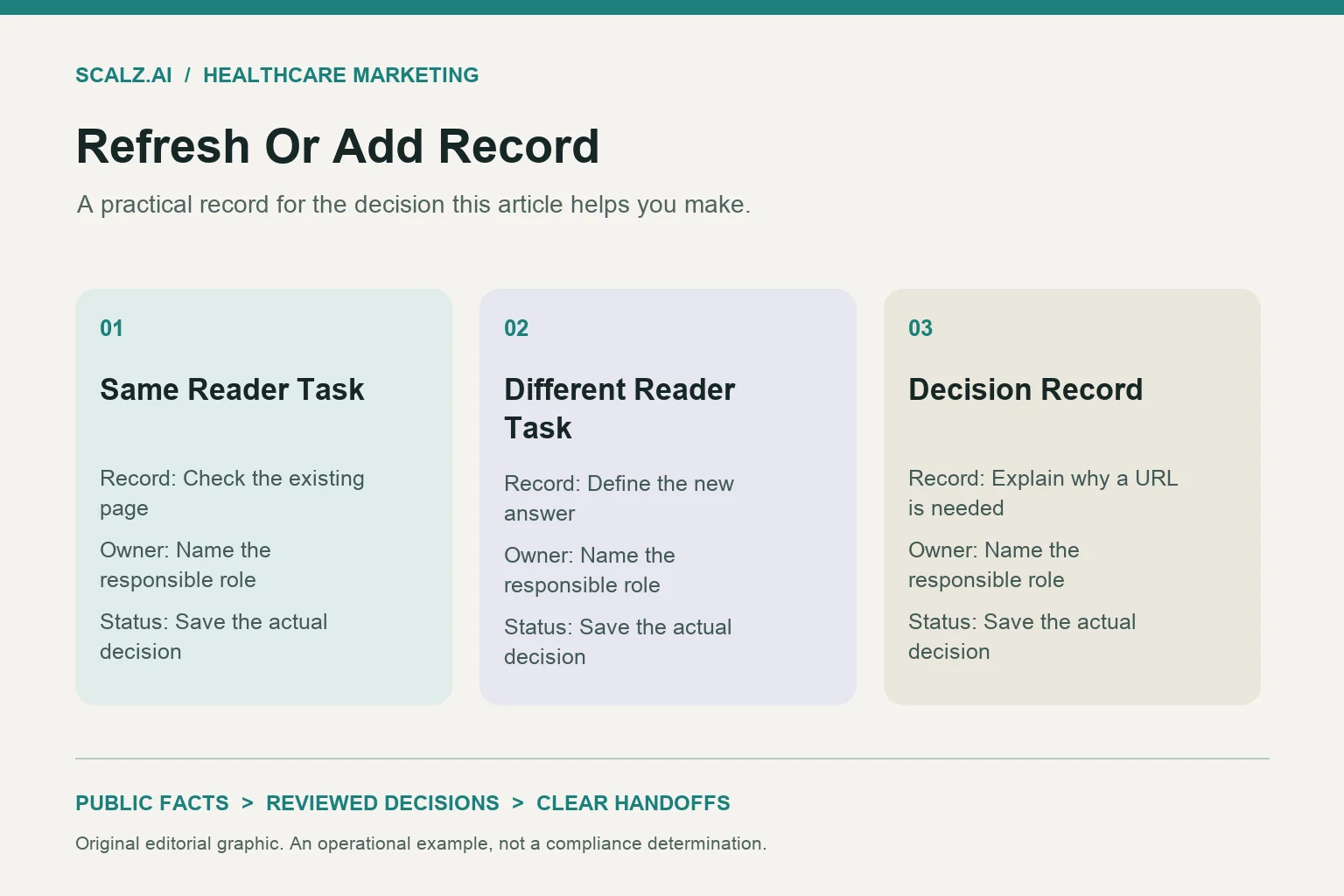
A broad content strategy for addiction treatment establishes which audiences matter. This routing decision works at a smaller scale: whether one newly discovered question belongs with an answer already published.
Describe the reader through the task they are trying to complete. “Family member” is too broad to settle page placement because locating a facility and finding visiting information are different tasks. Likewise, “professional partner” does not explain whether someone needs a public contact route or a description of an administrative process.
- Write a task statement such as, “The reader needs to find the correct public contact channel for a named location.”
- Write the existing page’s task in the same format so the comparison does not depend on matching vocabulary.
- Note the decision stage, distinguishing initial orientation from finding a specific published detail.
- Identify any reader difference that changes the answer, required facts, or next step.
Suppose a new query uses “center” while an existing page uses “facility,” but both seek the same location’s contact details. That wording difference supports an update if the page already owns the task. It does not establish a second audience or a separate informational purpose.
Conversely, two questions can share the phrase “contact the facility” while serving different jobs. A visitor looking for directions and an organization seeking a partnership contact may require separate routes. Document the difference in useful content before deciding how many pages to commission.
Compare the next action, including its reason
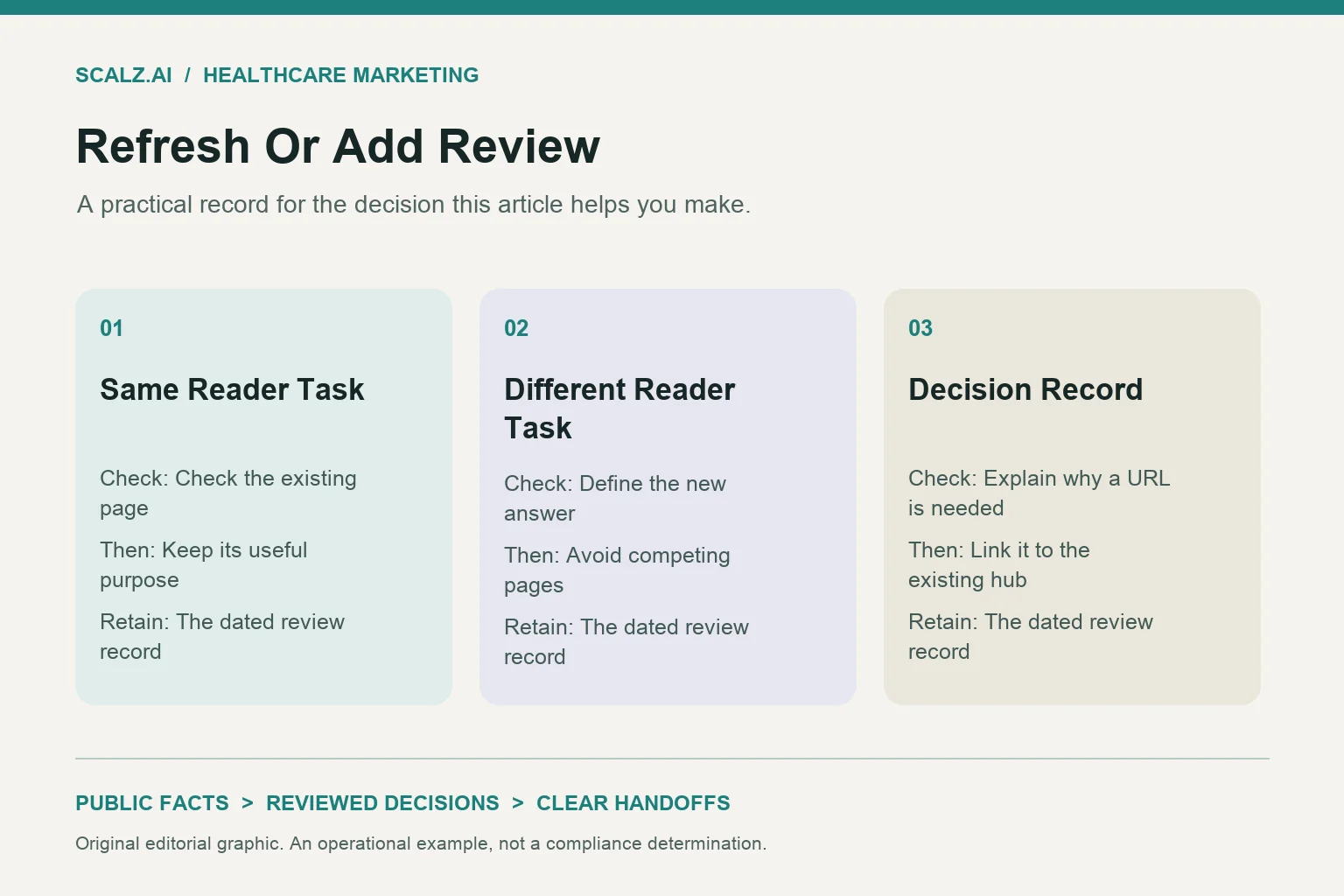
A shared call button does not prove that two questions have the same intent. Many facility pages can point toward contact while helping readers complete different preliminary tasks. Compare what the reader can do after receiving the answer, not just the button displayed below it.
Use a sentence that names both the action and its purpose. For example, “After reading, the visitor can locate the published contact details for the correct facility.” A proposed answer belongs nearby when it resolves an obstacle to that same action.
- Prefer an update when the new answer removes a small uncertainty within the existing task.
- Consider a separate page when the answer leads to a different department, public resource, or administrative decision.
- Do not split pages solely because one proposed call to action says “learn more” and another says “contact us.”
- Do not combine distinct topics solely because both eventually link to the same contact page.
For a hypothetical location page, explaining where its approved phone number appears is part of finding contact information. A detailed explanation of a separate public partnership process could have a different reader and purpose, even if the organization uses one central switchboard. The route depends on what the answer must explain.
If the next action remains vague, pause the URL decision and refine the task statement. “Learn about the facility” cannot distinguish a useful support page from another broad overview. A concrete action exposes whether the proposed content adds a missing step or starts a different journey.
Test whether the answer fits the existing page’s promise
Scope is the deciding gate when audience and next action overlap. Read the existing title, opening answer, headings, and conclusion together. Then describe where the proposed answer would sit and what surrounding content it would displace.
A supporting section should deepen the page’s existing answer. It should not require a new opening promise, a second sequence of decisions, or extensive background unrelated to the original task. Word count alone cannot distinguish a useful addition from a separate topic.
- Propose an insertion point and a one-sentence purpose for the added section.
- List the facts and examples needed to make that section useful, rather than estimating length first.
- Favor a separate page when the new answer needs its own sequence, exceptions, and reusable record.
- Reject a standalone proposal that would repeat the parent page’s explanation with only a different heading.
Apply a simple removal test to the proposed support page. Remove the background already covered by its parent, then inspect what remains. If the remainder is one short clarification, the existing page probably provides the better home.
Apply the reverse test to an update proposal. If inserting the answer makes the parent’s main task harder to find, the scope may be too large for that page. A distinct support URL can then carry the detail while the parent offers a short, contextual link.
Keep the proposed boundary explicit. Record the question the new page owns and the subjects it leaves to its parent, so both assignments can be reviewed without drifting into the same answer.
Let missing facts pause the assignment
A strong content idea can still be unready for either route. Separate editorial judgment from facility facts: the editor can propose placement, but cannot infer current services, locations, contact hours, visitor arrangements, or administrative procedures. Those details must come from verified facility records.
For each route, list only the facts needed to complete its answer. An update may need one current public contact detail, while a standalone operational page may need an approved process and exception handling. More writing space does not solve missing information.
- Identify the approved facility record supporting each material public detail.
- Name the person responsible for confirming that record and resolving conflicting versions.
- Mark missing information as a specific dependency, such as “Public partnership contact route awaiting confirmation.”
- Keep generic background from substituting for the facility detail that makes the proposed answer useful.
If the missing fact affects the central answer, hold the assignment. If it affects only an optional example, remove that example and assess whether the remaining answer still completes the task. Do not turn uncertainty into language such as “typically available” when availability has not been confirmed.
Treat program names as documented marketing labels, not invitations to describe care suitability. If resolving the informational question requires clinical judgment, the marketing editor should route that issue to the appropriate facility reviewer. The URL decision can remain pending without expanding the article into care advice.
Record the dependency beside the routing recommendation. This lets the team distinguish a rejected topic from a useful topic waiting for one concrete input.
Work through three borderline proposals
The following proposed examples show how the gates change a decision. They describe editorial assignments, not facts about any facility. Each recommendation depends on the existing page and approved records matching the stated conditions.
A small contact clarification belongs on the existing page
A location page already helps visitors find that facility’s published contact information. The new question concerns where current contact hours can be found. If an approved hours record exists, the task, next action, and scope remain aligned with the location page.
- Recommend an update containing the approved hours detail beside the relevant contact information.
- Record the location page as the answer’s owner and exclude a separate article that would merely repeat it.
If hours are unconfirmed, hold the factual addition. Do not create a new URL as a workaround for the missing record.
A separate organizational task may deserve its own answer
A proposed question concerns how community organizations locate the correct public partnership contact. The nearest existing page serves general visitors seeking facility contact details. A standalone page becomes reasonable if an approved partnership process provides enough distinct steps to answer the organizational task.
- Recommend a new support page only when its process, audience, and endpoint can be clearly distinguished.
- Limit the parent page’s addition to a brief signpost toward that separate public process.
If the whole answer is simply an approved contact name and number, reassess the need for a standalone page. A concise section on a suitable existing page may complete the task.
A large related answer can outgrow its parent
A facility location page addresses finding the site, while a proposed visitor-information resource needs several approved administrative details. Both may serve overlapping readers, but a complete resource could distract from the location page’s main purpose. Scope can justify separation even when audience overlap is high.
- Recommend a support page when the distinct administrative answer remains useful after repeated location background is removed.
- Hold the proposal if its essential visitor details lack verified records.
Keep a reusable question-to-URL decision record
Save the routing result before turning it into an assignment. The SEO content brief buyer guide helps define the later writing task; this record settles where that task belongs. Keep the record short enough for another editor to review without reconstructing the discussion.
Use the following fields for every candidate question. Each entry should explain a decision or identify an input, rather than repeat a keyword.
- Candidate question: Preserve the exact informational question and note where it was identified.
- Reader task: State what the intended reader needs to accomplish after receiving the answer.
- Closest existing page: Record its current URL, main promise, and relevant existing section.
- Audience and action comparison: Explain whether each matches and why any difference matters.
- Scope result: Record the proposed insertion point or the distinct answer a new page would own.
- Required facts: Identify approved records, unresolved details, and the responsible facility reviewer.
- Route and boundary: Select update, new support page, or hold, then state the material excluded from that assignment.
- Ownership: Name the editor, approval dependency, and trigger for revisiting the decision.
A completed proposed entry might read: “Contact-hours clarification; existing location page; same visitor task and contact endpoint; add beside contact details; hold until the hours record is confirmed.” That entry gives the team a route and a precise blocker. It does not imply that the facility has supplied the missing information.
Keep alternate wording in the same record when it serves the same task. Open a separate record when the useful answer changes, rather than when the query merely gains another modifier.
Approve the route and check the boundary after release
Once the route is approved, hand an update assignment to the AI SEO content refresh workflow. For a new page, carry the distinct answer and exclusions into its brief. The routing decision should constrain the work before drafting begins.
Review the draft against the decision record before release. A page commissioned for one narrow task can expand into a second overview during revision. Likewise, an update can acquire enough unrelated sections to undermine the original page’s promise.
- Confirm that the opening answers the assigned question and that every substantive section supports its task.
- Check that facility-specific statements match their approved records and that unresolved facts remain excluded.
- Verify that parent and support links explain the relationship without making both pages answer everything.
- For an update, preserve the existing URL and conversion path unless a separately approved change covers them.
- For a new page, inspect its rendered answer, internal links, and publication checks before considering the assignment complete.
After release, check whether the chosen page contains the complete answer and remains accessible through the intended link path. Available search-query observations can help identify whether related questions reach the expected page. AI-answer observations across Google AI Overviews, ChatGPT, Perplexity, and Gemini should remain separate from the original routing rationale.
Unexpected visibility does not by itself prove that the team chose the wrong URL. Revisit audience, action, scope, and facts before prescribing another page. If later review suggests consolidation, deletion, or redirects, require a separate reviewed migration plan.
For done-for-you support, contact SCALZ.AI with the proposed question and closest existing page. Those two inputs give the discussion a concrete starting point.
Frequently asked questions about choosing the answer’s home
Does a question appearing in an AI answer require a new page?
No, its appearance is a reason to assess the question, not a rule for adding a URL. Record the wording, platform, and observation date, then compare the actual reader task with existing content. The same answer may belong in a clearer section of a page already serving that task.
What if two existing pages are equally plausible homes?
Choose the page whose main promise most directly matches the task and can accommodate the complete answer. Record the other page as related context, with a short link if useful. If ownership remains unresolved, settle that overlap before assigning another support page.
Should low search volume rule out a separate support page?
No, a distinct, documented reader need can justify a useful support page even when volume estimates are limited. The proposal still needs a complete answer, verified facts, and a sensible place within the site. Low volume also does not excuse duplicating a task that an existing page already handles.
Call 407-954-8800 to talk through next steps.