

How Should Service Businesses Structure Internal Links for LLM Discoverability?

Service businesses need internal links that do more than move visitors from one page to another. A deliberate LLM SEO internal linking strategy should reveal how services, customer needs, locations, and supporting topics relate. Clear relationships help people explore a site and give search and answer systems more context for interpreting its content. The goal is not to place as many links as possible. It is to build a useful, consistent structure around the questions a qualified buyer asks.
Start With the Services That Drive Decisions
Begin by identifying the pages that explain what the business provides. These core service pages should act as destinations for relevant links from educational articles, related service pages, location content, and resource pages. For SCALZ.AI, that might mean organizing content around confirmed capabilities such as AI SEO, answer engine optimization, generative engine optimization, LLM SEO, technical SEO, local SEO, content strategy, and SEO audits.
Do not treat every page as equally important. Decide which pages help a prospective customer understand a service, compare options, or take a next step. Then identify supporting pages that can clarify concepts, answer objections, or explain a specific process. Each supporting page should point naturally toward an appropriate core page rather than linking indiscriminately across the site.
A simple planning document can record each core page, its purpose, its intended audience, its supporting articles, and the anchor phrases already in use. This prevents accidental isolation and exposes areas where several pages compete to explain the same subject.

Build Topic Clusters Around Real Buyer Questions
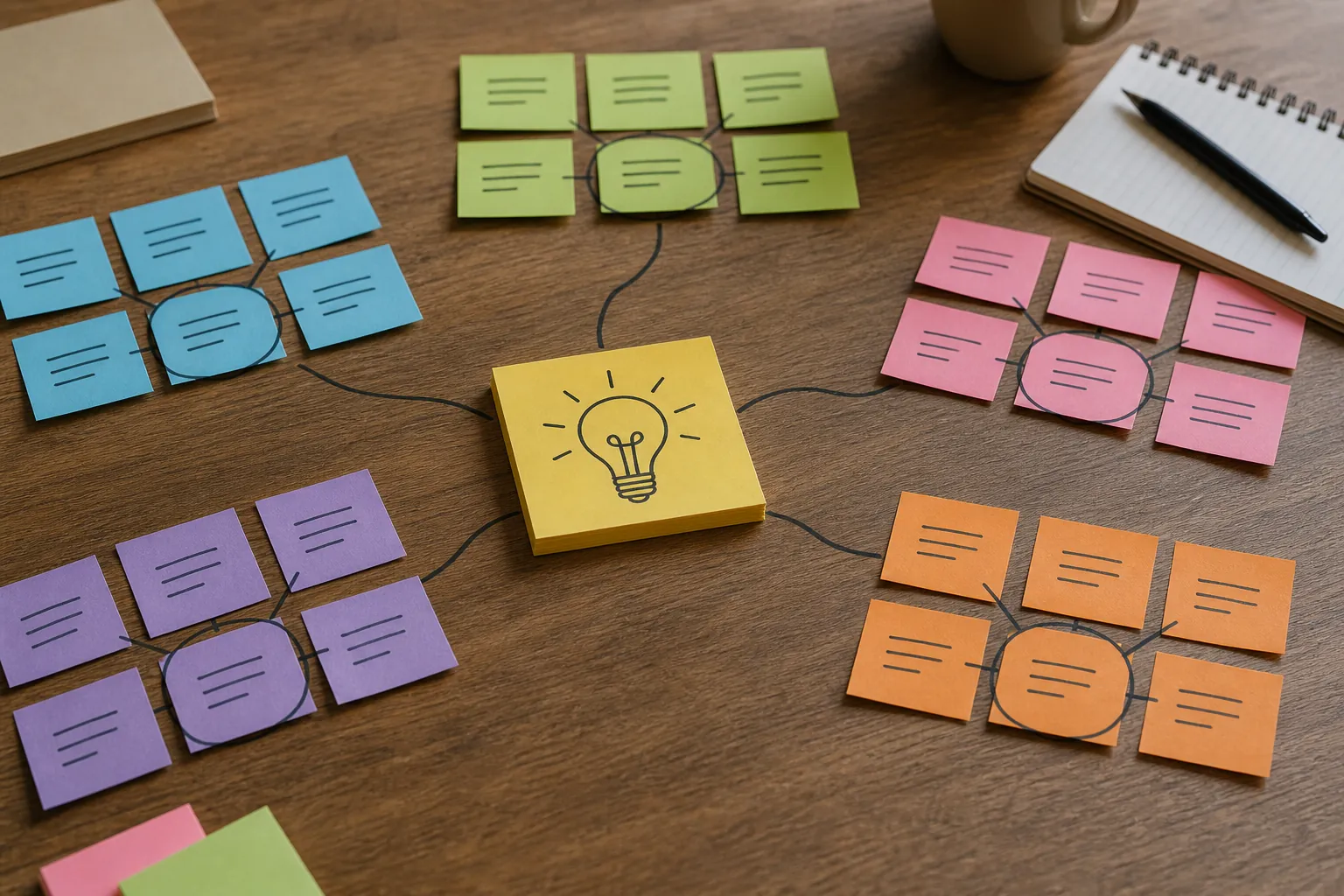
A topic cluster connects one broad service page with narrower resources that address related questions. The structure should reflect how buyers investigate a problem. For example, an LLM SEO page could connect to articles about entity clarity, content organization, citations, technical accessibility, and internal linking. Those articles can link to one another when the connection genuinely helps the reader.
Industry-specific content also needs deliberate organization. A behavioral health provider may need pages that distinguish services, audiences, markets, and informational topics without creating overlapping material. The article on behavioral health GEO content gaps offers a related planning perspective for teams evaluating where their content coverage is incomplete.
Use these questions when defining clusters:
- Which service page should serve as the primary destination?
- What questions arise before a buyer is ready to contact the business?
- Which existing pages answer those questions well?
- Where are two pages covering the same intent?
- Which important page has few or no contextual internal links?
Write Anchors That Explain the Destination
Anchor text should set an accurate expectation. Generic phrases such as “click here,” “read more,” or “learn more” provide little context on their own. Descriptive anchors can identify the subject of the linked page while still fitting naturally into a sentence. A link to a technical SEO audit page, for example, should use language that reflects technical SEO audits rather than an unrelated broad keyword.
Avoid forcing the exact same anchor text into every link. Natural variation can reflect the surrounding discussion while keeping the destination clear. One article might reference “LLM SEO planning,” while another uses “optimizing content for large language models.” Both can be suitable if the linked page addresses those concepts.
Context also matters. Place links near the relevant explanation, not in a disconnected block created only for optimization. Before adding a link, ask whether the destination expands the point, answers the next likely question, or supports a decision. If it does none of those things, the link probably does not belong.
Control Depth, Duplication, and Navigation Paths
Important pages should not depend on one obscure article for discovery. They need logical paths from primary navigation, service hubs, related content, or other established sections of the site. Breadcrumbs can reinforce hierarchy, while contextual links explain subject relationships that navigation alone cannot express.
Review pages that are several steps removed from the main site structure. A deep page is not necessarily a problem, but a valuable page with no clear route from related content deserves attention. Also examine duplicate and near-duplicate pages. If several URLs address the same intent, internal links may send conflicting signals about which page is primary. Consolidation, sharper differentiation, or a revised linking pattern may be more useful than adding another article.
Keep links focused. Repeating the same destination throughout a short page rarely adds value. Sitewide footer links should not replace contextual links, and automated related-post modules should be reviewed for relevance. A smaller set of purposeful connections is easier for visitors to understand and for site teams to maintain.
Audit the System and Maintain Editorial Rules
An internal linking strategy requires upkeep because new pages change the site’s structure. Include link review in the publishing process. When a new article goes live, add links from suitable older pages to the new resource, then link the new article to its core service page and any directly relevant supporting content. This two-way review helps prevent new pages from becoming isolated.
During an SEO audit, check for broken links, redirects used as internal destinations, orphan pages, misleading anchors, excessive repetition, and links pointing to outdated or weaker versions of a topic. Compare the linking map with the current business priorities, but do not remove useful educational paths simply because a page is not a primary sales destination.
Create concise editorial rules covering anchor clarity, placement, destination selection, and review ownership. These rules should support AI SEO, AEO, GEO, technical SEO, local SEO, and content strategy without turning every sentence into an optimization exercise. The strongest structure remains readable, useful, and grounded in genuine topic relationships.
Plan a Clearer Internal Linking Structure
SCALZ.AI can discuss internal linking as part of LLM SEO, GEO, AEO, content strategy, technical SEO, or an SEO audit. For a calm conversation about your site and priorities, call 407-954-8800.
Call 407-954-8800 to talk through next steps.