

See who shapes AI and local search visibility in your markets

Search competition changes from one city, state, and platform to the next. A company that dominates traditional Google results may be absent from map listings or AI-generated answers. Another may appear prominently in a local market despite having little national visibility. GEO competitor analysis services help businesses understand these differences and make informed decisions about where to focus their marketing effort.
SCALZ.AI evaluates the competitors influencing organic search, local results, Google Business Profile visibility, and AI answers across the United States. Our analysis supports AI SEO, answer engine optimization (AEO), generative engine optimization (GEO), LLM SEO, technical SEO, local SEO, and content strategy. The goal is not to copy competitors. It is to identify the signals, topics, and market conditions that deserve attention.
Why Geographic Competitor Analysis Matters
Your business competitors and your search competitors are not always the same. A familiar company may compete directly for customers but rank for few relevant searches. Publishers, directories, review platforms, local businesses, and specialized websites can occupy the results instead.
Geography adds another layer. Search results can vary by city, service area, and the location implied by a query. Google Business Profile results are especially sensitive to relevance, location, and listing quality. AI systems may also cite different sources depending on how a question is phrased and whether it has local intent.
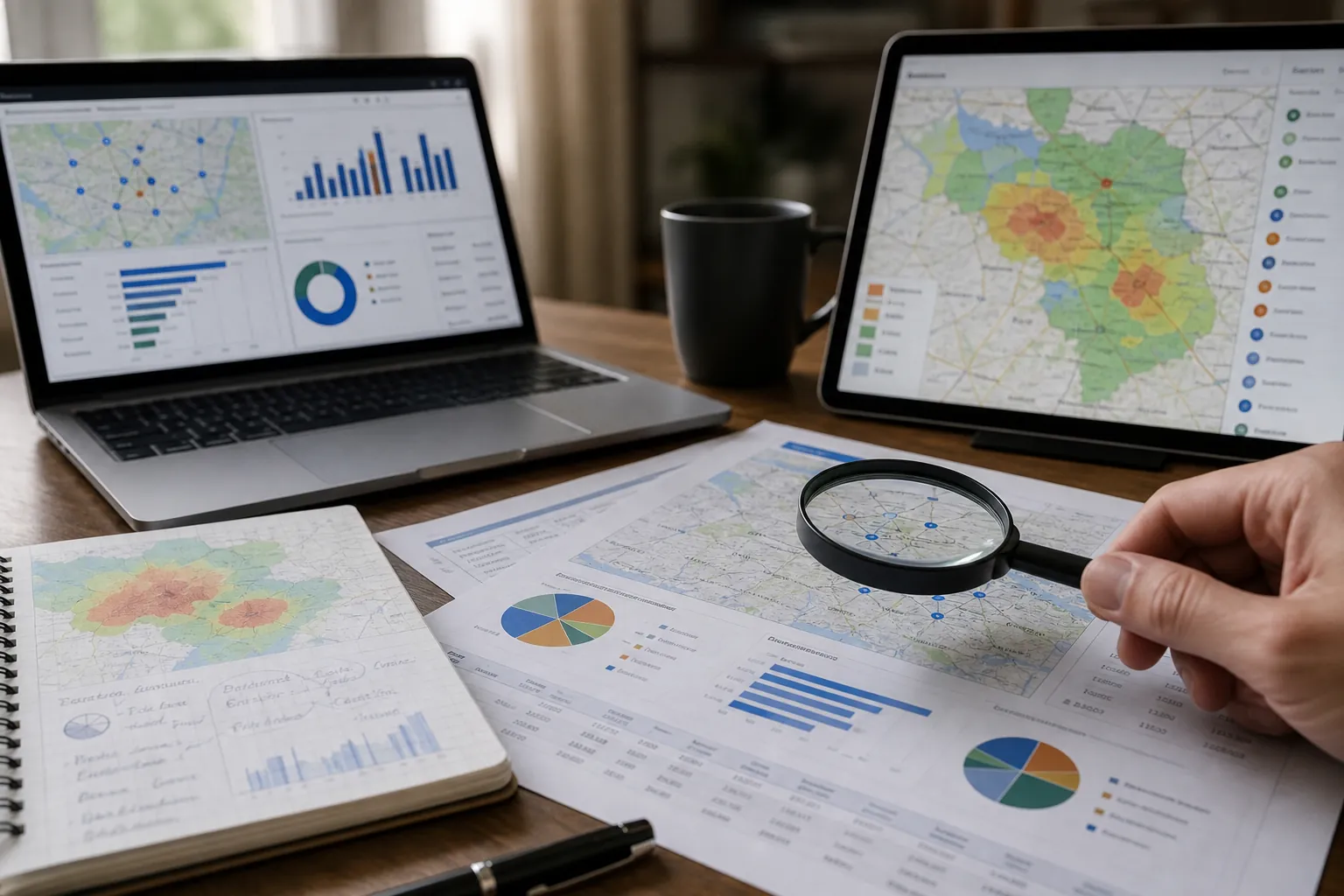
A geographic analysis separates these environments. It shows which domains, pages, profiles, and source types repeatedly appear for important searches in selected U.S. markets. That creates a stronger foundation for local SEO, content strategy, link building, and Google Business Profile optimization.

What We Examine Across Search And AI Platforms
SCALZ.AI begins with the customer questions, services, and locations that matter to the business. We then review the visible competitive set rather than relying only on a list supplied by stakeholders. This distinction helps reveal unexpected competitors and information sources.
A typical review may include:
- Search result composition: The mix of business websites, directories, editorial pages, map results, videos, and other formats appearing for target queries.
- Geographic overlap: Competitors that appear across multiple cities, states, regions, or service areas.
- Content coverage: Topics, questions, service pages, location pages, and supporting resources competitors address.
- Technical foundations: Crawlability, internal linking, page structure, structured information, site organization, and other observable technical SEO elements.
- Local signals: Google Business Profile categories, services, descriptions, landing pages, and listing consistency where publicly visible.
- Authority patterns: Relevant links, citations, mentions, and source relationships that may support discovery and trust.
- AI answer presence: Brands and sources surfaced in generative answers for representative prompts, along with the context in which they appear.
- Conversion paths: How clearly competitor pages guide visitors from information to a reasonable next step.
This process avoids treating one search result as a permanent truth. Competitive visibility is a changing pattern, so findings are organized by query theme, location, platform, and search intent.
How GEO, AEO, And LLM SEO Fit Together
Generative engine optimization focuses on making a brand's information clear, useful, and suitable for discovery in AI-generated experiences. Answer engine optimization addresses direct questions and concise answers. LLM SEO considers how content, brand references, entities, and source relationships may influence retrieval and representation by large language model systems.
Competitor analysis supports all three disciplines. We look at which sources AI systems reference, how those sources structure explanations, and what evidence helps establish context. Useful patterns can include direct definitions, well-organized service details, authorship information, topical depth, consistent company facts, and references from relevant websites.
The result is not a formula for forcing an AI citation. No agency controls how an answer engine selects or summarizes information. Instead, the analysis identifies practical ways to make your website and wider brand presence easier to understand. Recommendations may connect AI SEO with technical SEO, content strategy, link building, or web design when those services are appropriate.
From Competitive Findings To An Actionable Plan
A long spreadsheet of competing URLs is not a strategy. SCALZ.AI turns observations into a prioritized checklist based on business relevance, search intent, geographic importance, and implementation effort.
For example, an analysis may show that competitors use strong location pages but provide shallow answers to buyer questions. It may reveal that directories control an early research query while specialized service pages lead results for a higher-intent search. In another market, weak Google Business Profile information may be a more immediate issue than publishing additional articles.
Potential actions include updating core service pages, clarifying location coverage, improving internal links, correcting technical barriers, strengthening Google Business Profile information, and building content around unanswered customer questions. SEO audits can be used to validate technical priorities before larger changes begin.
Where paid visibility is part of the plan, findings can also inform PPC management by clarifying market language and landing page needs. Web design recommendations remain tied to discoverability, usability, and content structure rather than cosmetic changes alone.
Industry Context Changes The Competitive Set
Competitive analysis should reflect the way people research a specific service. In behavioral health marketing and rehab marketing, for example, search journeys can involve treatment questions, service types, locations, and sensitive decisions. The competitive landscape may include providers, directories, informational resources, and organizations answering educational questions.
That requires careful evaluation of intent and language. SCALZ.AI does not recommend copying claims or using aggressive messaging simply because a competitor does. We look for gaps where accurate, plain-spoken information can improve understanding. This same principle applies across B2B markets: relevance and clarity matter more than producing content for every keyword variation.
What To Prepare Before An Analysis
Good inputs make the review more useful. Before starting, identify priority services, current locations, planned markets, customer types, and common sales questions. Share known competitors, but treat them as a starting point rather than the complete list.
It is also helpful to document which services can genuinely be delivered in each location. This prevents a strategy from targeting areas that the business cannot support. Existing website data, Google Business Profile access, prior SEO audits, and content inventories can add context without replacing live competitive research.
Build A Clearer View Of Your Search Markets
Geographic competitor analysis can bring structure to a fragmented search landscape. It helps teams see who competes for attention, why certain pages or profiles are visible, and which improvements align with real business priorities.
SCALZ.AI provides a practical view across local, organic, and AI search environments in the United States. To discuss your markets and determine whether a competitive review fits your needs, call 772-267-1611.
Call 772-267-1611 to talk through next steps.