

Choose Schema Identities In AI SEO For Addiction Treatment
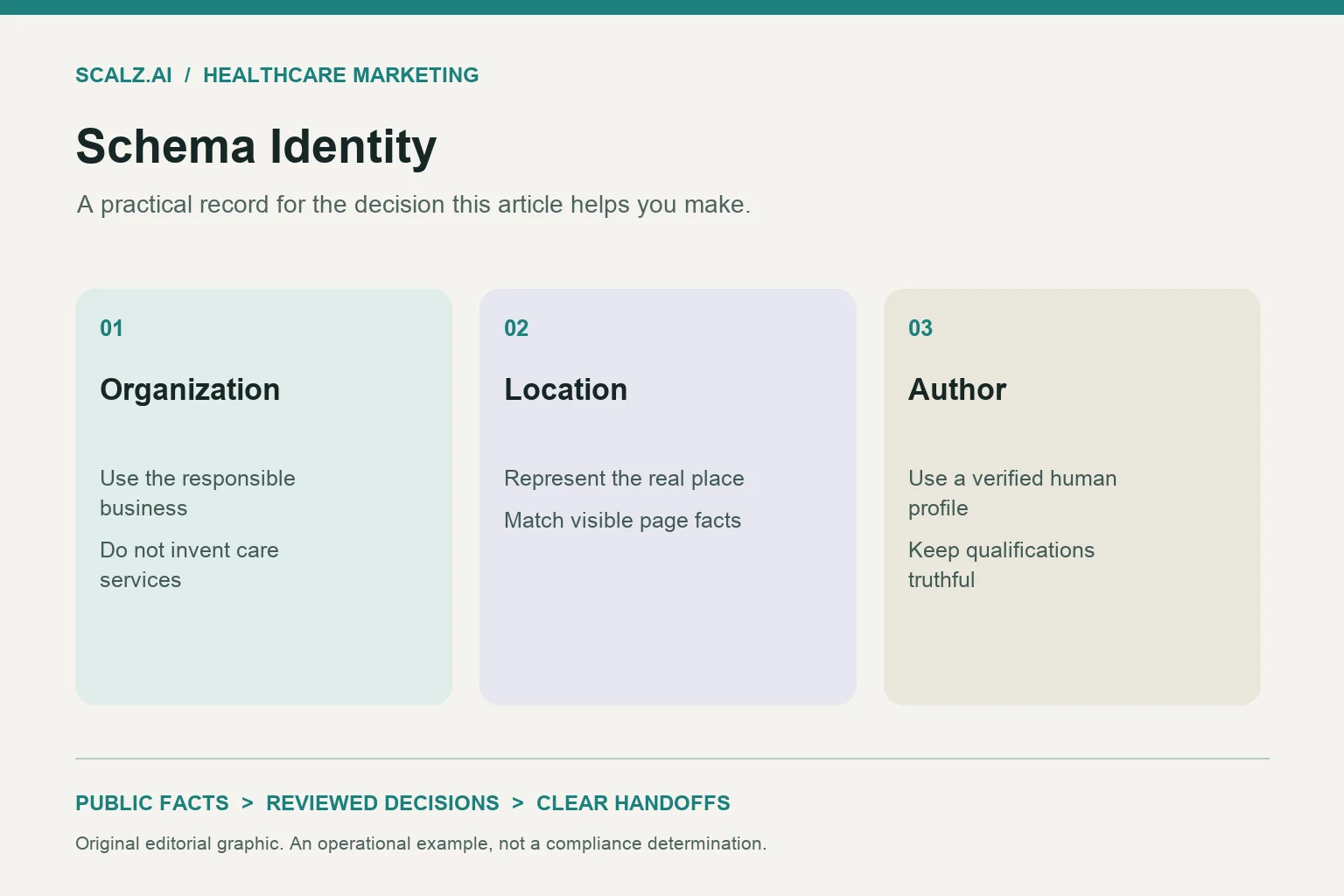
For AI SEO for addiction treatment, identify the article’s publisher, actual author and subject before choosing structured data identities. A SCALZ.AI marketing support article should represent SCALZ.AI as its publisher when the approved publishing record confirms that role. It should not represent the agency as a treatment provider simply because the article discusses treatment marketing.
Start with one short identity brief that separates organizations, physical locations and people. Include only identities needed to describe the page, and connect each one to an approved public record. The decisions below give a marketing editor a practical way to prepare that brief without writing code.
AI SEO for addiction treatment starts with separate identities
Separate the organization publishing the article from any organization discussed within it. The addiction treatment SEO service establishes the industry context, while AI SEO services describe the marketing work. Neither relationship makes the agency a care provider.
An article has several distinct roles: someone publishes it, someone writes it, and it covers a subject. A physical facility enters the picture only when its identity matters to the article. Treat these roles as separate choices rather than copying every entity from a sitewide template.
For this support article, the subject is a marketing decision about structured data identities. Addiction treatment is the industry context, not evidence that a named facility supplies care at the publisher’s address. No specific facility identity is needed merely to explain the decision process.
- Record the publisher as the organization responsible for publishing this article.
- Record the author only after the editorial assignment confirms the contributor’s identity.
- Include a provider organization only when a real provider is substantively discussed and its public record is approved.
- Include a physical location only when the page needs to identify that particular place.
A useful opening record reads: “Page purpose: B2B marketing support. Publisher: approved agency organization. Author: assigned contributor. Named facility: none.” That plain description gives the implementer a clear starting point and prevents an industry keyword from becoming a false business identity.
Assign the publisher according to editorial responsibility
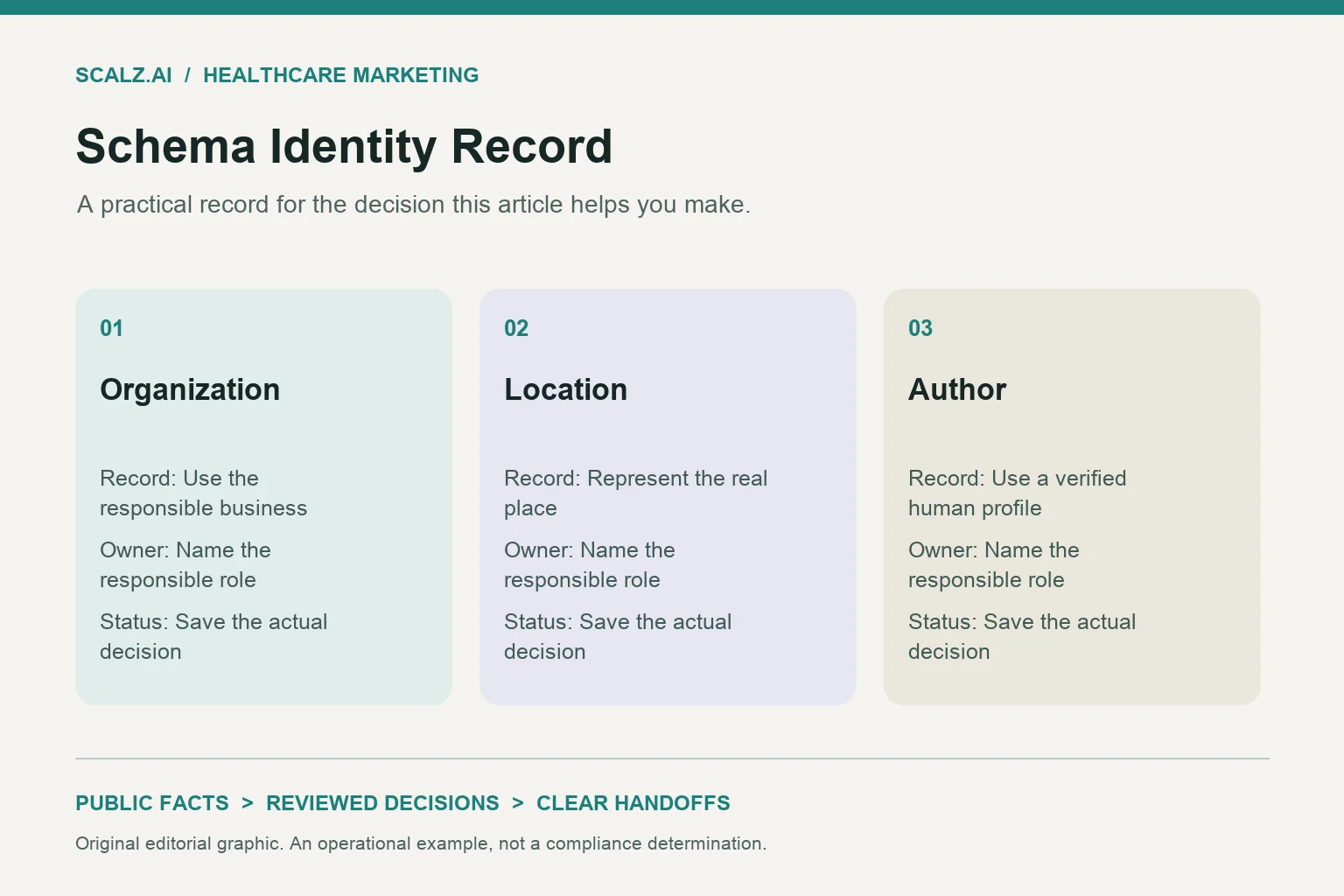
Choose the publisher from the article’s actual publishing arrangement. Domain ownership, agency involvement and facility ownership can point to different organizations, so the editor should resolve the role before handing over the article.
Consider a proposed article written by an agency contributor for publication on a facility’s website. The facility organization may be the publisher even though an agency prepared the draft. The contributor’s authorship and the agency’s service relationship should remain separate from that publishing role.
For an article published on the agency’s own website, use the approved agency publishing identity. A facility mentioned as an example does not replace the publisher. The same distinction applies when a parent company manages several facility websites but individual brands publish their own content.
- Save the approved publisher name and its existing public identity reference.
- State which organization takes responsibility for publishing the page.
- Describe an agency contribution separately when that relationship is relevant and approved for public display.
- Leave the publisher choice pending when the brand and editorial responsibility records conflict.
Use a short decision note: “The facility brand publishes this article; the agency supports content preparation.” For an agency article, reverse the roles only when the actual arrangement supports doing so.
Do not resolve uncertainty by assigning both organizations as interchangeable publishers. Ask the content owner to confirm the arrangement, then use that answer consistently in the visible publishing information and the implementation brief.
Resolve parent companies, public brands and facility names
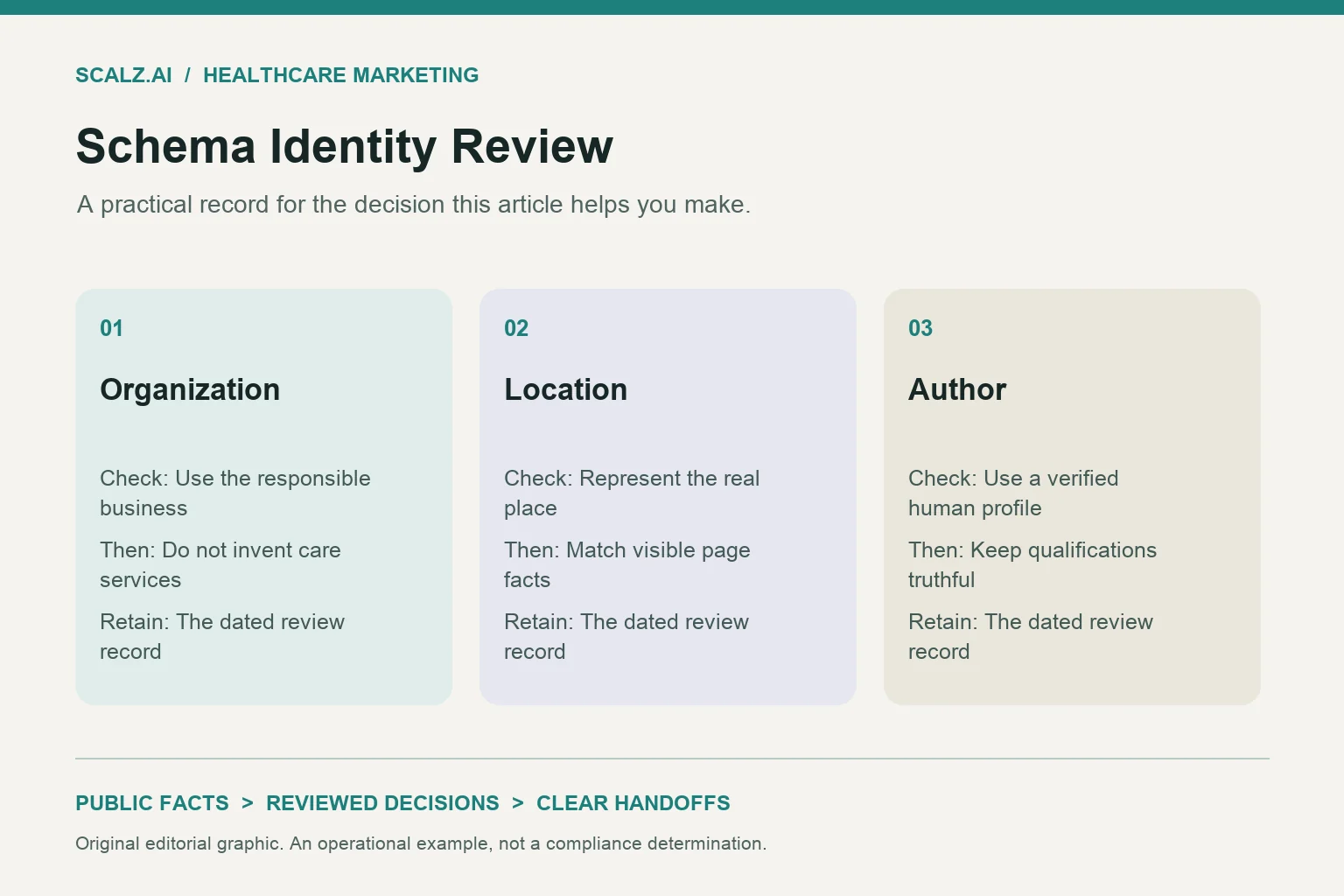
Select the organization name readers can recognize and the approved records can support. Keep a parent company, a public brand and a facility branch distinct when they represent different things. Shared ownership does not make their names interchangeable.
A proposed organization record can hold an approved public name, a legal name where appropriate, and documented former names. The editor should identify which name appears on the article’s publishing surface. Do not turn every spelling variation or shortened name into another organization.
Suppose an approved facility directory distinguishes a parent organization from two public facility brands. An article published by one brand should not automatically inherit the other brand’s name, address or services. Use the parent relationship only when the directory explicitly confirms it and the page needs it.
- Use the approved public brand name for the identity readers encounter on the page.
- Keep legal names in the organization record rather than substituting them without explanation.
- Treat a former name as historical information after the owner confirms its status.
- Record parent and branch relationships only when an approved organization record supports them.
A reusable name note might read: “Public name: approved brand name. Parent: confirmed in organization directory. Former name: retained for historical reference.” It should also identify the owner responsible for resolving future name changes.
If two records disagree, preserve the disagreement as an open editorial decision. A logo file, old footer or search snippet should not silently override the current approved organization record.
Include a location only when the article identifies a real place
A location represents a particular place, not the whole organization or the article’s geographic audience. A support article about marketing operations can discuss local search without identifying a specific facility location. Leave location identities out when they add no necessary meaning.
For a proposed facility article about one branch, use that branch’s approved public location record. Its address, public name and contact details belong to that location. A parent office or agency office should not be substituted because its record happens to be easier to find.
City names in a keyword plan do not establish physical premises. Likewise, a service area describes geographic coverage and should not be treated as an additional street address. Keep both distinctions clear before the implementer selects any location representation.
- Attach a location only when the article substantively concerns that verified place.
- Take public address and contact details from the approved location record.
- Keep administrative offices separate from care locations when the records distinguish them.
- Avoid creating a location identity for every city mentioned in a marketing brief.
The location decision can be one sentence: “No location identity is needed because this article explains a general editorial operation.” For a branch article, replace that sentence with the approved location reference and a reason for including it.
When one article covers multiple branches, name the relevant locations distinctly in the content. Do not create a composite facility by combining one branch’s address with another branch’s telephone number or program labels.
Connect authorship to the actual contributor
Use the verified contributor who wrote the article, with a public profile that accurately describes that person’s role. An author identity should help readers understand who contributed the work. It should not manufacture clinical authority for a marketing operations article.
An editor, subject contributor and reviewer may perform different tasks. Keep those assignments distinct in the editorial record instead of attaching a prominent employee’s name to every post. A review assignment also needs a defined scope, such as checking organization names or marketing terminology.
Use the approved public attribution record for this article’s author and editorial responsibility. The content handoff should reference that record without inventing a byline. The author’s description should reflect documented marketing expertise where available. Employment at a healthcare organization does not establish a clinical credential.
- Confirm the actual writing contribution before assigning an individual author.
- Use the contributor’s approved public name and profile reference.
- Include qualifications only when the person’s current record verifies them.
- Record a reviewer’s task separately from the author’s contribution.
A proposed author assignment note reads: “Contributor: verified author record. Contribution: article drafting. Reviewer: assigned editor. Review scope: organization and location identity choices.” The team can reuse this format without implying a clinical review occurred.
If the organization genuinely publishes under a team identity, document that editorial practice before using it. Do not create a fictional person to satisfy a template field, and do not borrow a staff biography merely because it already exists.
Keep article topics separate from service and provider identities
Describe what the article covers without turning each topic into a business or service claim. The broader AEO for rehabs overview addresses answer engine optimization; this article’s narrower task is choosing who and what the page represents.
An article may mention program terms because healthcare marketers use them to organize content. Those terms do not establish that the publisher offers those programs. A discussion of location pages also does not establish that the agency operates the locations being discussed.
For a proposed facility article, include service descriptions only when the facility’s approved records support them. Keep the description attached to the correct provider and location. A parent organization’s broader portfolio is not sufficient support for an individual branch’s service claim.
- Record the article’s main subject as an editorial topic.
- Treat program terms as marketing labels unless verified facility information supports a specific service description.
- Keep the agency’s marketing services distinct from a provider’s care services.
- Omit provider relationships that the article does not need to explain its subject.
Use a topic note such as: “Subject: public identity selection for marketing content. Industry context: addiction treatment. Specific provider services: none asserted.” This gives the implementer a useful boundary without requiring additional entities.
A general industry article can still link to relevant marketing services. The destination and surrounding language should make the commercial relationship clear rather than suggesting the marketing agency accepts treatment inquiries.
Reuse approved identities instead of inventing article-specific ones
Reuse the existing approved organization and author records when they describe the same real entities. The related schema markup and AI citations article covers a separate visibility topic. Here, the immediate decision is whether a record represents the correct identity.
Create one reusable identity card for each organization, location or person that the content operation actually needs. Keep its internal reference stable while allowing approved public details to change. A new article should refer to that identity card rather than create another slightly different version.
Structured data for Google Search must represent visible page content accurately; enhanced search display is not guaranteed.
- Give each identity card a unique internal reference and a plain description of the entity.
- Store the approved public name, public page reference and record owner.
- Keep organization, location and person cards separate even when their names overlap.
- Record confirmed relationships between cards rather than merging their details.
For a renamed brand, first determine whether the same organization continues under a new public name. A new logo alone does not answer that question. The responsible organization owner should settle continuity before the editor replaces or creates an identity card.
For an author who changes employers, preserve the person’s identity while updating the relevant approved biography details. Do not keep an outdated affiliation on new articles simply because earlier content used it.
Hand over a concise identity brief before implementation
Give the implementer explicit identity choices and the reasons behind them. The schema regression testing guide covers checks after implementation and changes. This brief settles the editorial identity decisions that those later checks depend on.
Use a compact record with the page purpose, selected publisher, assigned author, included locations and relevant subjects. Add a reference to each approved identity card and state which relationships the article needs. This is a content decision document, not a request for extra markup.
The same brief should name unresolved items and the role responsible for closing them. If the facility identity remains uncertain but the article is general marketing guidance, remove the unnecessary facility reference. If that identity is essential to the article, hold the affected content until it is resolved.
- Write the page purpose in one sentence that defines the intended B2B reader task.
- List the selected identities with their approved record references.
- State why each location or provider relationship belongs on this particular page.
- Mark unresolved names, affiliations and ownership relationships as pending.
- Assign each pending decision to the person who owns the relevant business record.
A proposed brief for this article would select the approved SCALZ.AI publisher record and the approved public attribution record. It would include no specific treatment provider or facility location. Its subject would remain the marketing operation of selecting accurate public identities.
No special schema markup is required for Google AI search features. Finish the identity choices before considering optional additions.
Three common identity decisions, answered
Should a marketing agency article use a treatment provider identity?
Use a treatment provider identity only when the article represents a verified provider in a relevant, clearly defined role. An industry keyword does not justify assigning that identity to the agency. A general SCALZ.AI support article can explain facility marketing without including any particular provider organization.
Can one organization identity represent every branch?
One organization identity can represent a shared organization, but it should not erase meaningful differences between physical branches. Keep branch locations distinct when the article discusses their individual names, addresses or approved services. Include only the branches relevant to the page rather than attaching the entire directory to every article.
What should happen when an author profile is incomplete?
Complete the approved profile details needed to identify the actual contributor, or leave unsupported optional details out. An incomplete biography does not justify inventing qualifications or assigning another person’s identity. If authorship itself is unresolved, return the assignment to the editorial owner before finalizing the article record.
- Keep the agency, provider and location choices separate in the final brief.
- Reuse confirmed records and resolve essential conflicts with their owners.
- Assign authorship from the real contribution and approved public profile.
For help turning these choices into a custom content operation, contact SCALZ.AI or call 407-954-8800. Bring the intended publishing site, approved organization names and existing author records so the discussion can focus on concrete decisions.
Call 407-954-8800 to talk through next steps.