

Resolve Location Facts In AI SEO For Addiction Treatment
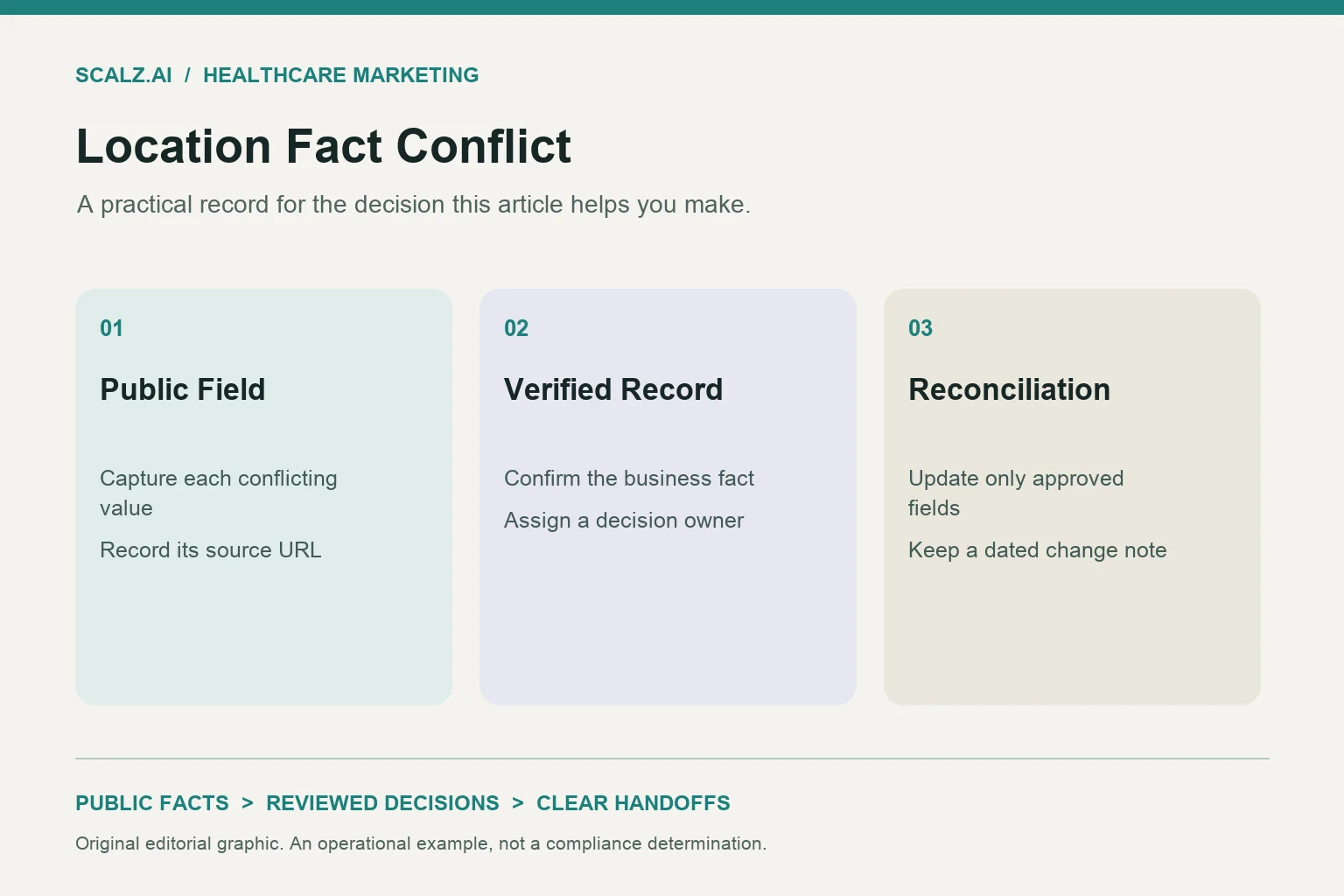
Resolve conflicting location facts by confirming the approved value for each disputed field, then correcting the service page, contact page and business listing against that record. For AI SEO for addiction treatment, the controlling value comes from a current, verified facility record approved by its responsible owner. It does not come from whichever public page was updated last.
When the location has not moved, treat the work as a correction with a defined scope. Keep the existing location identity and separate factual errors from legitimate differences, such as contact hours and program schedules.
Choose The Controlling Record For AI SEO for addiction treatment
Start with one location and the three conflicting surfaces. Connect the work to your addiction treatment SEO program and AI SEO service scope, but assign factual approval to the facility team responsible for each field.
No single document must control every fact. A verified facilities record may control the public entrance address, while an approved communications record controls the public phone number. An approved program inventory controls which service labels belong to that location.
Use a field-specific decision rule: the record must identify the same location, cover the disputed fact and have current owner approval. A recent website edit cannot override a verified facility record merely because its timestamp is newer. If two internal records disagree, pause that field and obtain a resolved value before drafting its replacement.
- Assign the public address and entrance description to a named facilities or operations owner.
- Assign the public phone and contact hours to the person responsible for those communications.
- Assign location-specific program labels to the owner of the verified service inventory.
- Assign the displayed business name to the approved brand record for that location.
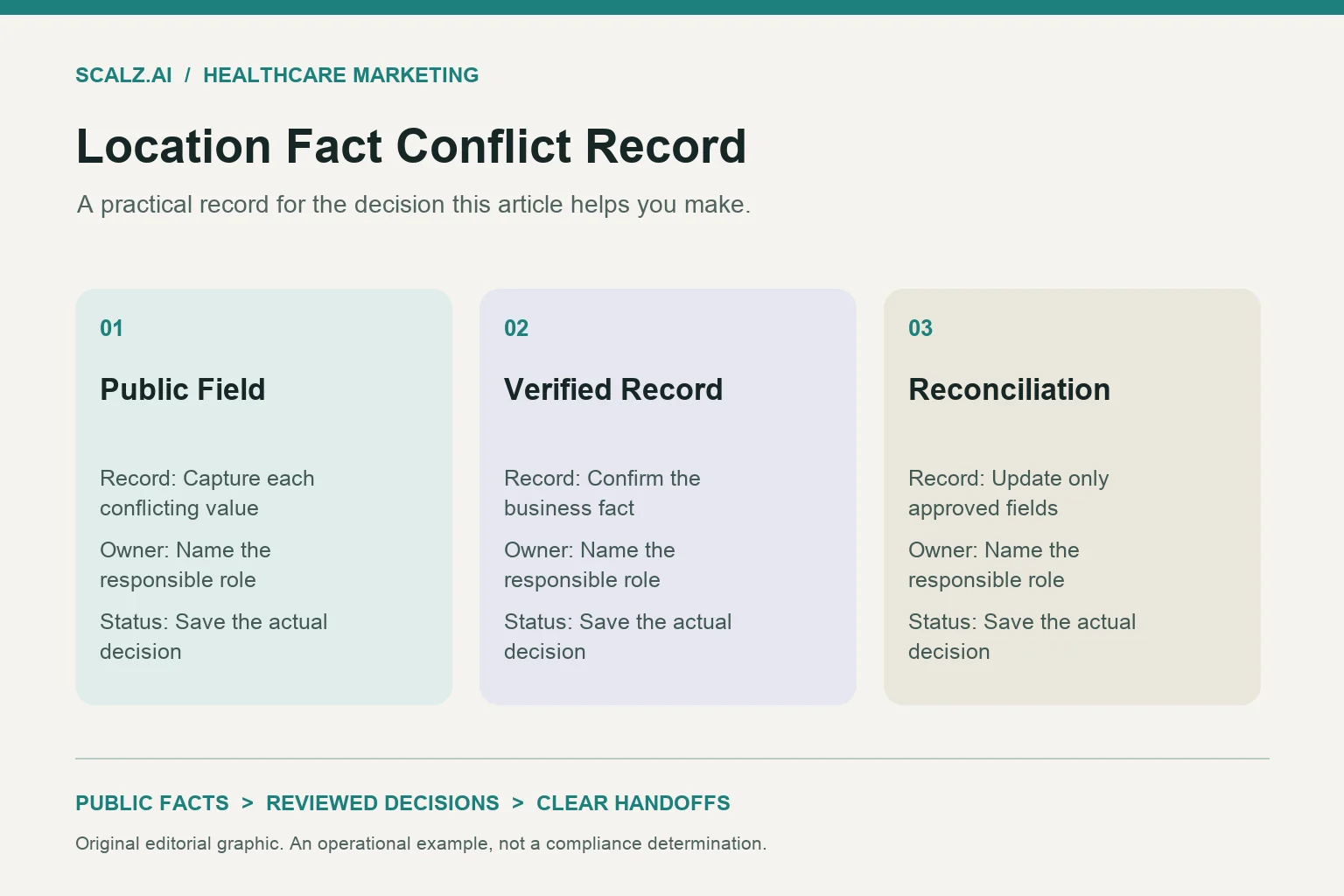
Record the document title, version, approval date and responsible owner in the correction ticket. Link to the approved internal record through your normal workspace permissions. The ticket needs a usable reference, not copied private operational material.
Compare Values Only After Defining Their Meaning
Before replacing text, determine whether the three surfaces are making the same claim. The broader citation inconsistency workflow covers public listing accuracy; this task isolates contradictions among one service page, one contact page and one listing.
A service page may display the facility address while the contact page displays a correspondence address. Both values could be approved, yet unclear labels make them look contradictory. Resolve the meaning first, then decide whether the value, label or both require a change.
Capture the exact visible wording and its surrounding label. Include the page heading or listing field where it appears. A copied number without context cannot show whether it represents a main contact line, a department line or an approved tracking number.
- Classify each address as a physical facility address, correspondence address or another verified purpose.
- Classify each hours statement by what it describes, such as staffed phone hours or public office hours.
- Classify each phone by its approved public function before deciding that different numbers conflict.
- Classify each service label by its location assignment rather than the brand's overall offering.
Use three dispositions: confirmed contradiction, valid difference needing clearer labels, or unresolved fact. This prevents a blanket replacement from removing useful distinctions. It also gives the editor a precise task instead of a vague instruction to make everything match.
Break Compound Claims Into Separate Decisions
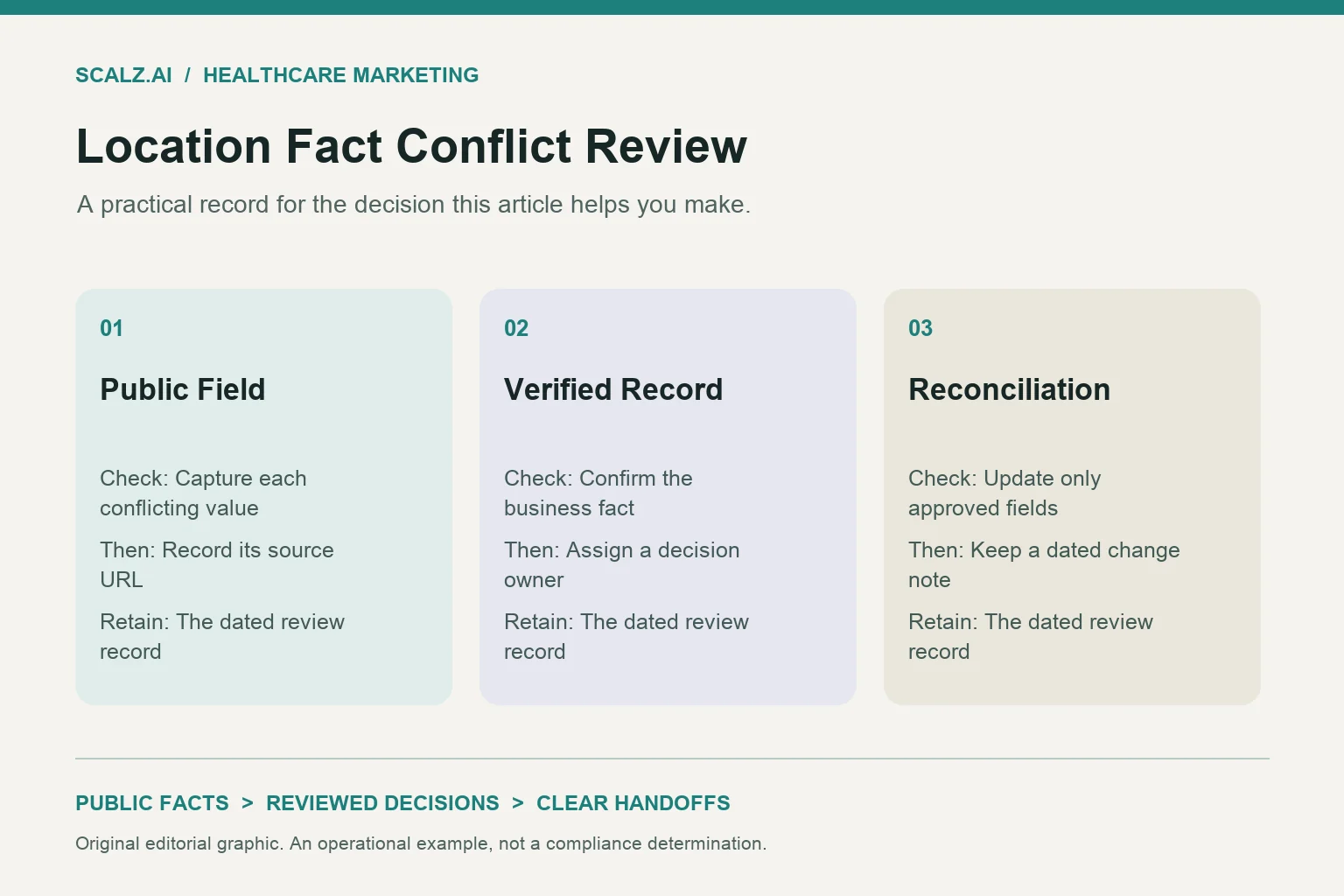
Read each location sentence as several editable claims. A sentence combining a business name, address, hours and service label can be partly correct. The correction ticket should preserve its approved parts while isolating the disputed ones.
For a proposed example, suppose a service page combines a facility address with the brand's central contact hours. The contact page labels those hours correctly, while the listing presents different public hours. The editor should separate address approval, phone availability and listing-hours meaning before changing any text.
Apply the same approach to location descriptions. A phrase naming a nearby city might describe the audience served rather than the physical location. Do not turn that phrase into an address claim or create a new local facility page to make it appear consistent.
- Separate street address, unit, locality and postal code so a unit correction does not trigger an unnecessary address rewrite.
- Separate a program's marketing label from the claim that the program operates at this specific location.
- Separate a contact-hours statement from any statement about the facility's operating schedule.
- Separate the displayed phone number from its destination and approved tracking function.
Keep an explicit unchanged-fields note in the ticket. For example, record that the location identity, approved street address and existing page URL remain unchanged while the unit field awaits approval. That note limits the patch and helps reviewers catch accidental expansion.
Use A Worked Reconciliation Packet For The Three Surfaces
Consider a proposed editorial exercise: the service page omits a verified unit, the contact page shows the approved address, and the business listing contains a different unit. The facility has not moved. The approved facilities record controls the unit correction; public agreement alone does not decide it.
The service-page action is to add the approved unit wherever that address is maintained. The contact-page action is to retain its correct value and verify any shared address component. The listing action is to request the approved unit and record the submission separately from its public appearance.
Keep one record per disputed field, with separate outcomes for each surface. This makes it possible to close the website correction while leaving the listing update pending. It also prevents a submitted edit from being reported as a completed reconciliation.
- Field decision: Record the location ID, disputed field, approved value, controlling record, approver and reason for choosing that value.
- Surface comparison: Record the service-page value, contact-page value and listing value exactly as observed, with a dated capture reference.
- Edit instruction: Specify the old text, replacement text, component or field affected, and fields that must remain unchanged.
- Completion state: Record website verification, listing submission status, public listing verification and any remaining blocker separately.
Add a plain-language resolution sentence: “The unit differs across public surfaces; the approved facilities record controls; the physical location is unchanged.” This proposed wording explains the correction without suggesting a move. For an actual relocation, use the separate treatment center address migration checklist instead.
Write Replacement Copy That Preserves Useful Distinctions
Draft exact replacement text after the field decisions are approved. Give reviewers the current wording beside the proposed wording in the ticket. Avoid requests such as “clean up location details,” which leave the editor to decide facts during implementation.
For an approved correspondence address, a proposed label could read “Mailing address,” with the verified value below it. For an approved facility address, use a distinct label that accurately describes its purpose. Do not add directions, entrance instructions or visitor availability unless those details are also verified.
Hours deserve equally careful labels. If the approved record describes staffed phone hours, the copy should say so. A shorter label such as “Hours” can accidentally turn a communications fact into a broader claim about the facility.
- Use the facility's approved public name without adding city keywords or unsupported service descriptors.
- Place the approved location statement beside the relevant contact or service information so readers can interpret it without searching another page.
- Remove an unverified location-specific service claim from the replacement draft and route it for approval rather than substituting a likely offering.
- Keep working contact links and their approved destinations intact while correcting surrounding text.
The service page can describe a verified offering in more detail than the contact page. Consistency means those pages agree on shared facts, not that they repeat identical paragraphs. Clear labels make the differences useful to readers and easier to interpret in search answers.
Patch The Publishing Source Behind Each Public Value
Find where each public value is maintained before editing the page. The visible service-page address may come from a shared location record, while the contact-page address comes from a separate editor field. Correcting one rendered paragraph can leave the underlying conflict active.
Trace only the components relevant to the approved correction. Check the visible address block, shared contact component, map destination and location markup when they contain the disputed field. Do not use a unit correction as a reason to rewrite unrelated SEO settings.
Correct location values in structured data describing the page alongside the visible facts they represent.
- Update the approved location data source first when multiple page components depend on it.
- Inspect page-specific overrides that could continue displaying the old value after the shared record changes.
- Compare the relevant structured data fields with the corrected visible location statement.
- Preserve page URLs, canonical settings, indexing directives and working contact paths unless a separately approved task changes them.
Give the listing owner the same field decision and exact requested value. Keep its submission receipt in the ticket without treating it as public confirmation. If the platform rejects or modifies the request, record the response and route it back to the responsible owner.
Include a rollback note naming the changed source fields or components. If the patch introduces a display or contact-link fault, the team can restore those changes while preserving the approved factual decision for a corrected release.
Verify The Correction At Its Actual Point Of Use
Verification should test what each surface now communicates. Open the public service page and contact page after release, then inspect the public listing independently of its management screen. Record the observed value and check time for each.
Check desktop and mobile presentations where different components appear. An expanded desktop footer may show the corrected address while a mobile contact drawer still uses an old override. Verification should follow those specific components rather than stop at a single page screenshot.
For proposed phone verification, inspect the approved click-to-call destination and confirm routing through the facility's established internal test process. A displayed number can be correct while its link points elsewhere. Different approved tracking numbers need routing confirmation, not automatic replacement with one number.
- Confirm that the corrected field appears with its intended label on both owned pages.
- Confirm that address links or map buttons still point to the approved facility destination.
- Confirm that relevant markup no longer contains the superseded value.
- Record the listing as pending until its public field displays the accepted correction.
If an AI answer still shows the old fact, save the exact prompt, engine, date and any cited page for that observation. Check the cited owned page for remaining conflicts before opening another edit. A stale answer alone does not justify changing an already verified value.
Ordinary SEO foundations apply to Google AI features; special AI markup is not required for inclusion.
Close The Conflict Without Inventing A Ranking Result
Close the ticket when the agreed surfaces pass their field checks, or document the specific surface still pending. The proximity and prominence guide addresses map-ranking interpretation. A location-fact correction has a narrower completion test.
A useful closure note states which contradiction was resolved, which approved record controlled it and which public surfaces were checked. It can report that the contact path remains functional or that a listing update is still awaiting public confirmation. It should not claim that the correction caused rankings, citations or inquiries to improve.
- Mark a field resolved only after all required public surfaces show the approved value or approved distinction.
- Mark a field partially resolved when owned pages are correct but the listing remains pending.
- Mark a field blocked when internal owners have not settled the controlling value.
- Reopen the same ticket if the superseded value returns, preserving the earlier edit and verification history.
Assign the next check to a named owner and a specific date suited to the pending item. Avoid creating a broad recurring audit merely to finish one correction. The handoff should identify the exact field, remaining surface and condition that will allow closure.
Keep visibility observations in a separate reporting record. That separation lets marketers assess SEO and AI search performance without confusing a factual publishing task with proof of marketing impact.
Frequently Asked Questions About Unchanged Location Facts
Should The Contact Page Automatically Override The Service Page?
No. The contact page is another published surface, not automatic authority over the facility's facts. Its value should control only when the responsible owner confirms it against the current approved record for that field.
Can AI Choose The Correct Address From Several Public Versions?
AI can organize the differences for an editor, but the facility owner must approve the controlling value. Give the tool approved public facts and a bounded comparison task; require it to mark unresolved differences rather than infer a unit, entrance or location assignment.
Does Correcting A Unit Number Require A New Location Page?
A unit correction at an unchanged location generally belongs on the existing page when its purpose and location identity remain the same. Document any proposed URL change as a separate decision with its own reason and review, rather than bundling it into the fact correction.
For a done-for-you review, ask SCALZ.AI to scope the three surfaces, disputed fields and required facility approvals through the contact page or call 407-954-8800. Start with the conflict you need resolved and the verified record that should control it.
Call 407-954-8800 to talk through next steps.