

A First-Week Brief For AI SEO For Addiction Treatment
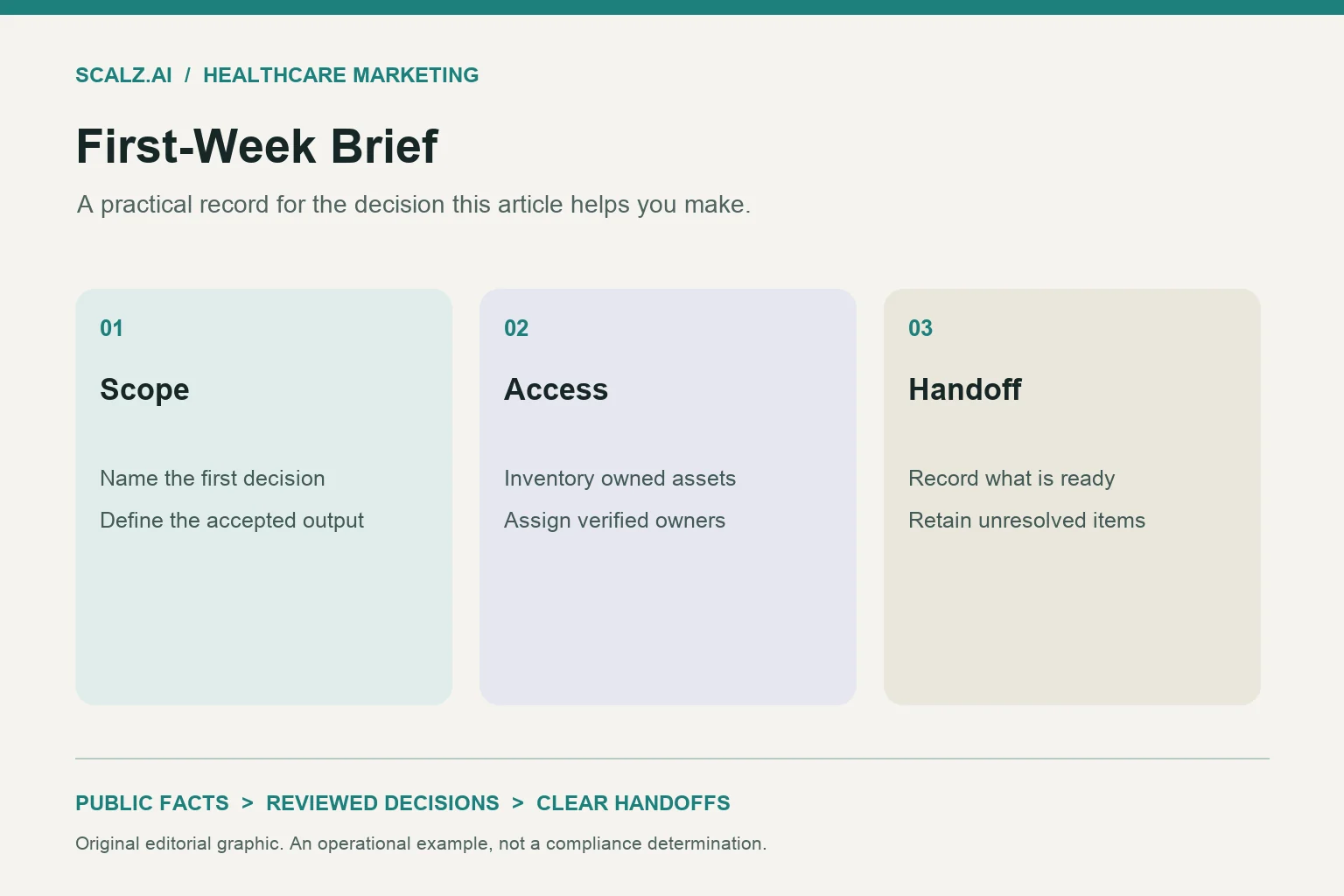
An approved AI SEO for addiction treatment project needs a first-week readiness brief that names the exact site, permitted decisions, access owners, fact records, and accepted outputs. By the end of that week, the sponsor should be able to authorize a defined implementation assignment or identify the dependency preventing it. Signing an engagement alone does not settle those details.
Use one short brief with linked supporting records. The useful result is a shared, accepted starting point: everyone knows what they can inspect, what they can propose, who decides, and what must be delivered before site changes begin.
Define The First-Week Result For AI SEO for addiction treatment
A useful first-week result is an accepted readiness package for the approved engagement. Connect its purpose to addiction treatment SEO and the agreed AI SEO service scope, then name the specific decisions this week must settle.
Start with a completion sentence that the sponsor can approve. For example: “The project is ready when the named team can access the approved environments, locate current facility facts, and submit implementation proposals through the agreed approval route.” This is a proposed operating example, not a description of any facility.
The package should help someone take responsibility for the next assignment without reopening the kickoff discussion. It should distinguish an accepted document from an accepted change to the website. Approval of the brief authorizes only the work explicitly described within it.
- The readiness brief names the project sponsor, site identity, included properties, and first-week completion conditions.
- The access record shows which approved environments are usable and which remain unavailable.
- The decision record identifies who can accept proposals and who can authorize public changes.
- The output list states what each deliverable must contain before the sponsor accepts it.
A finished slide deck is insufficient if the developer still cannot identify the correct staging site. Equally, working access does not make the project ready when nobody owns disputed facility wording. Judge completion by whether the next person can act within clear boundaries.
Turn The Approved Scope Into Exact Decision Rights
Translate the agreement into permitted actions rather than repeating its service descriptions. The AEO guide for rehabs explains the broader discipline; the first-week brief should resolve who may make which project decisions.
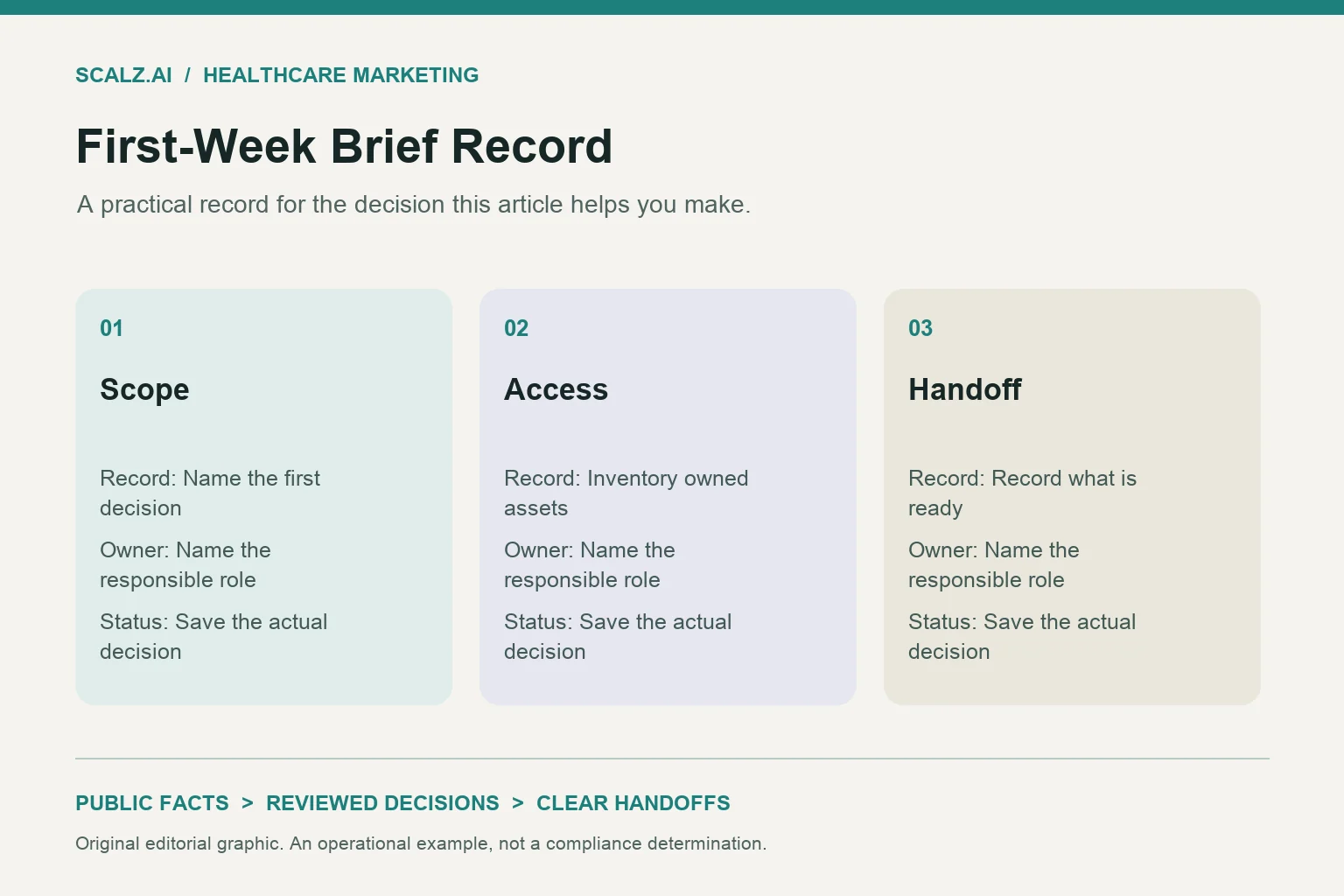
Use four action categories: inspect, propose, approve, and release. Assign each category to named people and specific environments. “The agency manages SEO” is too broad to determine whether someone may edit a live title, change a template, or publish a page.
For a proposed preparation-only week, the team might inspect public pages, confirm staging access, and assemble recommendations. The sponsor could accept readiness documents while reserving public changes for a separate release decision. Write that boundary beside the assignment so it survives a handoff.
- State whether inspection covers the public site, staging, selected reporting views, or a defined combination.
- Allow proposals only for the page set and work categories included in the approved engagement.
- Name the person who accepts marketing wording and the person who confirms facility facts.
- Require a separate release decision for public edits unless the approved scope explicitly includes them.
Add one boundary example: “The editor may propose revised wording for the selected location page; acceptance of that proposal does not authorize publishing.” Also name the person who decides whether an unexpected request expands the scope.
If someone requests a new facility section during kickoff, record it as a proposed scope change. Assign an owner and a decision date, then continue the original readiness work wherever that addition creates no dependency.
Make Site Access A Usable Record
The access record should tell the team where authorized work can happen and who resolves missing access. Keep it separate from the addiction treatment website audit procedure, which addresses checks performed after the relevant permissions exist.
Record the exact production domain, staging address, content system, and included site properties. Distinguish the public site from a development copy and identify the person responsible for each environment. Similar project names should never substitute for exact site identity.
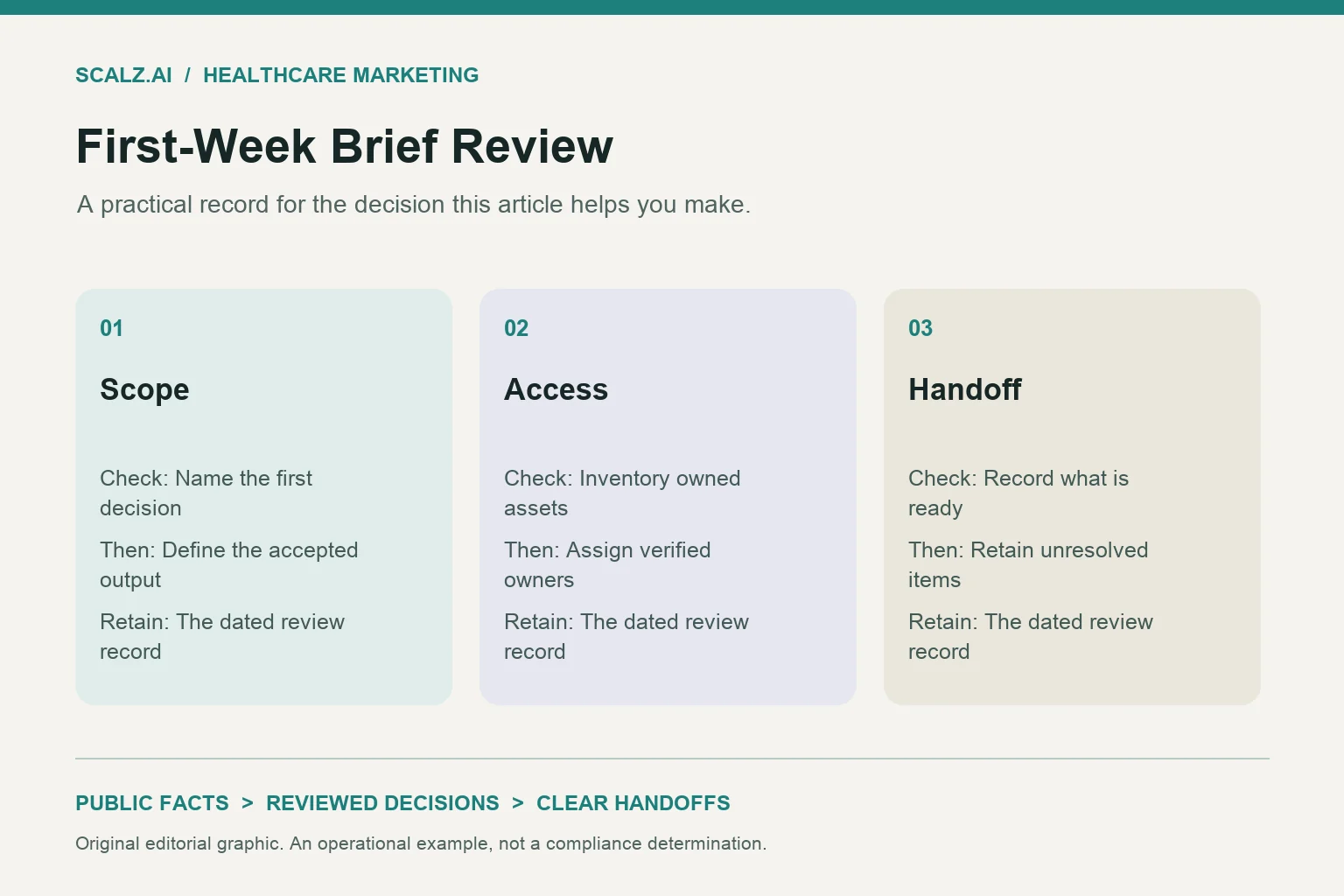
For each approved system, record the intended user, required role, access owner, current status, and confirmation date. Keep the record limited to access administration; passwords, tokens, and other credentials do not belong in the brief. Use the organization's established invitation process.
- Confirm that the assigned editor can open the intended content area with the approved role.
- Confirm that the technical owner can identify the correct staging environment and deployment controller.
- Confirm access to authorized reporting views without requiring admissions records or patient-level exports.
- Give each unavailable system a resolution owner and a dated follow-up action.
A proposed entry might read: “Staging content access is pending; the website administrator owns the invitation; readiness acceptance remains conditional for staging-dependent work.” That entry explains the consequence without exposing account details.
Use precise states such as requested, available, confirmed, and blocked. “Available” means an invitation exists; “confirmed” means the assigned person has successfully opened the intended resource. If access remains blocked, identify which output cannot be completed and which preparation can continue.
Assign Owners Who Can Close Decisions
Every required output needs one delivery owner and one acceptance owner. Role descriptions help organize the brief, but named people make it usable when a decision is due. A shared department label alone leaves nobody clearly responsible for closing the item.
The sponsor accepts the readiness package and resolves scope changes. The marketing lead owns editorial direction within approved facts. The website owner confirms environment and release responsibilities, while the designated facility fact owner confirms operational statements intended for public use.
These roles can overlap in a small team. Record each person's responsibilities separately so a single name does not hide several different approval functions. Where specialist review is needed, the brief should identify the appropriate reviewer and the material requiring that review.
- Give the delivery owner responsibility for assembling the output and resolving missing inputs.
- Give the acceptance owner authority to accept, return, or hold that output.
- Name a backup decision-maker only when that person has the required authority.
- Set a response date and an escalation route for decisions that remain unresolved.
For example, an editor might deliver the fact-source index while a facility operations owner accepts its service entries. The project sponsor then accepts the package as a whole. Those are separate decisions, even if they occur in the same meeting.
Record silence as pending rather than approved. If a decision-maker is unavailable, the sponsor can reassign the decision, adjust the acceptance date, or hold the affected work. The team should not infer permission from a calendar deadline.
Identify The Facility Records Editors May Use
The first week should establish where verified facility facts live and who maintains them. This supplies the factual starting point for later assignments, including an SEO content brief, without turning the readiness package into a writing assignment.
Create a compact index of approved records, their owners, and their last confirmation dates. Include only the facts relevant to the agreed site scope. A service label on an old page does not establish that the service belongs in a new page or search description.
Proposed record categories include public facility identity, addresses, contact details, approved program labels, and accepted descriptions of the admissions contact process. Specific program terms function here as marketing labels. Their use must follow verified facility records rather than an editor's assumptions.
- Identify the approved record for each location's public name, address, and phone number.
- Name the record owner who can confirm whether a program label is current.
- Distinguish approved wording from draft wording and superseded material.
- Mark unresolved conflicts as unavailable for public use until the responsible owner settles them.
Consider a proposed conflict: a location page lists a program that the current facility record does not include. The readiness brief should name the conflict owner and hold that wording for a decision. It should not instruct the editor to choose whichever version looks more complete.
Acceptance means the team knows which record governs each relevant fact category. It does not require rewriting the whole site during the first week. Missing facts become specific dependencies attached to the affected future assignment.
Specify Outputs The Sponsor Can Actually Accept
Define each deliverable by its required contents, owner, and acceptance condition. Avoid labels such as “strategy complete” or “AI readiness done,” which provide no clear basis for deciding whether the promised preparation exists.
The package should contain a scope boundary, access record, owner map, fact-source index, dependency list, and final readiness decision. These can be sections in one document rather than six separate files. Choose a format the client team can maintain and review without special software.
For SEO and AI search, keep the agreed work grounded in ordinary site responsibilities. Established SEO practices for Google AI features remain relevant; no special schema is required.
- Accept the scope boundary when every included property and permitted action is explicit.
- Accept the access record when required resources have confirmed states and missing access has an owner.
- Accept the owner map when delivery, factual review, acceptance, and release responsibilities are assigned.
- Accept the dependency list when each open item names the affected output and the decision needed.
- Accept the final readiness decision when it specifies which next assignment may begin.
Write a return condition beside each acceptance condition. For example: “Return the owner map if publishing authority is assigned only to ‘the team.’” This helps the delivery owner correct a concrete defect instead of guessing what the sponsor disliked.
Acceptance comments should describe whether the output meets its stated conditions. Record additional requests separately, with their scope effect. A new request may be useful, but it should not silently change the meaning of an already agreed deliverable.
Use The Week To Resolve Dependencies In Order
Sequence the week around decisions that unlock later preparation. A suggested schedule can guide coordination, but it should remain flexible when an owner or required record is unavailable. Completing every meeting matters less than producing accepted outputs.
Begin by confirming site identity, scope, and decision rights. Next establish access and record ownership, then assemble the supporting material. Finish by resolving acceptance comments and deciding whether the first implementation assignment can begin.
Use the following proposed cadence as a starting point. It allocates preparation work without promising that a particular facility can complete every dependency on that schedule.
- On the first working day, confirm the sponsor, included properties, permitted actions, and completion conditions.
- On the second working day, confirm required access and assign owners to missing invitations or environments.
- On the third working day, assemble the fact-source index and attach unresolved questions to their owners.
- On the fourth working day, submit the package for acceptance and resolve specific return comments.
- On the fifth working day, record the readiness decision and hand off the authorized next assignment.
Suppose staging access is delayed but the approved facility records are available. The editor can complete the fact-source index while the website owner resolves access. The schedule changes only for the outputs that depend on staging.
Send a short status note that names completed outputs, blocked outputs, and decisions due next. Avoid reporting a percentage complete when the final unresolved item determines whether implementation can start. A small blocker can carry a large practical consequence.
Close The Week With A Decision And Handoff
End with one recorded decision: ready, ready for a limited assignment, or held. The choice should describe actual authority and remaining dependencies. “Good progress” may acknowledge effort, but it cannot tell the next owner what work may begin.
A ready decision means the required preparation has been accepted for the named next assignment. A limited decision allows a narrower piece of work while excluding the blocked portion. A held decision identifies the unresolved requirement preventing that assignment.
Use this reusable closing record in plain prose. Each field should be complete enough for a person outside the kickoff meetings to understand the decision.
- Project identity: Name the engagement, exact site, included properties, and brief version.
- Accepted outputs: List the accepted records, their acceptance owners, and acceptance dates.
- Readiness decision: State ready, limited, or held, followed by the reason.
- Authorized next assignment: Describe the permitted work, assigned owner, environment, and expected output.
- Open dependencies: Name each unresolved item, its owner, and the work it prevents.
- Release authority: Identify who must authorize any subsequent public change.
A proposed limited decision could authorize a staging-only draft for one selected page while holding live publication until facility wording is confirmed. It should explicitly exclude other pages and any production release. That gives the next owner a bounded assignment.
Keep the closing record with the accepted brief and supporting records. If the scope or decision authority changes, issue a revised version that identifies the change. This preserves a usable handoff without requiring the team to reconstruct decisions from message threads.
First-Week Brief FAQs
Does the first week need to produce published website changes?
No, the first week can finish successfully with accepted readiness outputs and a clear implementation authorization. Publication belongs in the completion conditions only when the approved engagement explicitly includes it. A staging draft or proposed edit should retain its own approval status rather than being counted as a live change.
Can work begin while one access request remains unresolved?
Yes, a limited assignment can begin when its own inputs and permissions are confirmed. Record the unavailable resource, the work it blocks, and the owner responsible for resolving it. For example, document preparation may continue while staging access remains pending, but the team should not label staging-dependent work ready.
What should the sponsor reject at the end of the week?
The sponsor should return a package that leaves a required action, owner, input, or acceptance condition unclear. Typical defects include an unnamed publishing approver, an unresolved site identity, or facility wording with no approved record. Specify the correction needed and the responsible owner so the return leads to a decision rather than another broad kickoff discussion.
If you want SCALZ.AI to prepare a custom first-week scope for a done-for-you engagement, request a project conversation or call 407-954-8800. Bring the approved project scope and the names of your site and facility fact owners so the discussion can focus on concrete readiness decisions.
Call 407-954-8800 to talk through next steps.