

Fix Duplicate Answers In AI SEO For Addiction Treatment
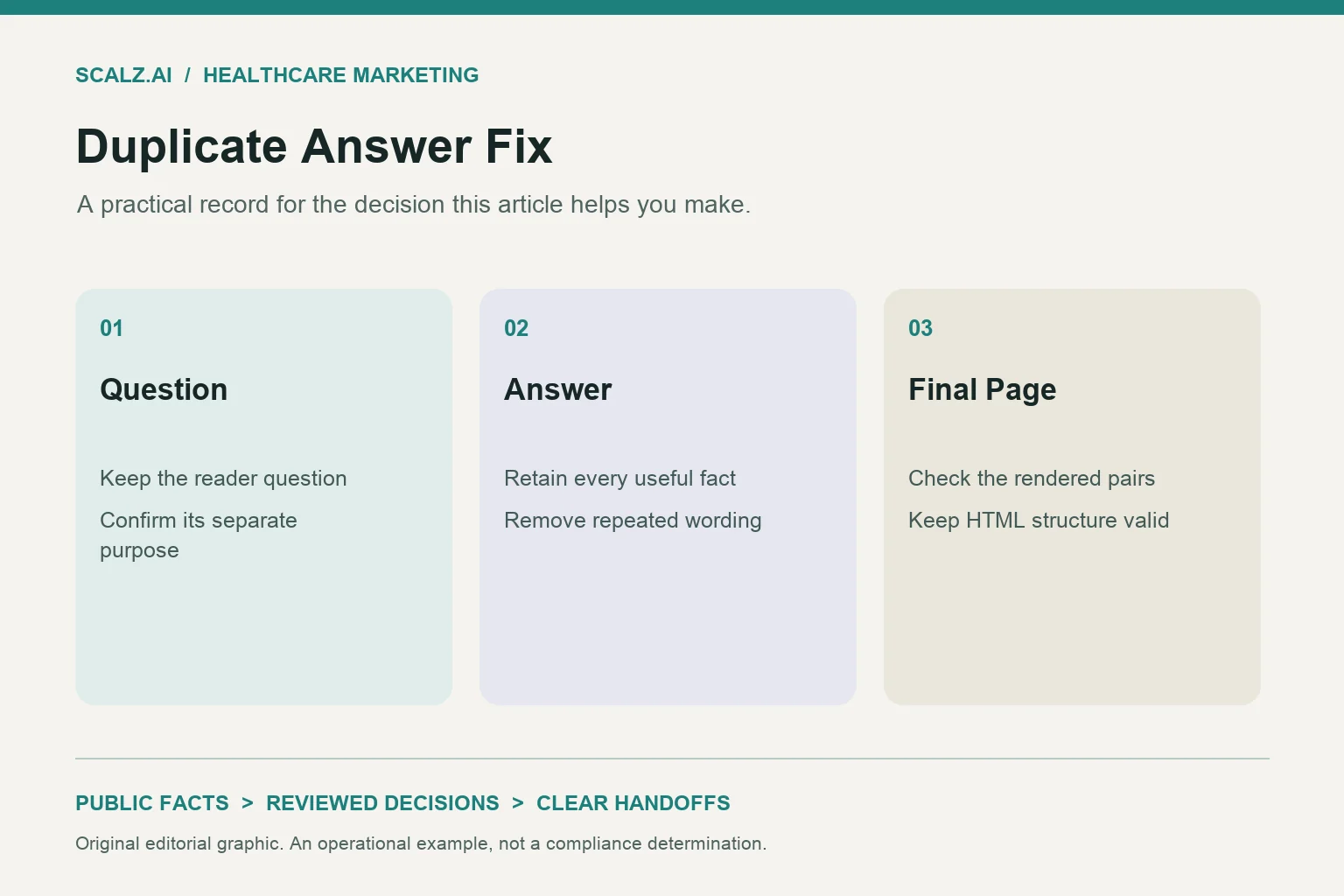
To repair repeated FAQ answers inside one treatment marketing article, keep every question, identify what each answer must resolve, and replace repetition with the missing information. For AI SEO for addiction treatment, a shorter answer works only when it remains complete and preserves every relevant verified qualification. Rewording the same vague response under several questions leaves the underlying problem intact.
Work from a saved copy of the article and the facility’s approved records. Give each question a stable identifier, choose its answer length, and check the finished HTML before handing over the revision. The method below produces a reviewable repair without changing the article’s subject or inventing facility details.
Define the one-page repair for AI SEO for addiction treatment
A focused answer repair fits within addiction treatment SEO and the content work covered by AI SEO services. Its scope is the relationship between questions and answers inside one article. Keep the page URL, topic, question inventory, and verified facility facts stable while improving how each answer serves its reader.
Start with a concrete acceptance rule: every retained question receives an answer that addresses its exact subject without requiring the reader to assemble pieces from unrelated sections. Repeated facts can remain when they are necessary for understanding. Repeated filler, misplaced explanations, and duplicated paragraphs need an editorial decision.
- Save the original body and record the article revision so the reviewer can compare the same starting point.
- Identify the affected question headings and answer blocks before making changes elsewhere on the page.
- State that success means complete, distinct answers and valid HTML, rather than a promised change in rankings or citations.
Existing SEO foundations apply to AI feature eligibility; no special AI markup is required. Keep this repair focused on a clearer reading experience, with search and answer visibility evaluated separately if the page is later published.
Create a question inventory that survives the edit
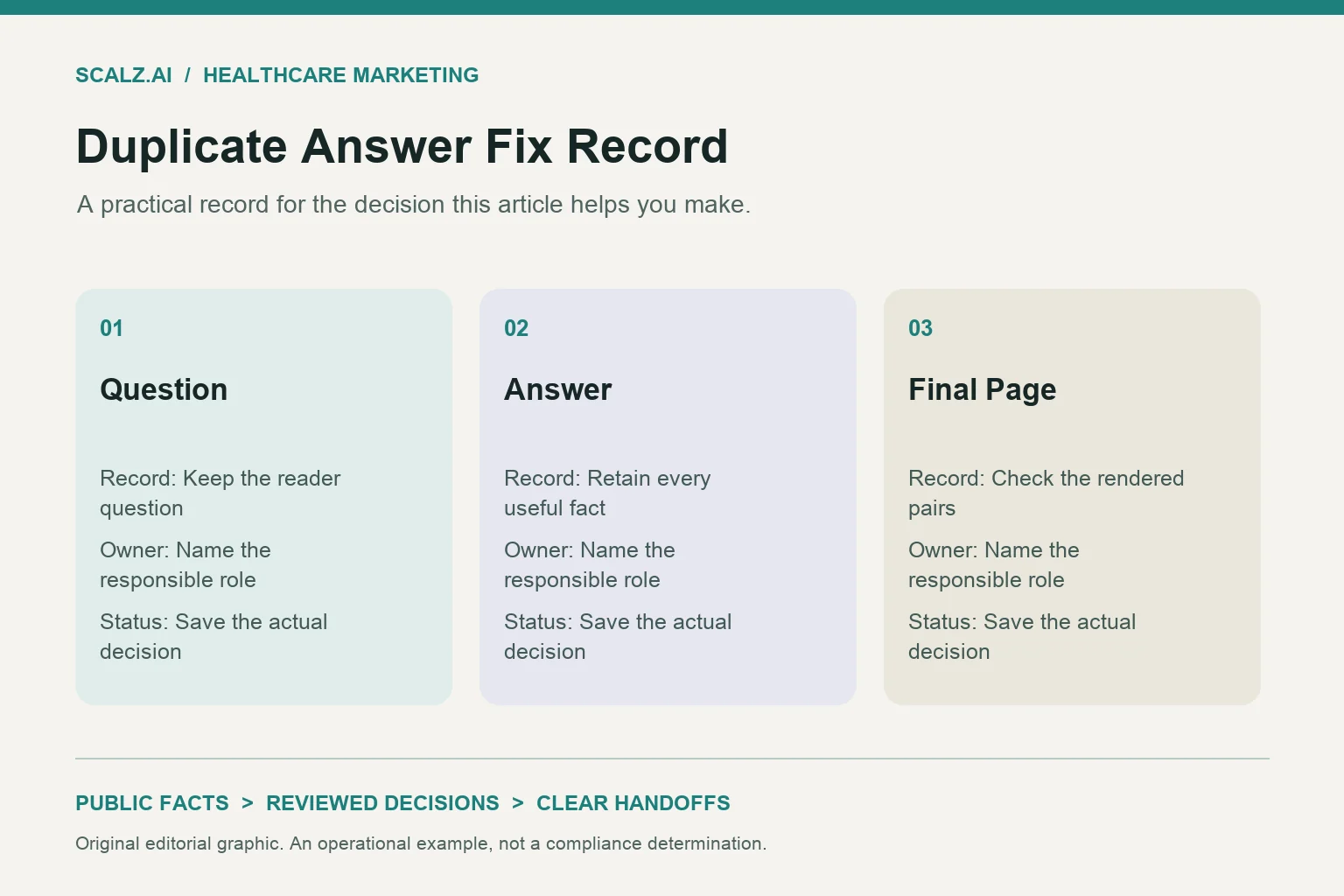
List every question in page order, including questions outside the final FAQ section. Assign working identifiers such as Q01 and Q02 in the review document; these identifiers do not need to appear publicly. Copy each heading exactly so a shortened or missing question cannot slip through unnoticed.
For each entry, capture the current answer, its location, the reader task, and the approved records it depends on. Also note whether the answer contains a necessary exception, a link, or a contact instruction. This inventory becomes the reusable record for both the rewrite and the final comparison.
- Record the reader task as a complete statement, such as, “The reader needs to identify which location the published information describes.”
- Record the supporting facility document by its internal name, revision date, and relevant section without copying sensitive material into the article.
- Record the intended action as “retain,” “shorten,” or “expand,” and explain what the change will accomplish.
A proposed entry might read: “Q04; location question; generic contact answer; approved location register; expand to identify the applicable location.” Another might read: “Q05; schedule question; repeated program overview; approved schedule record; replace with schedule scope and its stated qualification.” These entries describe editorial work, not facility facts.
Count the questions before editing and repeat the count afterward. Equal counts are a useful first check, but the heading-by-heading comparison must also confirm that each original question remains.
Separate shared facts from interchangeable answers
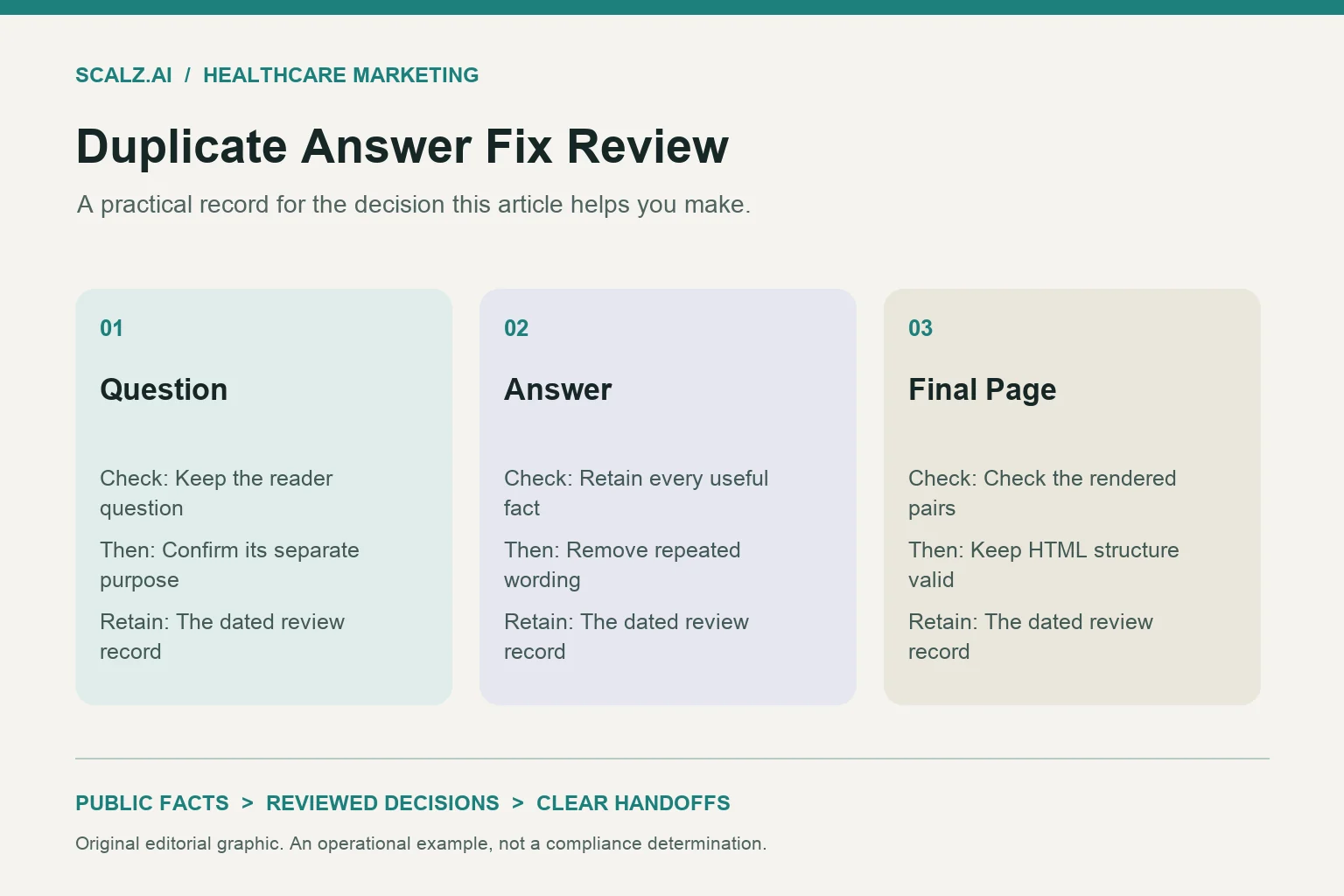
Two answers can repeat a facility name or location without being redundant. The problem begins when their main response could be swapped between questions and still appear equally plausible. A sentence such as “Contact the team to learn more” often reveals that neither question has received a substantive answer.
Use two passes to identify the issue. First, compare exact or nearly identical passages after ignoring harmless spacing differences. Then read the answers for meaning, because changing “learn more” to “find out more” creates different wording while preserving the same empty response.
- Label a passage as necessary repetition when removing it would make the answer’s subject or limitation unclear.
- Label a passage as misplaced when it answers another question better than the heading directly above it.
- Label an answer as incomplete when it supplies an action but omits the fact or distinction the question requests.
Consider a location question and a schedule question that both receive a general program summary. The location answer needs the approved geographic scope; the schedule answer needs the approved timing information and any applicable limitation. Moving the same summary between them does not resolve either task.
Keep a short decision beside each repeated passage. “Retained because this qualification applies independently to both answers” is more useful than “Duplicate accepted,” because the next editor can understand the reason.
Write an answer-completeness brief for each question
Decide what the visible answer must contain before choosing its wording or length. Keep AEO planning for rehabs focused on the reader’s actual question, and treat FAQ schema implementation as a separate task.
An answer-completeness brief needs three parts: the direct response, the qualification that affects its meaning, and any useful next step. The direct response answers the heading. The qualification keeps the answer accurate, while the next step helps only when the reader still needs an action after receiving the information.
- Write the required response as a specific instruction, such as, “Identify the location covered by this article using the approved location record.”
- List every qualification that must survive shortening, including restrictions tied to a location, service label, or document scope.
- Mark optional background separately so it can move into a supporting paragraph without weakening the opening answer.
For a question about whether two program labels mean the same thing on the page, the brief should require the facility’s approved descriptions. An editor must not infer equivalence from similar wording. If the approved records do not resolve the distinction, the answer remains pending factual confirmation.
Keep that pending status in the internal review record. Do not replace missing information with a confident generalization or present editorial uncertainty as a verified public fact.
Choose concise or detailed answers by the reader’s task
A concise answer is appropriate when one fact or distinction resolves the question and its qualification fits comfortably alongside it. A detailed answer is appropriate when the reader must understand several documented conditions or a sequence. Neither format should be chosen simply to make every answer look uniform.
Use a proposed target of roughly 35 to 65 words for a straightforward answer, then allow more space when completeness requires it. This is an editorial working range, not a search-engine requirement. A short opening response followed by a supporting paragraph can serve both scanning and careful reading.
- Choose a concise answer for a location-identification question when the approved record supports one clear location and a brief qualification.
- Choose a detailed answer when a published detail varies across documented locations and those differences matter to the question.
- Keep a documented exception next to the statement it limits, even when that makes the answer longer.
- Remove background that belongs elsewhere when it delays the direct response without adding necessary context.
Record the length decision in plain language: “Concise because this question asks for one approved label,” or “Detailed because the answer must distinguish location-specific information.” That explanation prevents a later editor from expanding every answer for consistency. It also prevents another editor from cutting a necessary distinction to meet an arbitrary word count.
Read the opening response by itself before approving either format. It should name its subject clearly rather than depend on phrases such as “as mentioned above” or “the same applies here.”
Replace repeated filler with question-specific information
Rewrite the opening sentence around the heading’s actual task. Then add only the approved detail needed to complete that response. If the current answer includes useful information for another question, move it deliberately and record the transfer instead of copying it into both places.
A concrete editorial example can involve two questions: “How should program names be checked?” and “How should location details be checked?” Giving both the answer “Review the information before publication” leaves their separate tasks unexplained. The revised answers should name the different records and checks.
- For the program-name question, use: “Compare each published program label with the facility’s current approved service register. Keep the approved wording and flag any label the register does not support.”
- For the location-details question, use: “Compare the article’s location references with the approved location register. Confirm that each detail belongs to the location discussed before approving the answer.”
- For public facility FAQs, follow the same distinction but insert only the actual facts confirmed in the relevant approved records.
These proposed answers demonstrate an editorial method without assigning services or locations to a facility. Their value comes from resolving different tasks, not from avoiding every repeated word. Both can use “approved” because that word describes a necessary check.
Keep any useful contact instruction after the substantive answer. A next step can supplement an answer, but it should not substitute for information already available in verified facility records.
Keep paragraphs, headings, and lists structurally separate
Give each retained question a clear heading, then place its answer in separate paragraphs or a list to support behavioral health website accessibility. Do not insert an entire formatted answer into a paragraph that already wraps the content.
A proposed valid sequence is a question heading, an opening answer paragraph, a supporting paragraph, and a useful list when needed. Each element closes before the next begins. A paragraph should never contain another paragraph, a heading, or a list.
- Close the opening paragraph before adding a second paragraph with supporting detail.
- Place a list after the preceding paragraph and keep each complete-sentence item inside its own list item.
- Check the editor’s saved HTML as well as the preview, because visual spacing alone does not prove that the structure is correct.
- Preserve useful inline links while removing duplicated wrappers created by pasted or imported content.
Inspect the rendered result after saving a draft because browsers and editors may rearrange malformed markup. An answer can look acceptable while its saved structure places text outside the intended block. Confirm that each heading still leads directly into its own answer.
Keep this check limited to the repaired content and its immediate boundaries. Broader navigation, design, and accessibility changes should remain separate tasks unless they are necessary to make the answer usable.
Review the repaired answers against the original inventory
Compare each revised answer with its original question and completeness brief. Read it without the surrounding article first, then read it in context. The isolated check catches vague references, while the contextual check catches contradictory wording, duplicated explanations, and awkward transitions.
If a separate FAQ markup layer exists, include its owner in the handoff so revised answers and structured data stay aligned with the visible page content. Matching markup does not guarantee enhanced display.
- Confirm that every original question remains and that each answer addresses the subject named in its heading.
- Compare revised facility statements with the same approved records used during editing.
- Check that every necessary qualification survives and remains close to the statement it modifies.
- Read retained links and contact instructions to confirm that they still make sense in the shortened or expanded answer.
Use clear review statuses such as “passes,” “needs copy correction,” and “awaits facility confirmation.” Keep an unresolved factual item separate from an HTML problem so the correct owner receives it. A well-formatted answer with an unsupported detail still needs correction.
Record only checks actually completed. A useful receipt can say that the question inventory and saved HTML were reviewed while noting that rendered-page verification remains pending.
Practical FAQs about repairing repeated answers
Should every repeated sentence be removed?
No. Keep a repeated sentence when it supplies a fact or qualification that each answer independently needs. Remove or relocate it when it merely repeats background and leaves the current question unresolved.
For example, the same verified location name may be necessary in two answers with different subjects. The location answer and the schedule answer should still provide different primary information.
When should a short answer be expanded?
Expand an answer when the direct response leaves out a documented condition, exception, or distinction needed to understand it. Add that information immediately after the opening response rather than padding the answer with general background.
A question covering several documented locations may require separate details for each relevant location. The expansion should follow the approved records and stop when the question is fully resolved.
What should happen when a retained question lacks verified facts?
Keep the question in the repair inventory and mark its answer as awaiting facility confirmation. Route the precise missing fact to the responsible facility reviewer instead of creating a plausible answer.
The internal draft can remain pending while that detail is checked. Approval should depend on the missing information being resolved, rather than replacing the answer with an unrelated contact message.
Hand over a repair packet the next editor can use
Finish with a compact packet containing the original revision, revised body, question inventory, and open review items. Include a short change note for each answer that was shortened, expanded, or reassigned. The next editor should be able to see both what changed and why the answer remains complete.
Make release readiness explicit rather than treating a finished rewrite as publication approval. Separate completed content checks from any remaining facility confirmation, rendered-page review, or connected markup check. Preserve the original revision as the rollback reference.
- Attach the before-and-after question inventory with a decision and review status for every entry.
- List the approved record references supporting changed facility details without adding sensitive information to the packet.
- Identify the owner of each remaining issue and the specific correction or confirmation required.
- Record the saved revision and the verification performed so later edits have a dependable starting point.
For done-for-you support, contact SCALZ.AI to discuss a focused one-page answer repair. Share the article URL, affected questions, and approved public facility information so the review can begin with a clear scope.
Call 407-954-8800 to talk through next steps.