

Match Cited Pages In AI SEO For Addiction Treatment
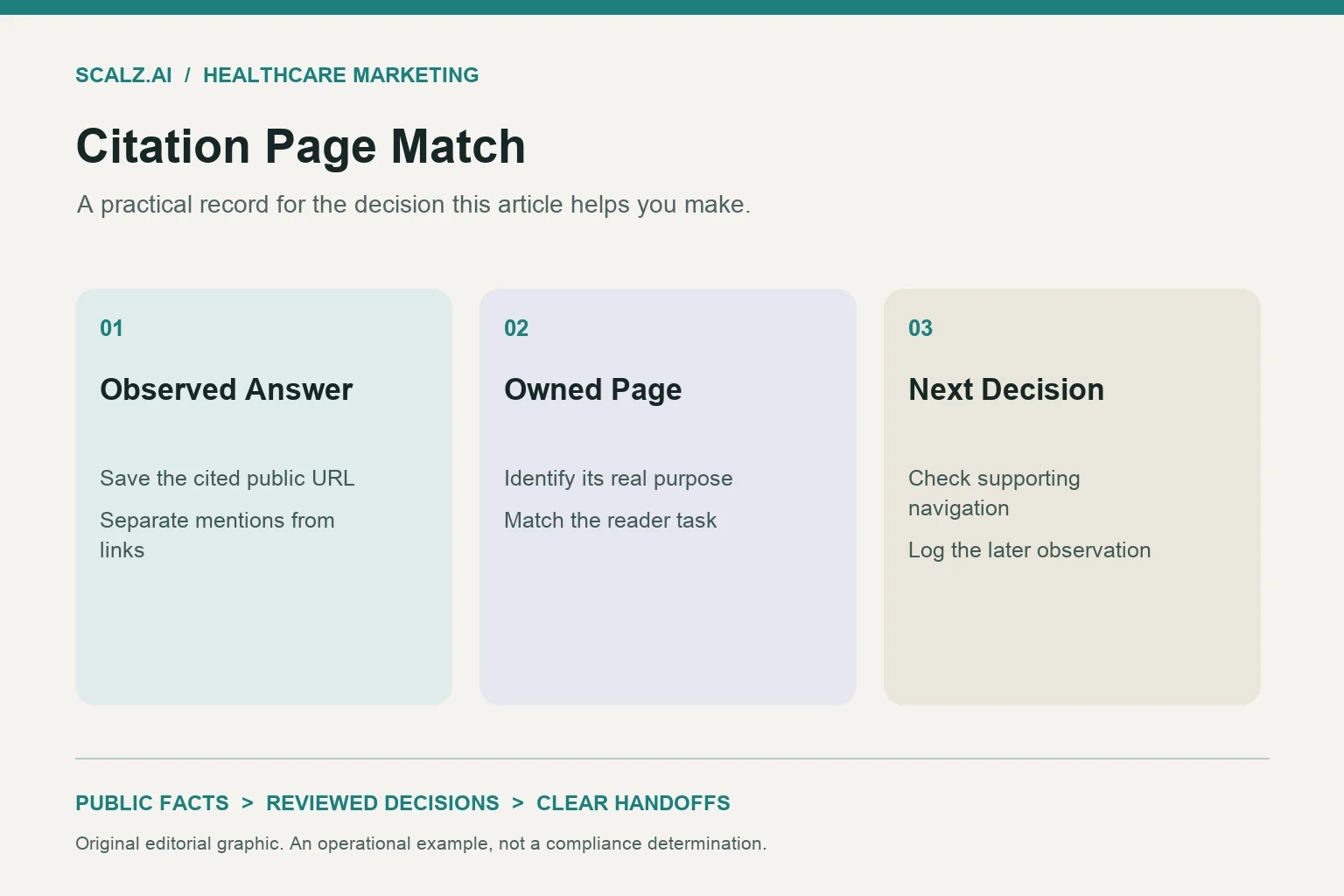
Match each observed AI citation to the specific statement it supports, then choose the owned page whose purpose fits that statement. In AI SEO for addiction treatment, a citation to a homepage may support a brand description but offer a poor destination for a specific program fact. Record that difference before changing content or navigation.
Start with answers your team already has. Open the cited page, identify the relevant passage, and compare its purpose with the intended destination. The practical deliverable is a page match and a focused work order. Your team can improve the site's paths and explanations; it cannot control which source an answer engine selects.
Define Page Purpose in AI SEO for Addiction Treatment
Give every candidate page one primary job before judging a citation. A service page explains a verified offering, a location page identifies a facility, and a support page answers a specific operational question. This distinction connects the facility focus of addiction treatment SEO with the broader site work involved in AI SEO services.
Write the page job as a complete sentence that an editor can test against the content. For example, a proposed page job could be, “This page explains the facility's approved outpatient program information.” Program names here are marketing labels, and using them requires confirmation in facility records.
- Assign the homepage the job of introducing the organization and directing visitors to its main destinations.
- Assign each service page a defined offering and facility scope supported by approved records.
- Assign each support page a discrete information need, such as explaining the published contact process.
- Assign educational articles an informational purpose without treating them as proof that a facility offers a service.
If a page has several unrelated jobs, describe its current purpose before proposing a narrower one. A broad page can remain useful while pointing readers toward focused destinations. Citation matching should expose that distinction rather than turn every page into another service landing page.
Attach the Citation to the Statement It Actually Supports
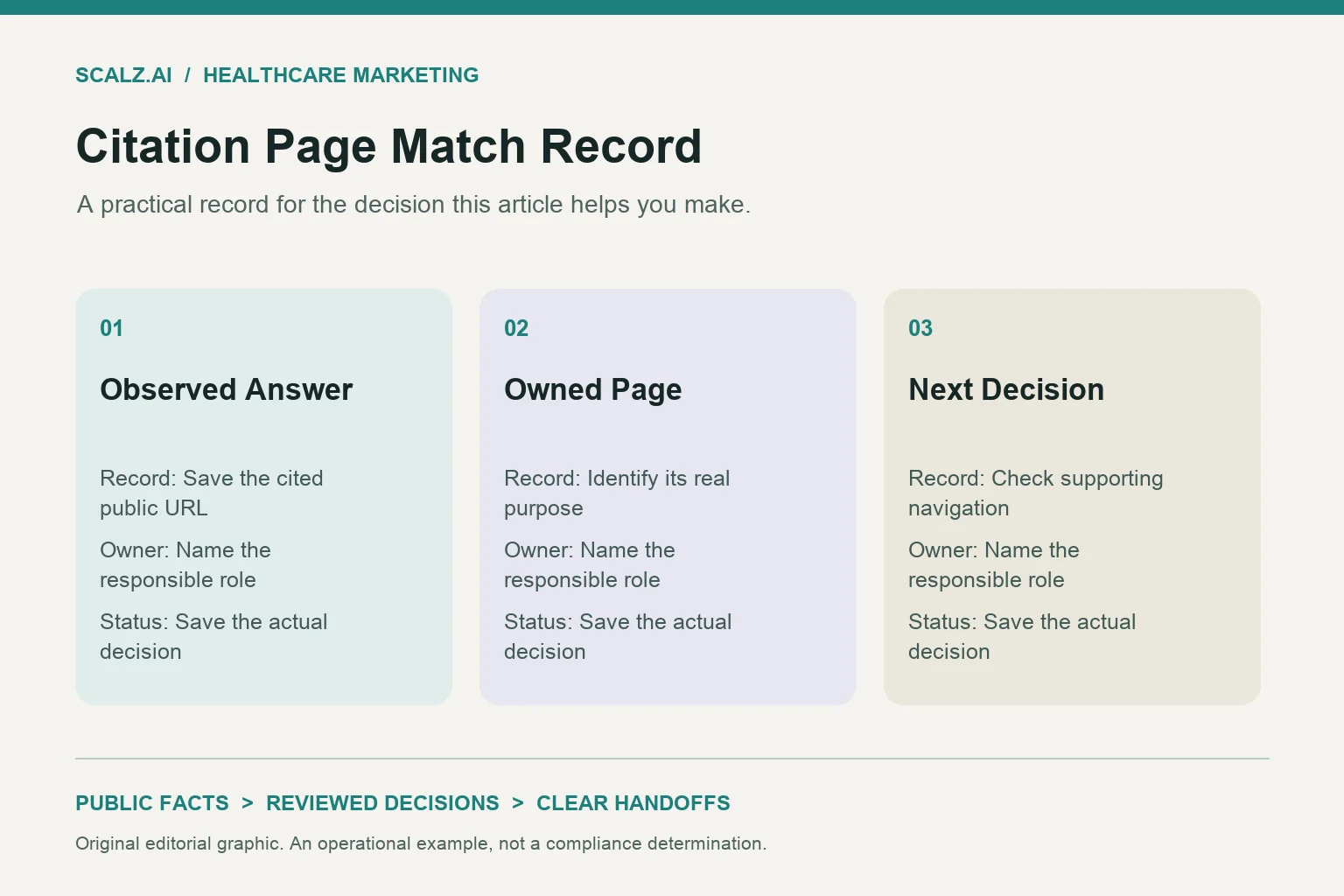
Review the answer passage beside the citation before reviewing the whole page. The scope differs from explaining ChatGPT source selection for treatment centers: this task starts after a citation has been observed. It asks whether the linked destination supports the particular statement attached to it.
Separate a sentence containing several claims into individual statements for matching. An answer might mention an organization, its location, and a program label together. A cited homepage may support the organization name while leaving the location or program claim unsupported.
- Copy only the relevant public answer passage into the matching record and identify the statement under review.
- Open the actual citation destination and locate the visible passage that supports that statement.
- Mark support as clear, partial, absent, or unresolved, with a short explanation of the missing connection.
- Keep separate entries when one cited page is attached to statements with different purposes.
Suppose an observed answer names an approved program but cites a general educational article. The article may explain the label without establishing that the named facility offers it. Record a service confirmation mismatch and identify the owned destination containing the approved facility fact.
Do not expand that observation into a claim about why the engine selected the article. The actionable finding is narrower: the cited page and the statement serve different jobs.
Choose the Owned Destination That Completes the Reader's Task
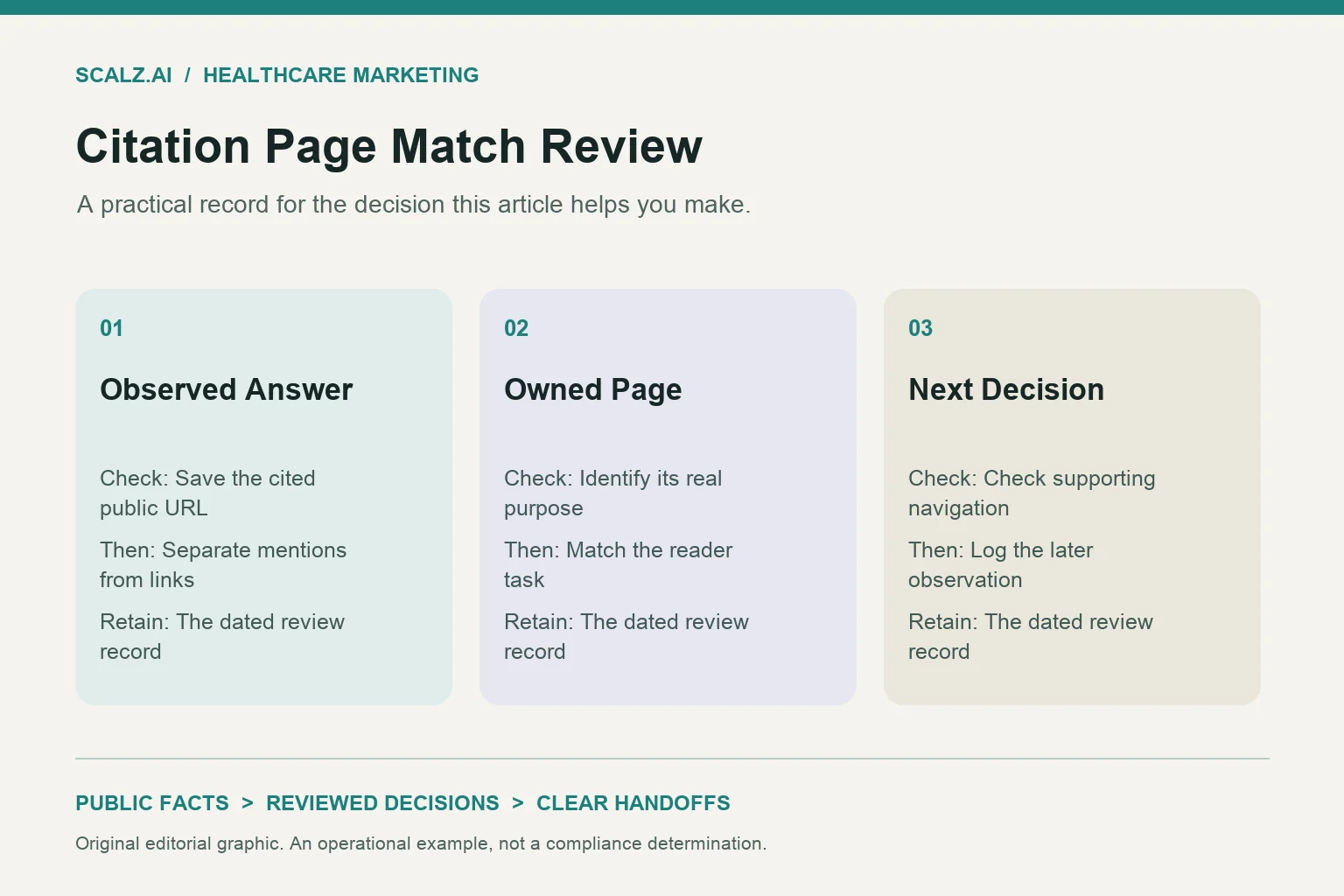
Select the destination by the information needed after someone follows the citation. A page with a similar keyword is only a candidate until its purpose, facility scope, and visible content match. The reader should find the relevant fact without moving through several broad introductions.
Use existing pages first and check their current approved content. If a dedicated destination lacks the necessary facts, record it as incomplete rather than selecting it because its title looks right. A clear page name cannot compensate for missing information.
- Choose a service destination when the statement concerns a verified offering at the named facility.
- Choose a location destination when the statement concerns an address or a facility-specific public contact detail.
- Choose a support destination when the statement concerns a published administrative process.
- Keep an educational destination when the statement is general information and makes no facility offering claim.
Consider a proposed administrative example: an answer describes where to find a facility's published contact options. The homepage may display a phone number, while a contact support page explains the available routes. Choose according to the statement's scope, without assuming hours, response times, or availability.
If no owned page completes the task, leave the intended destination unassigned. A content request should specify the missing purpose and required facility records. Creating a page simply to fill an empty field adds work without resolving the underlying information need.
Use a Compact Citation-to-Page Matching Record
The matching record should let another editor reproduce the page decision without reading a long search report. Broader comparisons belong in AI citation gap analysis for treatment center brands. This record stays focused on the observed destination, intended page purpose, and proposed site change.
Use one entry per statement and destination pair, with a stable reference to the existing answer capture. Store public page information and editorial decisions only. Keep facility fact references limited to the approved business records needed for the page.
- Record the cited destination and the exact public statement being matched.
- Describe the cited page's current purpose and the passage that provides support, if present.
- Name the intended owned destination and explain why its purpose fits the statement.
- Record the mismatch category, proposed action, responsible editor, and approval status.
- Identify the navigation element to change and the existing wording that needs review.
A proposed entry could read: “The answer names an approved program. The citation opens the program directory, which contains a brief label. The dedicated service page contains the approved description. Keep the directory, strengthen its descriptive link, and assign the navigation revision to the web editor.”
Add a closure field stating what was actually checked. “The directory link now opens the intended service page” is a testable completion statement. “The engine will cite the service page next time” is a forecast that the record cannot support.
Separate Broad Matches From Wrong-Purpose Matches
A broad destination and a wrong-purpose destination require different responses. The first may contain a valid summary with an unclear onward path. The second may answer a different question, even when its wording overlaps with the observed statement.
Use a few defined categories so reviewers assign consistent work. The categories describe the relationship between statement and page; they do not measure authority or visibility. Each category should lead to a practical editorial decision.
- Mark a direct match when the page clearly supports the statement within its primary purpose, and keep the existing destination.
- Mark a broad match when the page supports a summary but readers need a clearer route to the focused page.
- Mark a wrong-purpose match when the destination addresses another task, and review the links that connect the two topics.
- Mark a scope conflict when the page concerns a different facility or offering, and hold changes until the correct scope is confirmed.
- Mark an unresolved match when support or facility facts remain unclear, and assign the missing check.
For example, a directory describing an approved service briefly can be a broad match. A blog explaining a program label becomes a wrong-purpose match when the answer uses it to confirm that a facility offers that program.
Keep these judgments tied to the statement. The same article might be a direct match for an educational explanation and a wrong-purpose match for a facility-specific offering claim.
Revise the Supporting Navigation Before Expanding the Page
When a focused destination already exists, inspect how broader pages introduce and link to it. A vague label such as “Learn more” gives readers little context about the destination. A descriptive link can explain the page's job without expanding the surrounding copy into a duplicate.
Established SEO practices apply to Google AI search features; no special AI markup is required. Treat navigation revisions as useful site improvements, with citation selection remaining outside the team's control.
- Place the focused link beside the summary that introduces the matching topic.
- Use anchor wording that accurately describes the destination and its approved scope.
- Keep broader navigation labels broad enough to represent their actual destination.
- Link support explanations to service pages only when the relationship helps readers complete the stated task.
A proposed directory edit could replace a generic button with a link naming the approved service page. If the directory covers several facilities, the surrounding text should make the facility relationship clear. Do not imply that every listed service is available at every location.
A support article might need a short transition explaining where facility-specific information lives. Keep the article's educational purpose intact and link only to a verified relevant destination. Repeating the full service description across several pages can blur their roles.
Change the smallest useful set of links first. Sitewide menus, redirects, and canonical settings deserve separate review because their effects reach beyond one citation match.
Turn Common Mismatches Into Specific Work Orders
Write work orders around the observed reader problem and the proposed site behavior. These examples are proposed editorial situations, rather than accounts of client results. They give a content lead enough detail to assign a bounded change.
A Homepage Receives a Specific Service Citation
The homepage contains an approved service summary, but its nearby link opens a general directory. The dedicated service page already contains the relevant description. Propose a direct contextual link beside the summary while preserving the directory's separate role.
- Specify the homepage section, current link target, proposed destination, and approved anchor wording.
- Require confirmation that the destination concerns the same facility and approved offering.
An Educational Article Is Used as Offering Confirmation
The article explains a program label but does not establish facility availability. The work order should clarify its informational purpose and add a relevant facility link only if the offering is verified. If verification is missing, assign the fact check before requesting copy.
- Identify the sentence that could blur education and facility-specific information.
- Keep general explanations separate from the approved statement about the facility's offering.
A General Support Page Is Cited for a Location Detail
The support page describes a shared contact process, while the location page holds the relevant public details. Propose a location-specific link at the point where readers need it. Preserve the support page's process explanation rather than adding several location descriptions.
- Name the public location detail that requires a focused destination.
- Verify the link label and destination together before approving the navigation change.
Accept Changes Against Page Purpose and Working Links
Acceptance should prove that the approved site change works for readers. It should not depend on a future answer selecting a different source. Keep any wider AI Overview planning separate from this check, including the distinct topic covered in treatment center AI Overview visibility planning.
Review the revised section in context, then follow each changed link. Confirm that the destination's opening content fulfills the purpose recorded in the work order. A technically working link can still be an editorial failure if it sends readers to another broad page.
- Check that each changed link opens the approved destination without an unexpected redirect.
- Confirm that anchor text and surrounding copy describe the destination accurately.
- Verify that every facility-specific claim remains consistent with approved records.
- Check that the change preserves nearby contact routes and existing useful links.
- Save the prior wording and target so the editor can reverse the change if needed.
Close the record with the completed edit, reviewer, and date. If a later observed answer still cites the broad page, retain that as a separate observation. It does not erase a verified improvement to the reader's path.
A useful handoff might state: “The directory now links directly to the approved service page beside its summary. The destination and facility scope were checked. No conclusion has been drawn about future citation selection.” This gives leadership a clear account of what changed.
Three Practical Citation Matching Questions
Should Every Homepage Citation Trigger a Change?
No. Keep a homepage citation when the attached statement concerns the organization as a whole and the page supports it clearly. Consider a navigation revision when the statement requires a more specific destination and the homepage's onward path leaves that task unresolved.
Should the Team Redirect a Broad Page to the Preferred Destination?
Usually, a contextual link is the better first proposal when both pages serve valid purposes. A redirect changes the destination for every visitor using the old address, so a citation mismatch alone does not justify retiring the broader page. Evaluate retirement separately against the page's remaining uses.
What If the Intended Service Page Cannot Be Verified?
Leave the match unresolved and name the missing facility record or approval. Continue work on other entries with confirmed destinations, but keep the unverified service claim out of the navigation revision. This prevents an uncertain page choice from becoming a public assertion.
For a custom, done-for-you review, contact SCALZ.AI with a public cited page and the owned destination you believe fits its statement. That pair provides a concrete starting point for discussing page purpose and supporting navigation.
Call 407-954-8800 to talk through next steps.