

Agency Access Handoffs For AI SEO For Addiction Treatment
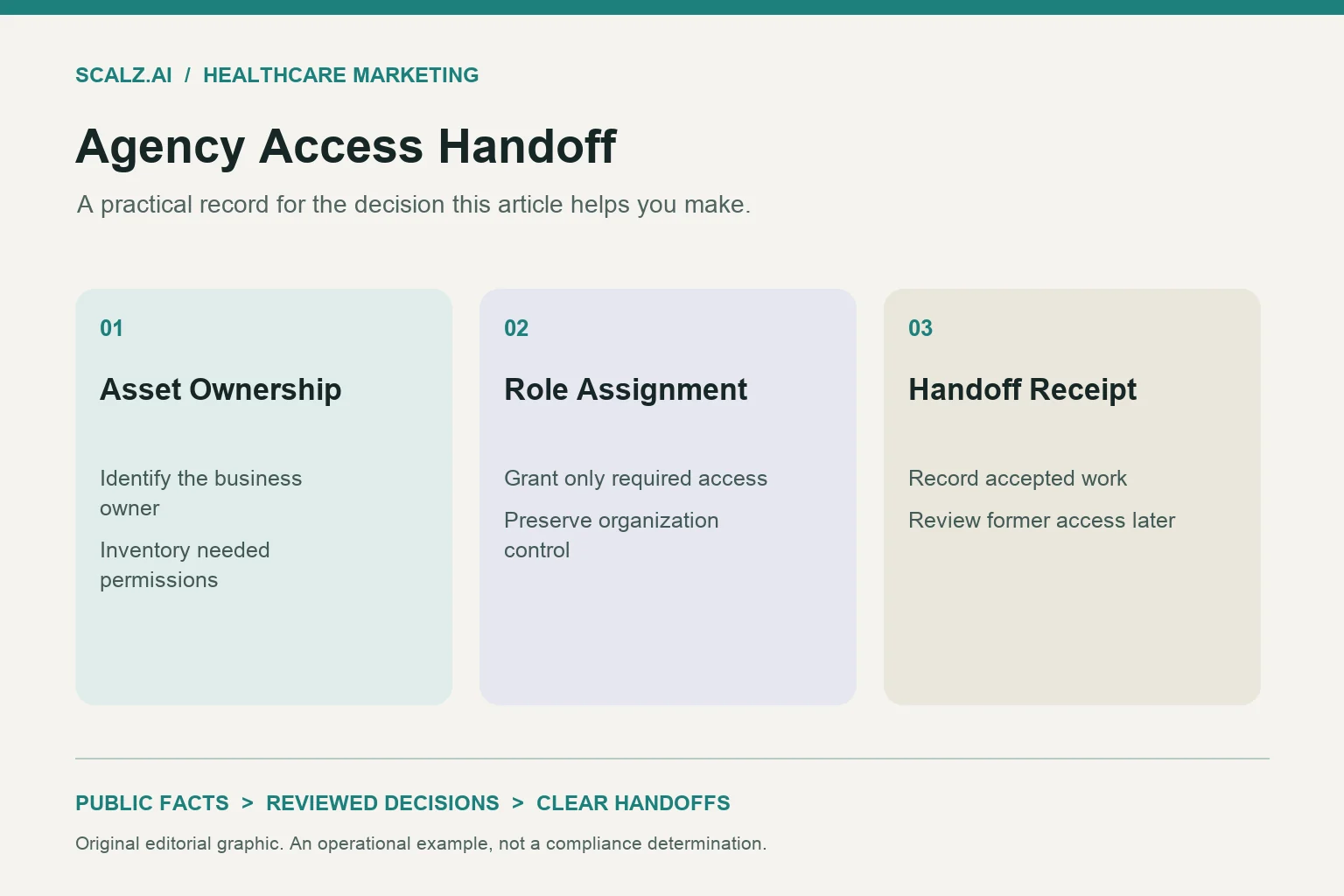
Start an AI SEO for addiction treatment agency handoff by listing each website and search asset, confirming its business owner, and assigning access to a specific task. Set the cutover date, publishing authority, and removal conditions before either partner changes anything. Keep a business representative accountable for approving access, accepting transferred work, and confirming that the outgoing agency’s permissions have ended.
The practical output is a small handoff pack: an asset register, a permission record, a change log, and signed acceptance notes. Use the proposed examples below as record formats, replacing each entry with your actual account names and verified responsibilities.
Map Asset Owners Before Inviting the New Partner
An access handoff for addiction treatment SEO starts with ownership across the website, search properties, and public business listings. A staff member who receives agency reports may not be the person authorized to manage those assets.
Create one register entry for each asset, including separate properties for different facilities or domains. Record the business owner, internal administrator, current agency role, intended incoming role, and unresolved ownership issue.
- List the domain registration, hosting account, website management system, and source repository separately, because control of one does not establish control of the others.
- Identify the exact Search Console property, analytics property, business profile, and reporting workspace connected to each website or facility.
- Mark agency-owned reporting subscriptions as dependencies, then name the business-owned files or reports that must remain available after the engagement ends.
- Assign an internal person to resolve every unknown owner, with a due date and a clear condition for closing that entry.
A proposed entry could read: “Main website; business owner: operations director; administrator: internal web lead; incoming role: draft editor; ownership status: confirmed.” Another might mark a search property as unresolved because nobody has confirmed which business representative controls it.
Keep unresolved assets visible rather than treating an invitation as proof of ownership. If the incoming agency cannot inspect a required property, record that task as blocked and continue only with work that does not depend on it.
Match Each Permission to a Named Task
The AI SEO service scope should explain why each requested permission is needed. If responsibilities are still unclear, the AI SEO agency role overview can help separate research, editing, implementation, and reporting duties.
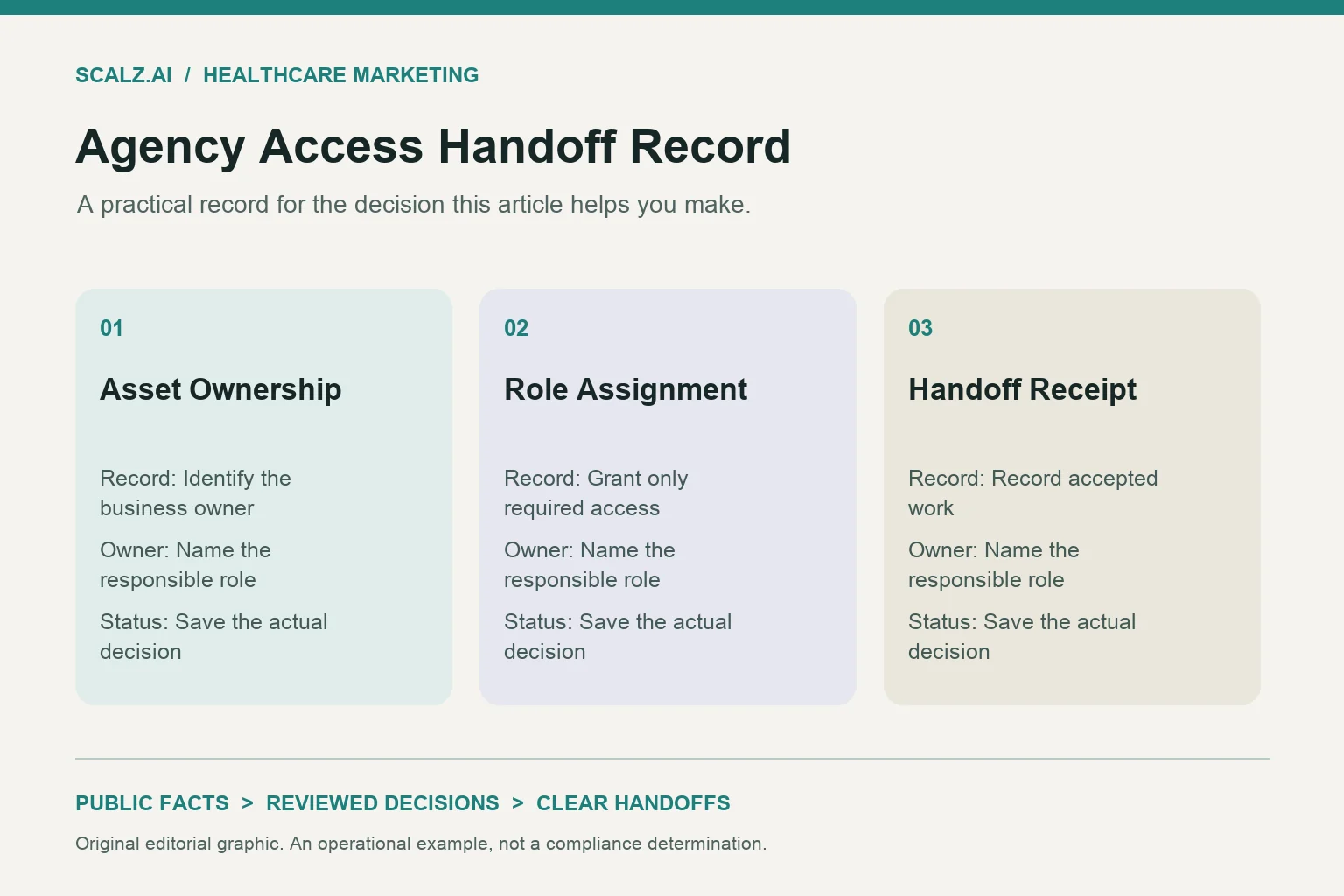
Use least privilege as a working rule: grant the narrowest available role that supports the approved task. Product roles differ, so record both the platform’s role name and the actions your team expects that role to permit.
- Give a researcher viewing access where available when the assignment is to inspect search performance and prepare findings.
- Give a writer draft access when the assignment is to revise approved pages, while retaining publication authority with the designated publisher.
- Give a developer access to the relevant test environment when the assignment is to prepare a template change for review.
- Limit business-profile editing to the approved locations and fields, with public service facts checked against facility records.
- Reserve user management and ownership decisions for the authorized business representative unless a specific delegated task requires otherwise.
A useful permission record reads: “Role: draft editor; task: revise approved location pages; approver: marketing director; review date: end of revision batch.” Include the recipient’s business identity and the asset reference so similarly named accounts cannot be confused.
When the available role is broader than the task requires, document the gap. The owner can choose supervised execution, a narrower delivery method, or a temporary grant with a defined removal condition.
Separate Access Approval From Publishing Approval
Access permits an action technically, but your operating record should also state who may authorize that action. Keep this transition focused on execution controls; the SEO consulting decision guide covers the broader decision about buying consulting support.
Create a short authority record covering draft changes, public releases, business-profile edits, and measurement changes. Name the person who approves each category and the person who checks the completed result.
- Require the assigned editor to approve revised website copy before the publisher releases it.
- Route redirects, canonical changes, indexing controls, and sitemap changes to the technical owner responsible for release review.
- Route changes to public facility names, addresses, contact details, and service descriptions to the internal owner of those verified facts.
- Require a separate approval for analytics or tracking changes, even when the incoming agency already has permission to edit the website.
For example, a new partner may prepare a revised location-page introduction while the existing web team remains responsible for publishing. Record that split explicitly, along with the review location and the person who confirms the live page matches the approved version.
Define a pause rule for disputed changes. If the agencies disagree about a pending redirect, leave it unapproved until the business’s technical owner resolves the destination and release check.
Preserve the Search Baseline and Active Dependencies
Capture the current website state before the cutover so the next team can distinguish inherited conditions from later changes. The baseline should cover public pages, search configuration, approved content, and the dependencies needed to maintain them.
Google’s Existing SEO practices apply to Google AI features; no special AI schema is required. Carry the website’s ordinary search foundations through the transition.
- Record the current sitemap location, robots directives, canonical patterns, redirect register, and important page addresses in a dated baseline note.
- Preserve the approved versions of priority page titles, descriptions, visible content, structured data, and internal links.
- List scheduled marketing reports, public-site checks, and content queues, identifying which depend on an outgoing agency’s tools.
- Retain measurement definitions and reporting periods so a later report does not silently change what a metric means.
A proposed dependency entry could read: “Weekly broken-link report; current operator: outgoing agency; destination: business reporting folder; replacement operator: incoming agency; next expected run: first agreed review date.” Mark the replacement as pending until its output has actually been received.
Preserve the method for existing AI-answer observations, including the prompts, engine names, dates, and public pages reviewed. Keep Google rankings, AI mentions, and citations as separate measures when transferring the reporting history.
Do not bundle a redesign or measurement overhaul into this baseline exercise. Record those as later work, with their own approval and checks.
Transfer Editorial Decisions Along With the Files
The incoming editor needs to know which page decisions are settled and which remain open. A folder of drafts is incomplete when approval status, facility facts, and page purpose are missing.
Give each active page a short editorial entry with its address, intended reader task, current version, reviewer, and next action. Link that entry to the business’s approved facility record rather than carrying unsupported claims forward from an old draft.
- Mark each draft as proposed, under review, approved, published, or withdrawn, and name the person responsible for moving it to the next stage.
- Identify the verified facility record supporting public service labels, location details, hours, and other business-specific statements.
- Carry forward unresolved factual edits as open items, with the responsible internal reviewer and the affected sentences identified.
- Record why an existing page is being retained, revised, or consolidated so the new editor does not restart a settled discussion.
A proposed page entry might read: “Location overview; purpose: explain this facility’s verified public information; status: approved draft; next action: publisher review.” If a program label is still awaiting confirmation, identify that label as pending instead of filling the gap.
Include planned internal-link destinations and any approved answer blocks in the entry. This lets the new editor maintain the page’s SEO, AEO, and AI-search purpose without rewriting it merely because the agency changed.
Make the review boundary explicit: agency editors manage marketing copy, while the business assigns the reviewers needed for specialized factual statements.
Stage the Cutover Around Observable Checks
Choose a cutover sequence that keeps one team responsible for each active task. A short overlap can help transfer work, but it needs clear limits on who may edit, publish, and manage accounts.
Use a change window to prevent simultaneous releases by both agencies. Record unfinished work before that window begins, then assign each item to the outgoing partner, incoming partner, or internal team.
- Set a final outgoing release deadline and require the outgoing team to list any approved work that will remain unfinished.
- Have the incoming team confirm that it can view the assigned properties and reach the agreed draft or test environments.
- Verify a low-impact task, such as reviewing an existing report or saving an unpublished draft, before expanding execution rights.
- Keep the internal publisher responsible for the first public change and its checks during the transition.
- Define the condition that pauses the cutover, such as unresolved ownership or an unavailable business administrator.
For example, the incoming agency could inspect the approved page queue on the first handoff day, prepare one draft revision next, and submit it to the internal publisher. Broader editing responsibility follows only after those steps have been checked and accepted.
If a required asset remains inaccessible, document the blocked task and its owner. Avoid treating partial access as a completed transition.
Keep any fee discussion in the separate AI SEO agency pricing review. The cutover record should remain focused on assets, responsibilities, and completion conditions.
Accept the Handoff With Specific Receipts
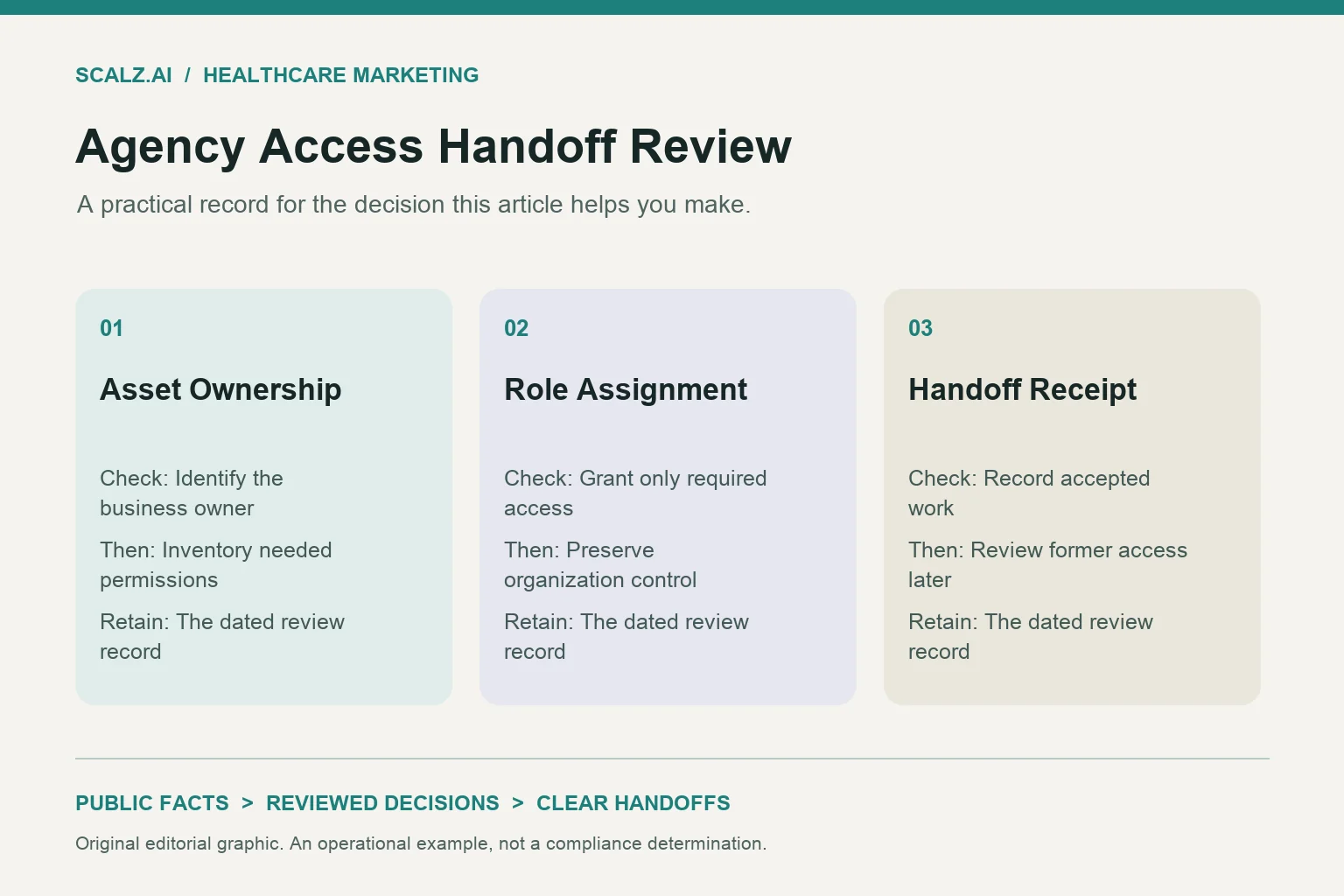
A handoff receipt records what was delivered, what was checked, and what responsibility changed hands. It should distinguish receipt of a file from acceptance of usable work.
Use one receipt for each meaningful asset group, such as website operations, search reporting, or editorial work. The business owner accepts the group only after the required items are available and the remaining exceptions have named owners.
- Record the asset or work package, its business owner, the delivering party, the receiving party, and the acceptance date.
- List the transferred items by descriptive name and version, including where the business-controlled copy is retained.
- State the check performed, such as opening the reporting file, confirming draft status, or matching a redirect record to the current configuration.
- Identify missing items and unresolved decisions, with an assigned owner and a next review date.
- Record whether responsibility has transferred fully, transferred with exceptions, or remains with the outgoing operator.
A proposed receipt could read: “Editorial package accepted with exceptions; approved page queue received; two drafts remain pending facility review; internal editor owns those reviews.” That entry gives the next team a usable starting point without implying that unfinished work has been approved.
Keep delivery and validation separate when necessary. A redirect register can be received today while its entries remain unchecked against the website.
Close each exception with a short follow-up entry rather than rewriting the original receipt. This preserves the sequence of decisions and shows who accepted the final state.
Make Revocation a Recorded Business Decision
Removing access should follow a clear decision, not an assumption that the outgoing agency will stop using it. The authorized business owner should approve the removal timing and identify any narrowly defined work that still requires access.
Review direct user roles and known agency-managed connections separately. Removing one person’s website role does not confirm that every reporting workspace, integration, or other delegated permission has been addressed.
- Remove access that has no remaining approved task once the business has accepted the corresponding handoff package.
- Retain limited access temporarily only when a named unfinished task requires it, with a deadline and an accountable internal owner.
- Record unresolved access paths as open exceptions and assign them to the appropriate administrator for verification.
- Confirm that required reports and checks have a continuing operator before retiring an agency-managed dependency.
A proposed decision might read: “Outgoing draft-editor role ends after editorial acceptance; reporting access remains through delivery of the final agreed report; operations director approves closure.” If that report is delayed, the business owner decides whether to extend the narrow task or end access.
The administrator then records what was removed and when it was checked. Keep the revocation receipt alongside the asset register so future staff can see the final responsibility split.
After closure, retain approved content, change records, measurement definitions, and accepted deliverables in the business workspace. Assign recurring permission review to an internal owner rather than leaving it solely with the new agency.
Agency Access Handoff FAQs
Does an incoming AI SEO agency need ownership of every account?
No, grant access that matches its approved tasks and the platform’s available roles. Keep business ownership and an internal administrator in place, and document any exceptional role that exceeds ordinary research, drafting, or implementation needs.
When should the outgoing agency’s access end?
End it when its approved tasks are complete and the business has accepted the relevant transfer. Any temporary extension should identify the remaining task, allowed role, deadline, and internal decision-maker.
What if the outgoing agency controls a required asset?
Mark ownership as unresolved and assign an authorized business representative to coordinate its resolution. Continue only with independent tasks, and leave the affected transfer open until business control and the intended working permissions are confirmed.
Keep AI SEO for addiction treatment Accountability In-House
The agency transition ends with a responsibility check. Keep the current records together and make three ownership assignments visible to the staff who will manage the next engagement.
- Name the internal owner of the asset register and permission reviews.
- Name the approver for marketing copy and public releases.
- Name the person who accepts completed work and closes exceptions.
For a custom SCALZ.AI engagement, use the contact page to discuss the website and search assets involved. Bring the asset register and unresolved items so the conversation can focus on the access and responsibilities the work requires.
Call 407-954-8800 to talk through next steps.