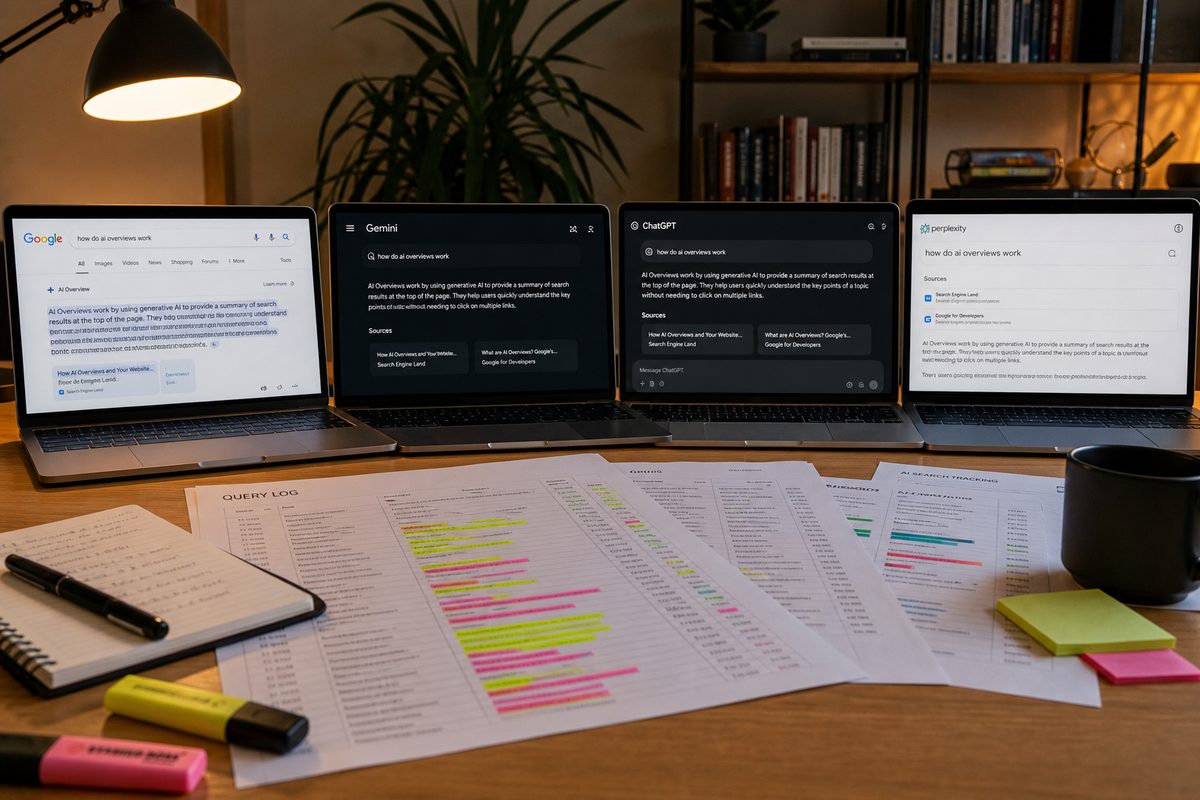
Every marketing lead I talk to this year asks some version of the same question: are Google AI Overviews, Gemini, ChatGPT, and Perplexity citing content the same way? The honest answer is no, and the confusion costs teams real budget. These four surfaces run on different infrastructure, are documented in different developer resources, and follow different access rules. Before you build a citation strategy, you need to know what is actually documented versus what is assumed.
This post walks through a cross-engine comparison grounded in four primary sources: Google's Search Central documentation on AI features, Google's Gemini API grounding docs, OpenAI's web search tool documentation, and Perplexity's crawler documentation. I separate what those sources state outright from where SCALZ.AI is making a reasoned inference. That distinction matters more than any single tactic, because most bad advice in this space comes from treating a documented API feature as if it describes consumer chat behavior.
I'm Tim Francis, founder of SCALZ.AI. We help clients build answer-first content and track citation share of voice, but I won't tell you this comparison guarantees anything. AI citation behavior is non-deterministic, under-documented in places, and moves fast. What follows is a testing matrix and an evidence discipline, not a promise. Pair it with our /blog/aeo-audit/ process if you want a repeatable baseline instead of a one-off screenshot.
What decision are marketers actually trying to make about AI citation surfaces?
The real decision is where to put content, schema, and monitoring effort across four different products, Google's AI features, Gemini's API grounding, ChatGPT's web search tool, and Perplexity's crawlers, based on documented behavior rather than the assumption that 'AI search' is one unified system with one set of rules.
Most budget conversations start backward. A team sees a citation in ChatGPT, assumes the same tactic will work in Perplexity, and reallocates spend without checking whether the two surfaces even source content the same way. Google AI Overviews draw on the existing Search index and crawling infrastructure documented at Search Central. Gemini's API grounding, OpenAI's web search tool, and Perplexity's crawlers are separate products with separate documentation, separate access models, and in some cases separate business terms. Treating them as one channel is the fastest way to misallocate a content or engineering budget, because the fix for low visibility in one surface, crawler access, for example, may be irrelevant to another.
Setting the evidence boundary early prevents a second failure mode: reporting a single favorable screenshot as proof of a repeatable strategy. Vendor documentation tells you what a system is designed to do and what inputs it accepts. It does not tell you that your specific page will be cited, how often, or under which query phrasing. Our own working definition, laid out in /blog/what-is-answer-engine-optimization/, treats AEO as an ongoing measurement discipline rather than a one-time optimization. That framing matters here because the decision isn't 'which surface to win,' it's 'which surface to test, on what cadence, with what documented mechanism in mind.'
What do the four cited primary sources actually document?
Google's Search Central page describes AI Overviews and AI Mode as features built on Search's existing index and ranking systems. Gemini's API docs describe a grounding tool that returns search results and citation metadata to developers. OpenAI's docs describe a web search tool for the API. Perplexity's docs list its crawler user agents and access rules.
Google's documentation is explicit that there is no separate ranking system for AI features; standard crawling, indexing, and content guidelines apply, and eligibility follows the same technical requirements as regular Search visibility. That is a meaningful fact, because it undercuts any pitch built around a proprietary 'AI Overviews algorithm' you can hack independently of normal SEO fundamentals. The Gemini API documentation describes a developer-facing grounding feature: an application calls the API, the model can issue a search, and the response includes citation objects pointing to sources. That is an API behavior, built and controlled by developers, not the consumer Gemini app experience by default.
OpenAI's developer documentation for the web search tool describes how the API can be configured to search the web and return citations within a response object, again a developer-controlled feature rather than a description of every consumer ChatGPT session. Perplexity's crawler documentation lists named user agents and access behavior for its crawlers, which matters for the infrastructure side of visibility: if a crawler is disallowed in robots.txt, the mechanism the docs describe for surfacing your content cannot function. None of the four sources publish a citation-frequency guarantee, a ranking formula for citations, or a schema-markup requirement, which is worth stating plainly before anyone extrapolates one.
How should you audit your current citation exposure before changing anything?
Before adjusting content or code, run a documented baseline audit: fixed query set, logged responses with timestamps, robots.txt and crawler-access checks for each surface's named agents, and a record of which pages, if any, currently get cited anywhere, so later changes can be compared to a real starting point.
Start with infrastructure, because it's binary and checkable today. Confirm your robots.txt does not block the crawler user agents documented by the surfaces you care about, and check server logs for whether those crawlers have actually visited. This is the same groundwork we walk through in our /blog/aeo-audit/ process: crawlability first, content quality second, because no amount of answer-first writing overcomes a disallow rule or a firewall blocking a documented crawler. Do this per surface, not once for 'AI search' generally, since Perplexity's crawlers and Google's crawlers are documented separately and can be blocked independently of each other.
Next, log content behavior: run the same 10 to 20 queries across each surface on a fixed schedule, save the response text and any cited URLs, and note the date and whether you used the consumer app or an API call, since those are not documented as equivalent. This baseline is not a vanity metric, it's the control group against which every future content or schema change gets compared. Skipping this step is the single most common reason teams can't tell whether a later change did anything, because they have no honest 'before' record to compare against.
What evidence receipts should you keep and what should stay an open assumption?
Keep timestamped screenshots, exact query text, the surface and mode used, and the full response including cited URLs. Treat as unresolved whether results are stable across sessions, whether personalization or location changes citations, and whether documented API behavior maps onto consumer chat sessions, since none of the four sources make that comparison explicit.
A citation receipt should include enough detail that someone else could attempt to reproduce it: the exact query text, the date and time, the surface, Google AI Overviews versus AI Mode, ChatGPT app versus API, Perplexity default versus Pro, and a saved copy of the response, not just a cropped screenshot of the citation. Without the query text and timestamp, a receipt is closer to anecdote than evidence. This matters most when reporting results internally or to a client, because 'we got cited' without reproducibility detail invites the same false confidence the vendor docs are careful not to promise.
The unresolved assumptions are just as important to name out loud. None of the four sources document citation stability across repeated identical queries, none document how personalization or account history affects results, and none confirm that API-level grounding behavior, Gemini or OpenAI, predicts what a logged-in consumer sees in the corresponding chat app. SCALZ.AI's working assumption, stated as an assumption and not a fact, is that consumer surfaces are more variable than API calls because they layer personalization and conversation context on top of the documented retrieval mechanism. Treat that as a hypothesis to test, not a claim to repeat.
What shortcuts and false-causality claims should you avoid?
Avoid three shortcuts: assuming schema markup alone earns a citation, assuming one good test result proves a repeatable pattern, and assuming API documentation describes consumer chat behavior. None of the cited sources support those claims, and treating a single favorable screenshot as causal evidence is the most common analysis error I see in this space.
Schema markup helps machines parse your content unambiguously, which is genuinely useful, but none of the four documented sources state that structured data guarantees inclusion as a citation anywhere. If a vendor pitch implies otherwise, ask which primary source it's citing. The same discipline applies to 'we added FAQ schema and got cited the next week' claims: a week is one data point, surrounded by dozens of variables, query phrasing drift, index refresh, other sites' changes, that had nothing to do with your markup. Schema guidance is best framed as clarity for machines, not a citation guarantee, and that distinction should hold here too.
False causality shows up hardest in before-and-after storytelling. If you publish a new page and get cited two weeks later, the honest next question is whether a control set of unrelated pages also changed in citation frequency over the same window, since index refresh cycles and query-set drift move independently of your publishing calendar. Multiple confounders are always present, competitor changes, seasonal query shifts, model updates, and reporting a single before-after pair as proof skips all of them. This is the same statistical discipline outlined in our /blog/how-to-measure-aeo/ guidance, and it applies with extra force here because these surfaces are non-deterministic by design, not despite it.
How do you measure outcomes without confusing correlation and causation?
Measure citation share of voice across a fixed, repeated query set over time, with a control group of unchanged pages, so you can compare trend lines rather than single events. A citation appearing after a content change is a correlation until you've ruled out the more common alternative explanations.
Set up a repeatable measurement cadence: the same query list, run weekly or biweekly, logged with date and surface, split into a test group of pages you're actively changing and a control group of pages left untouched. If citation frequency shifts for the test group but not the control group over multiple cycles, you have a defensible signal, not a guarantee. This is slower and less exciting than a single screenshot, but it's the only structure that lets you rule out index-wide fluctuations, seasonal query changes, or model updates that would have moved both groups equally.
Report ranges and trends rather than point estimates, and say explicitly when a sample size is small, because a query set of five gives you noise, not a trend line. It's also worth tracking documented infrastructure signals alongside citation counts, whether the relevant crawler has visited recently, whether robots.txt changed, whether the API version in use has changed, since those are checkable facts that can explain a shift without invoking a mysterious algorithm update. None of this replaces the primary source documentation; it just gives you an evidence trail that ties back to it.
What's the next action to take based on your verified findings?
Act on what your audit actually showed: fix any documented crawler-access blocks first, since those are binary and verifiable, then run the query-set baseline for four to six cycles before changing content. Only after that baseline exists should you attribute movement in citation share of voice to a specific change.
Sequencing matters. If your audit found a crawler disallowed or blocked at the server level, that is the highest-priority fix, because it's a documented mechanical barrier, not a content or writing problem, and no amount of answer-first rewriting fixes a firewall rule. If crawler access is confirmed and the baseline shows zero or low citation activity across all four surfaces, the next reasonable step is improving content clarity and structure, the kind of work covered in /blog/what-is-answer-engine-optimization/, before assuming a deeper technical issue exists.
If the baseline already shows citations on some surfaces and not others, the next action is surface-specific: check that surface's documented mechanism again, indexing for Google, grounding configuration for API-based products, crawler access for Perplexity, rather than applying a generic 'AI SEO' fix across the board. Revisit the full comparison quarterly, since vendor documentation for all four of these products has changed multiple times in the past year, and a testing matrix built on stale assumptions is worse than no matrix at all.
What does a practical cross-engine testing matrix with owners look like?
A usable testing matrix assigns a specific owner to each recurring task, query logging, crawler-access checks, schema review, and reporting, so the comparison doesn't stall after the first audit. Below is a five-step version you can adapt; treat the owners as roles, not fixed job titles, if your team is small.
- Query set and logging (owner: content or SEO lead): fix 10 to 20 queries per target topic, run them across Google, Gemini, ChatGPT, and Perplexity on a set schedule, and log the date, surface, and full response text, not just a screenshot of any citation.
- Crawler and robots.txt review (owner: developer or IT): confirm none of the documented crawler user agents from Google, Perplexity, or the relevant API providers are blocked, and check server logs monthly to verify the crawlers actually visited, since documentation only describes intended access, not confirmed access.
- Schema and markup check (owner: content or dev, jointly): verify structured data is valid and matches the content on the page, treating it as clarity for machines rather than a citation guarantee, and re-test after any template or CMS change that could break markup silently.
- Baseline and control comparison (owner: analytics or SEO lead): separate pages into a test group and a control group, track citation frequency for both across at least four measurement cycles, and flag any divergence as a signal worth investigating, not a conclusion to report yet.
- Quarterly documentation recheck and reporting (owner: whoever owns the AEO program, often the marketing lead or founder): re-read the four primary sources for changes, update the matrix, and report trend lines with sample sizes attached, not single anecdotes, to internal stakeholders or clients.
Sources and further reading
These are the primary sources referenced in this article. Each is an authoritative documentation page or publication we verified before citing.
- Google Search Central: AI features documentation: Cited to establish that Google AI Overviews and AI Mode run on Search's existing index and ranking systems, with no separate AI-specific ranking system documented.
- Gemini API Google Search grounding docs: Cited to establish that Gemini's search grounding is a developer-configured API feature returning citation metadata, distinct from the consumer Gemini app.
- OpenAI API web search tool documentation: Cited to establish that OpenAI's web search tool is an API-level, developer-controlled feature for returning citations in responses.
- Perplexity crawler documentation: Cited to establish the named crawler user agents Perplexity documents and why robots.txt access checks are part of the audit.